
Quick answer: Free residential proxies are IP addresses borrowed from real devices and offered at no cost, often through peer-to-peer networks or ad-supported apps. They can work for light testing or casual browsing, but most free residential proxy services carry serious risks slow speeds, data privacy concerns, and unreliable uptime. For USA users who need consistent performance for scraping, marketing research, or account management, paid providers like Proxy4u typically offer a safer, more stable experience.
Every year, thousands of people in the United States search for "free residential proxies," hoping to unlock geo-restricted content, run web scraping projects, or manage multiple social media accounts without spending a dime. It's an understandable impulse. Paid proxy services can feel like an unnecessary expense, especially for hobbyists or small businesses testing the waters.
But free doesn't always mean risk-free. Residential proxies route your traffic through real household IP addresses, which makes them valuable and that value comes at a cost somewhere in the chain. Understanding how free residential proxies actually work, and where they fall short, helps you make a smarter decision before your data (or your project) gets compromised.
Most articles ranking for this keyword either focus on proxy lists without explaining the risks, or jump straight into paid recommendations without answering the basic question users are actually asking: Are there legitimate free residential proxies in 2026? What are my real options? This guide covers both sides honestly.
By the end, you'll know what free residential proxies are, which types of free options exist and what their real limitations are, how they compare to VPNs, and what to look for when choosing a paid alternative.
What Are Residential Proxies?
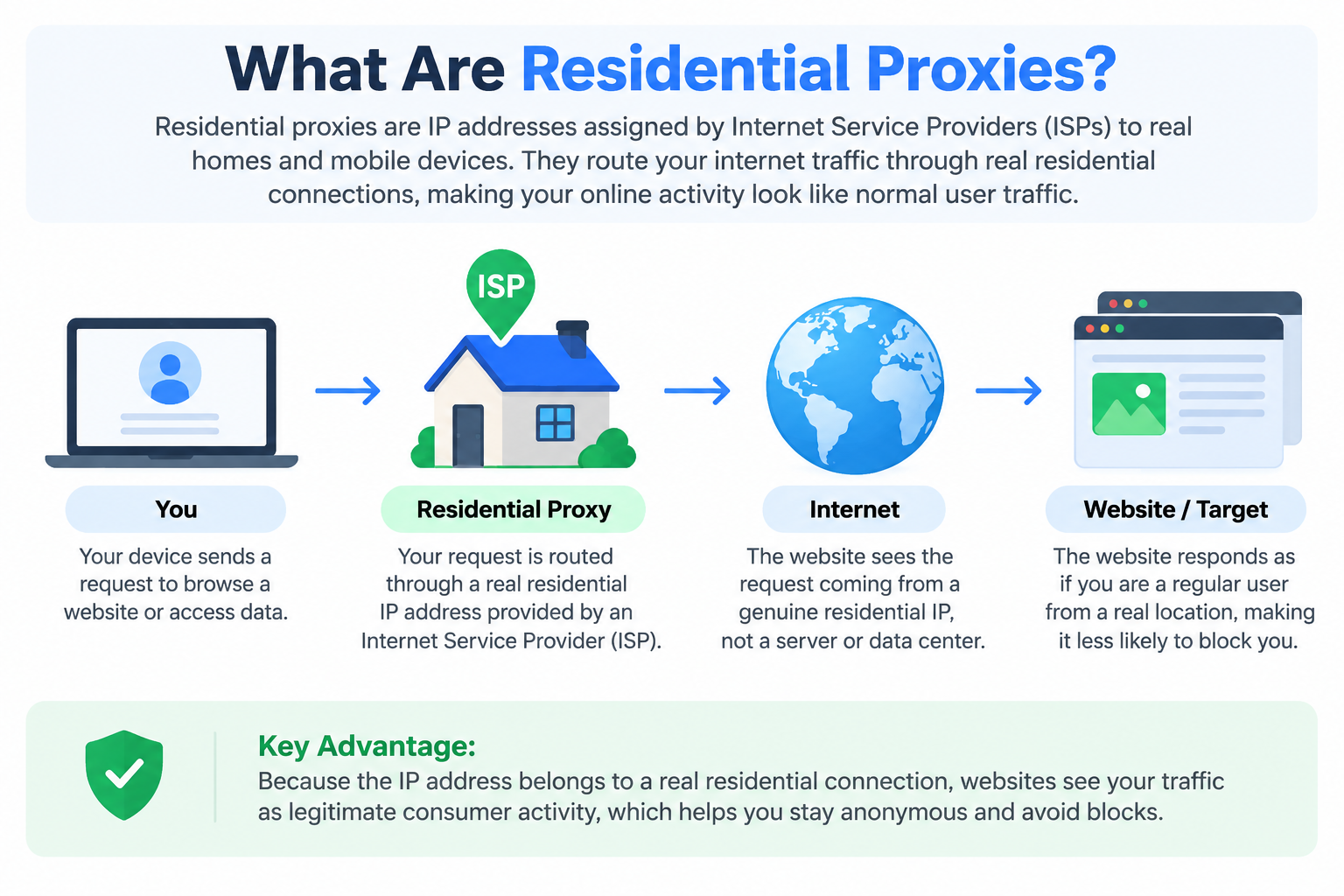
Residential proxies are IP addresses assigned by Internet Service Providers (ISPs) to real homes and mobile devices. Unlike datacenter proxies, which originate from servers in data centers, residential IP proxies look like ordinary consumer internet traffic to websites and platforms.
This distinction matters. Websites can detect and block datacenter IPs relatively easily because they don't match typical consumer browsing patterns. Residential proxies, on the other hand, blend in. A website sees a real ISP-assigned address not a server farm which makes residential proxies far more effective for tasks requiring anonymity or geographic accuracy.
Businesses use residential proxies for a wide range of purposes:
- Web scraping large volumes of data without getting blocked
- Verifying that ads display correctly in specific US regions
- Tracking search engine rankings from different cities or states
- Monitoring competitor pricing across e-commerce platforms
- Managing multiple social media accounts without triggering platform flags
Real-world example: An SEO agency based in New York may use US residential proxies to check Google Maps rankings from Chicago, Houston, and Los Angeles simultaneously without each query being traced back to a single IP in New York. A retail brand's price intelligence team might use rotating residential proxies to scrape competitor product pages hourly across dozens of e-commerce sites, cycling through IP addresses to avoid detection.
The core appeal of residential proxies is legitimacy. Because the IP address belongs to a real residential connection, websites are far less likely to flag or block the traffic.
What Are Free Residential Proxies?
Free residential proxies are residential IP addresses offered without a subscription fee. They're typically distributed through browser extensions, VPN-style apps, or proxy-sharing networks that enroll real users' devices sometimes with their clear consent, sometimes buried in lengthy terms of service they never read.
Providers offer free residential proxy access for several reasons:
- Lead generation: Free tiers attract users who may later upgrade to paid plans.
- Data harvesting: Some "free" services monetize by collecting and selling user browsing data to third parties.
- Bandwidth sharing models: Certain apps grant free proxy access in exchange for using your device's bandwidth to power other users' requests.
That last model is especially common. If you've ever installed a "free" VPN or proxy app, your device may have become part of someone else's proxy network without you realizing it. You got free access; they resold your idle bandwidth.
The Electronic Frontier Foundation (EFF) and privacy researchers have documented this practice, noting that many free proxy tools operate opaque data collection practices that users rarely scrutinize. A 2020 study published in cybersecurity research literature found that a significant share of free VPN and proxy applications logged user activity or shared data with third-party advertisers a concern that remains relevant in 2026 as the number of free proxy apps has grown.
Common limitations of free residential proxies include:
- Small IP pools that get blacklisted quickly
- Slow connection speeds due to overcrowded nodes
- No dedicated customer support
- Limited or no US-specific location targeting
- Inconsistent uptime and frequent disconnections
- No free residential proxy API for programmatic access
- No guaranteed session control for multi-step workflows
How Do Free Residential Proxies Work?
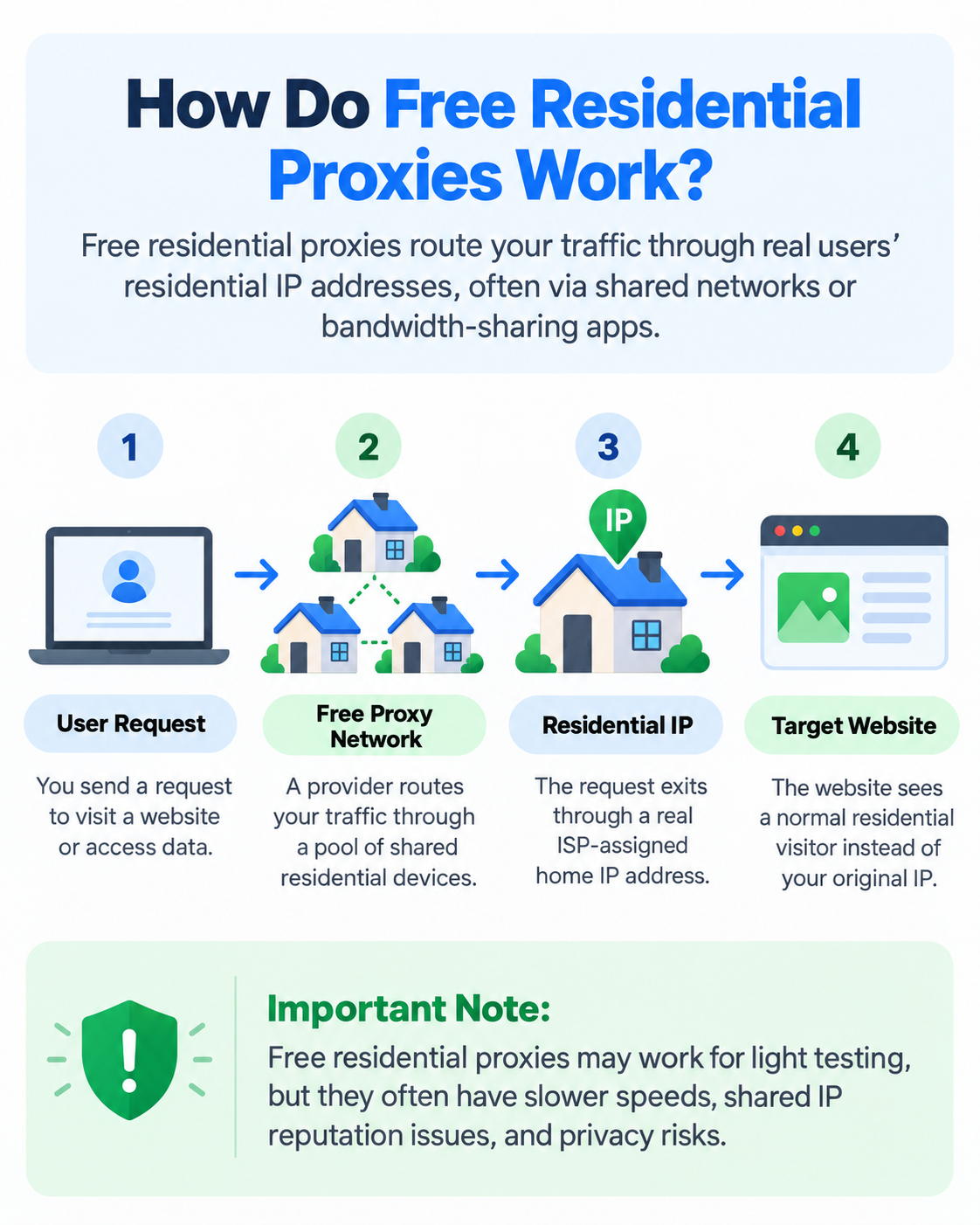
The technical process behind a free residential proxy server is straightforward, even if the business model behind it is not.
- Recruitment: A provider builds its network by getting users to install an app, browser extension, or SDK that turns their device into an exit node.
- IP assignment: When another user requests a proxy, the provider routes their traffic through one of these residential devices, using its real ISP-assigned IP address.
- Traffic masking: The destination website sees the residential IP not the original user's actual location or device.
- Rotation: Some free residential proxy list services rotate IPs automatically to reduce the chance of a single address getting flagged or banned.
The result is a functional but often fragile proxy network. Since free residential proxies rely on volunteer or unknowing device owners, the pool of available IPs can shrink or degrade without warning. A user in a free shared proxy pool has no control over how many other people are using the same addresses or what those addresses have been used for previously.
Why Do People Search for Free Residential Proxies?
Demand for free US proxy access spans a wide range of use cases. Here are the most common reasons people look for free residential proxies:
- Web scraping: Extracting data for research, pricing analysis, or content aggregation.
- Market research: Gathering competitive intelligence without exposing a company's real IP address.
- SEO tracking: Checking local search rankings from different US cities or states.
- Ad verification: Confirming that ads display correctly and without manipulation in specific regions.
- Social media management: Running multiple accounts without triggering platform bans tied to IP patterns.
- Website testing: Developers and QA teams checking how a site performs across different geographic regions.
- Anonymous browsing: Individuals looking for a free US proxy for basic privacy while browsing.
Each of these use cases benefits from the legitimacy that residential IP proxies offer over standard datacenter alternatives. The challenge is that free options rarely deliver the consistency these tasks require especially at scale.
Best Free Residential Proxy Options in 2026: What Actually Exists
This section is what most competing articles skip entirely. Users searching for "free residential proxies" or a "free proxy list 2026" deserve a direct answer not an immediate redirect to paid products. Here's what the free landscape actually looks like.
Free Tiers and Residential Proxy Trials
Several reputable proxy providers offer limited free access as part of a residential proxy trial or entry-level plan:
- Webshare offers a free plan that includes a small number of datacenter proxy IPs. Residential access is not free, but the trial gives users a sense of their dashboard and tooling.
- Decodo (formerly Smartproxy) is noted for offering a genuine free trial from a major provider, with access to residential IPs during the evaluation window.
- IPRoyal operates a pay-as-you-go model with no minimum commitment, which makes it accessible for users who want to test cheapest residential proxies without a monthly contract.
These options aren't unlimited free residential proxy services they're structured trials. But they're legitimate, and they're how many professionals test proxy performance before committing to larger plans.
Public Free Proxy Lists
A "free proxy list 2026" search will surface dozens of sites publishing rotating lists of open proxy servers. These are almost never true residential proxies. They're typically misconfigured or compromised servers running open proxy software not ISP-assigned home connections.
The risks are substantial:
- IPs are burned quickly as they're shared publicly across thousands of users
- No encryption or authentication protects your traffic
- Many listed proxies are already dead or flagged by the time you test them
- Some are operated by malicious actors specifically to intercept traffic
For casual browsing where no sensitive data is involved, a public proxy list might technically work. For anything involving login credentials, personal data, or business research, avoid them entirely.
Bandwidth-Sharing Apps
Apps like Honeygain and EarnApp pay users to share their internet connection and in doing so, create a residential proxy network. Some apps have offered limited free access to their proxy network in exchange for sharing your own bandwidth.
This model is more transparent than many free proxy tools, but it still carries tradeoffs: your own connection becomes part of a commercial proxy network, which may affect your bandwidth, and the IPs available to you are limited and shared.
The honest bottom line on free residential proxies: Legitimate free options exist, but they come in the form of trials, limited free tiers, or bandwidth-sharing arrangements not unlimited free residential proxy access to premium-grade IP pools. If you encounter a site offering a large free residential proxy list with no strings attached, treat it as a red flag.
Free Residential Proxies vs VPNs: What's the Difference?
Many users searching for free residential proxies are actually looking for what a VPN provides anonymity and the ability to appear in a different location. These tools serve overlapping but distinct purposes.
Key distinction: A VPN encrypts all traffic from your device through a single server. A residential proxy routes specific application traffic through a real home IP and proxy pools allow you to use hundreds or thousands of different IPs at once, which is essential for scraping or research tasks. VPNs are not a viable replacement for residential proxies in professional use cases.
If you're using a free VPN for anonymity and wondering whether a free residential proxy would be better: it depends on the task. For multi-request scraping or geographic targeting at scale, residential proxies win. For personal browsing privacy, a reputable VPN is often the simpler choice.
Are Free Residential Proxies Safe?
This is the most important question for anyone considering a free residential proxy free trial or a free proxy servers list. The short answer: proceed with caution.
Security Risks
Free residential proxy networks often lack transparency about data handling. Some apps require broad permissions that expose your device and data unnecessarily, creating openings for malware or unauthorized data collection. The EFF and security researchers have repeatedly noted that free privacy tools including many proxy apps frequently collect more data than users realize.
Data Privacy Concerns
If you're routing traffic through someone else's device as a proxy, your data passes through hardware you don't control. There's no guarantee that a free provider isn't logging your browsing activity, credentials, or personal information along the way. Unlike paid providers with audited privacy policies, free proxy operators rarely disclose their data retention practices clearly.
Slow Speeds and Limited Bandwidth
Free residential proxies typically serve large numbers of users through a limited pool of IPs. This leads to congestion, slow load times, and frequent timeouts a serious drawback for any time-sensitive task like web scraping at scale or ad verification with tight deadlines.
Shared IP Reputation
Because free residential IP proxies are shared across many users, an IP address can get flagged or banned due to someone else's behavior. You might inherit a poor reputation you had no part in creating and have no recourse to fix it.
Reliability Issues
Free proxy networks depend on volunteer devices that can go offline at any moment: a laptop closes, a phone loses signal, or a user uninstalls the app. This makes free residential proxies inherently unstable for consistent, professional use.
When free makes sense: Testing a small, low-stakes project. Learning how proxies work. Occasional single-location checks where no sensitive data is involved.
When paid is worth it: Any recurring task, business-critical project, or workflow involving logins, financial data, or high-volume scraping.
Free Residential Proxies vs Paid Residential Proxies
For casual, one-off tasks, free residential proxies might get the job done. But for anyone running recurring scraping jobs, managing business accounts, or handling sensitive data, the gap in reliability and security becomes hard to ignore.
How We Evaluated Proxy Services for This Guide
To ensure this guide reflects real-world performance rather than marketing claims, the evaluation process for proxy options discussed here considered the following criteria:
- IP pool size and diversity: Number of available residential IPs and geographic coverage, particularly within the United States.
- Transparency of IP sourcing: Whether the provider discloses how residential IPs are recruited and whether device owners consent to participation.
- Privacy policy clarity: Whether the provider specifies what data is logged, retained, and shared with third parties.
- Protocol support: HTTP, HTTPS, and SOCKS5 compatibility with common scraping tools and automation frameworks.
- Session management: Support for rotating residential proxies and sticky sessions for multi-step workflows.
- Pricing structure: Pay-per-GB models, trial availability, and whether cheapest residential proxies in a given tier represent fair market value.
- Independent user reviews: Aggregated reviews from verified platforms including Trustpilot and G2 to supplement provider claims.
- SERP competitor analysis: Review of articles currently ranking for "free residential proxies" to identify gaps in coverage including the near-universal failure of competing pages to honestly discuss what free options exist before recommending paid alternatives.
Provider-specific claims in this article are attributed directly to the source (e.g., "According to Proxy4u…") to distinguish verified claims from independent editorial assessment.
How To Choose a Residential Proxy Provider
Whether you go free or paid, evaluate any residential proxy provider against these criteria:
- IP pool size: Larger pools reduce the chance of hitting blacklisted or overused addresses. Pools below a few million IPs tend to degrade faster for high-volume tasks.
- USA location coverage: If you specifically need free US proxy access or US residential proxies, confirm the provider offers state, city, or zip code targeting not just country-level filtering.
- Rotation options: Rotating residential proxies cycle IP addresses at set intervals for better anonymity. Sticky session proxies hold the same IP for a defined period useful for workflows that require continuity across multiple requests.
- Free residential proxy API: For developers and scraping engineers, API access for programmatic proxy management is essential. Most free options don't offer this.
- Speed and success rate: Look for published benchmarks or trial access to test real-world performance before committing to a plan.
- Privacy policies: Read the fine print on data logging, retention policies, and third-party data sharing. This matters more for residential proxies than for most other tools, since your traffic passes through others' devices.
- Customer support: Responsive support matters most when something breaks mid-project. Free services almost never offer this.
Best Alternative to Free Residential Proxies
While free residential proxies can be useful for learning and light testing, users who need consistent performance for professional tasks often move to paid solutions. One option worth evaluating is Proxy4u positioned here as a reliable alternative for users who need more than a free tier can deliver.
According to Proxy4u, the service operates a residential proxy network covering more than 90 million IPs across 195 countries, with US targeting available at the state, city, and zip code level. That level of granularity is a meaningful advantage for projects like local SEO audits, regional ad verification, or geotargeted scraping tasks where a rough country-level proxy simply won't produce accurate results.
Proxy4u supports both rotating and sticky residential proxies, giving users the flexibility to choose based on their workflow. Rotating proxies cycle through the IP pool automatically useful for high-volume scraping where each request benefits from a fresh IP. Sticky sessions maintain the same IP for a defined window important for tasks like account login flows or multi-step checkout testing.
According to Proxy4u, pricing scales with usage, starting at $0.99 per GB for smaller volumes (10–99 GB) and dropping to $0.60 per GB for larger business tiers (500 GB and above). A residential proxy trial is also available, which allows users to test real network performance against their actual target sites before purchasing a larger plan a practical alternative to relying on free residential proxies for evaluation.
Proxy4u supports HTTP, HTTPS, and SOCKS5 protocols, making it compatible with most scraping tools, browser automation frameworks, and custom bots. According to Proxy4u, customers commonly use the service for web scraping, multi-account social media management, and SEO rank tracking all tasks where free proxies consistently underperform.
For USA users evaluating free options against paid alternatives, the decision typically comes down to how much reliability and geographic precision matter for the specific task at hand. A free trial with a reputable paid service offers a low-risk way to answer that question with real data rather than assumptions.
Making the Right Call for Your Proxy Needs
Free residential proxies fill a real need for casual users experimenting with anonymous browsing or small-scale testing. But the tradeoffs slower speeds, shared IP reputations, and unclear data privacy practices make them a poor fit for anything business-critical.
If your work depends on consistent uptime, accurate US location targeting, or handling data responsibly, a paid residential proxy provider is worth the investment. Start by identifying your specific use case web scraping, ad verification, SEO monitoring, or social media management and match it against the provider criteria above. From there, a residential proxy trial with a reputable paid service gives you a low-risk, evidence-based way to compare performance before committing to a plan.
Frequently Asked Questions
Are free residential proxies really free?
Some are, but most "free" residential proxy services monetize indirectly by collecting user data, reselling your bandwidth to other users, or offering heavily limited access to push upgrades. Always review a provider's privacy policy and app permissions before installing any free proxy tool.
Can I use free residential proxies for web scraping?
Yes, but expect significant limitations. Free residential proxies typically have small IP pools, slow speeds, and no API access which leads to frequent blocks, timeouts, and failed requests during large-scale scraping. They work better for light, infrequent scraping than for ongoing or high-volume data extraction.
Are free residential proxies safe to use?
Not always. Free residential proxy networks can expose users to data privacy risks, including traffic logging and credential interception. Privacy researchers and organizations like the EFF have documented data collection practices across many free proxy tools. Paid providers generally operate under clearer, audited privacy policies and offer more secure infrastructure.
What's the difference between residential and datacenter proxies?
Residential proxies use IP addresses assigned by ISPs to real homes, which makes them appear as genuine consumer traffic harder for websites to detect and block. Datacenter proxies originate from commercial server infrastructure, which makes them faster and cheaper but much easier for anti-bot systems to identify and block. For tasks requiring high anonymity or accurate geographic targeting, residential proxies are typically the better choice.
What's the difference between free residential proxies and VPNs?
VPNs route all of your device's traffic through a single encrypted tunnel and a single server IP typically a datacenter address. Residential proxy pools allow you to rotate through hundreds or thousands of real ISP-assigned home IPs simultaneously, which makes them far more effective for scraping, account management, and location-specific testing. VPNs are better suited for personal privacy; residential proxies are better suited for professional, multi-IP, location-targeted tasks.
Are USA residential proxies better than global ones for US-based tasks?
Yes. For tasks that require US-specific results local SEO tracking, regional ad verification, or price monitoring on US e-commerce platforms using US residential proxies with granular state or city targeting ensures accurate results. Global IP pools without precise US coverage may return skewed data or trigger geographic mismatches that undermine the whole purpose of using a proxy.
What is the best alternative to free residential proxies?
Paid providers that offer residential proxy trials are the most practical starting point for users moving beyond free options. Proxy4u, for example, offers a trial that allows users to test real network performance against their actual targets before purchasing a plan. Key factors to compare include IP pool size, US location coverage, session control, and whether a free residential proxy API is available for programmatic integration.
What are the cheapest residential proxies available in 2026?
Pricing across the proxy market varies widely. Entry-level pay-as-you-go plans from providers like IPRoyal or Webshare start at a few dollars and don't require minimum monthly commitments. Mid-market providers typically price residential proxy access between $0.60 and $2.00 per GB depending on volume. Premium networks with larger IP pools and higher success rates against protected targets command higher rates. According to Proxy4u, their tiered pricing starts at $0.99/GB and drops with volume competitive for a network of its size.