


Quick answer: A residential proxy is a service that routes your internet requests through a real household IP address provided by an ISP. Websites see that residential IP instead of your original IP, making the connection appear like normal user traffic.
If you've spent any time researching web scraping, ad verification, or online privacy tools, you've probably run into the term "residential proxy" more than once. It sounds technical, and honestly, it is a little technical. But the concept behind it is simpler than most explanations make it out to be.
At its core, a residential proxy lets you browse the internet using someone else's real IP address instead of your own. That IP address comes from an actual residential internet connection, not a server farm. This distinction matters, and it's the reason residential proxies have become a common tool for businesses that need reliable access to websites at scale, especially those with strict anti-bot defenses.
This guide breaks down exactly what a residential proxy is, how it works, when you'd want one, and what to watch out for when choosing a provider. From developers building scraping tools to marketing teams verifying ads across different regions, you'll find practical, evidence-based answers here, not just definitions.
What Is a Residential Proxy?
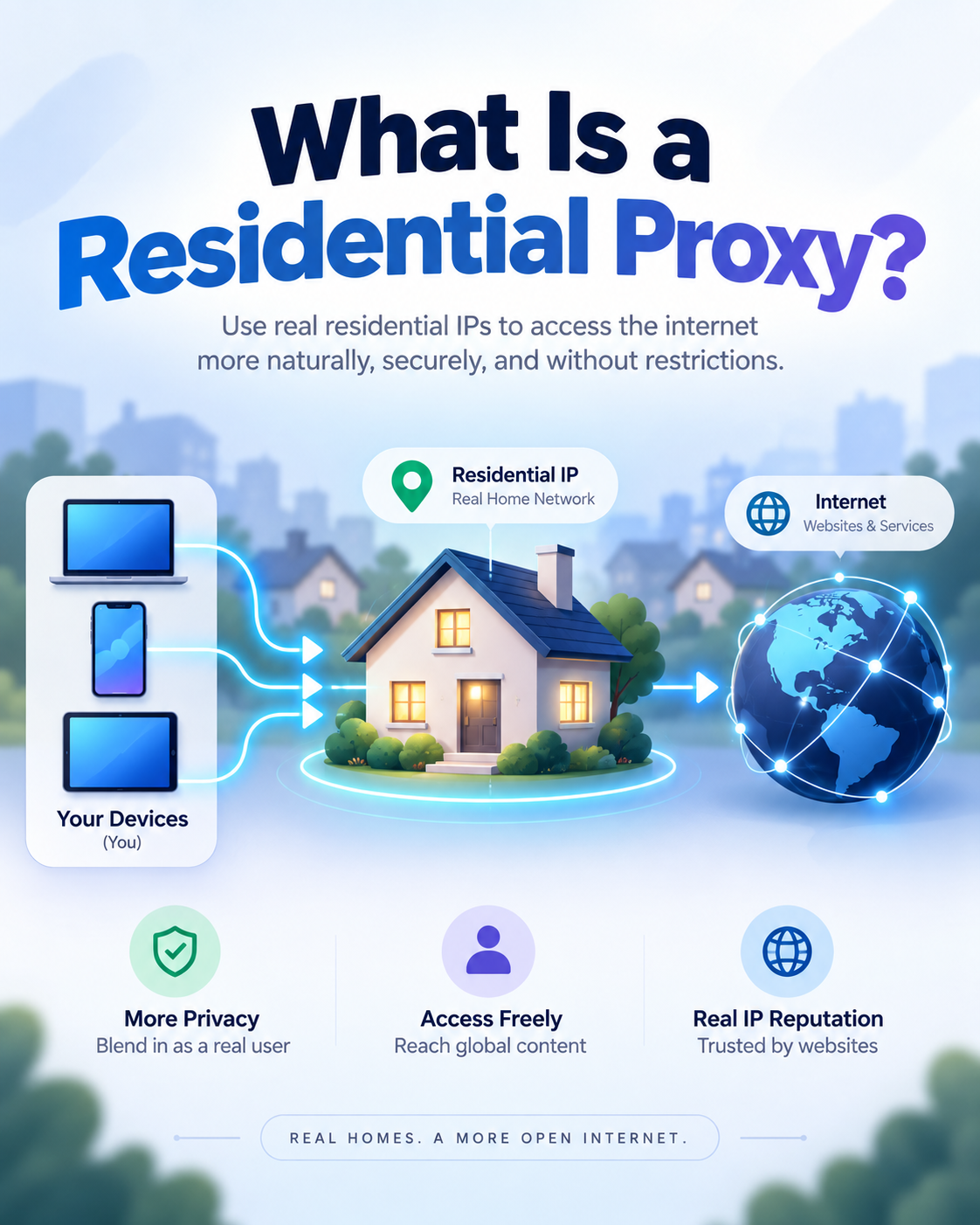
A residential proxy is a type of proxy server that uses an IP address tied to a physical residence and issued by an internet service provider. When you connect to a website through a residential proxy, the site sees a legitimate home IP address rather than a server address or your own connection.
Think of it like this: normally, when you visit a website, your request travels directly from your device to that site, carrying your own IP address as a kind of digital return address. A residential proxy sits between you and the website, forwarding your request through someone else's real home connection instead. The website responds to that residential IP, and the proxy relays the information back to you.
A simple analogy: Imagine wanting to check out a store in a different city without the staff knowing you're an out-of-towner. Instead of walking in yourself, you ask a local friend to go in, look around, and report back. The store only ever sees your friend, a genuine local resident, not you. That's essentially what a residential proxy server does for internet traffic.
Because these IPs come from real households through legitimate ISPs like Comcast, Verizon, or AT&T, they carry a level of authenticity that datacenter IPs can't replicate.
How Does a Residential Proxy Work?
Understanding the mechanics of a residential proxy server explains why it behaves so differently from other proxy types. Here's the step-by-step process:
- You send a request. Your device sends a request to access a website through a residential proxy service.
- The proxy assigns a residential IP. The proxy network selects a real residential IP address from its pool, one belonging to an actual device connected to a home ISP.
- The request is routed. Your request travels through that residential IP address rather than your own connection.
- The website responds to the proxy IP. The target website sees the residential IP and treats the traffic as coming from a genuine home user.
- Data is relayed back to you. The proxy server sends the website's response back to your device, completing the exchange.
This entire process typically happens in milliseconds. Most residential proxy providers manage large networks of these IPs, sometimes numbering in the millions, sourced through peer-to-peer arrangements, apps, or partnerships with ISPs.
Some services offer a single residential IP for extended use, while others rotate through thousands of IPs automatically, a distinction that shapes almost every decision you'll make about which proxy type fits your use case.
Residential Proxy Example: How Businesses Use Them
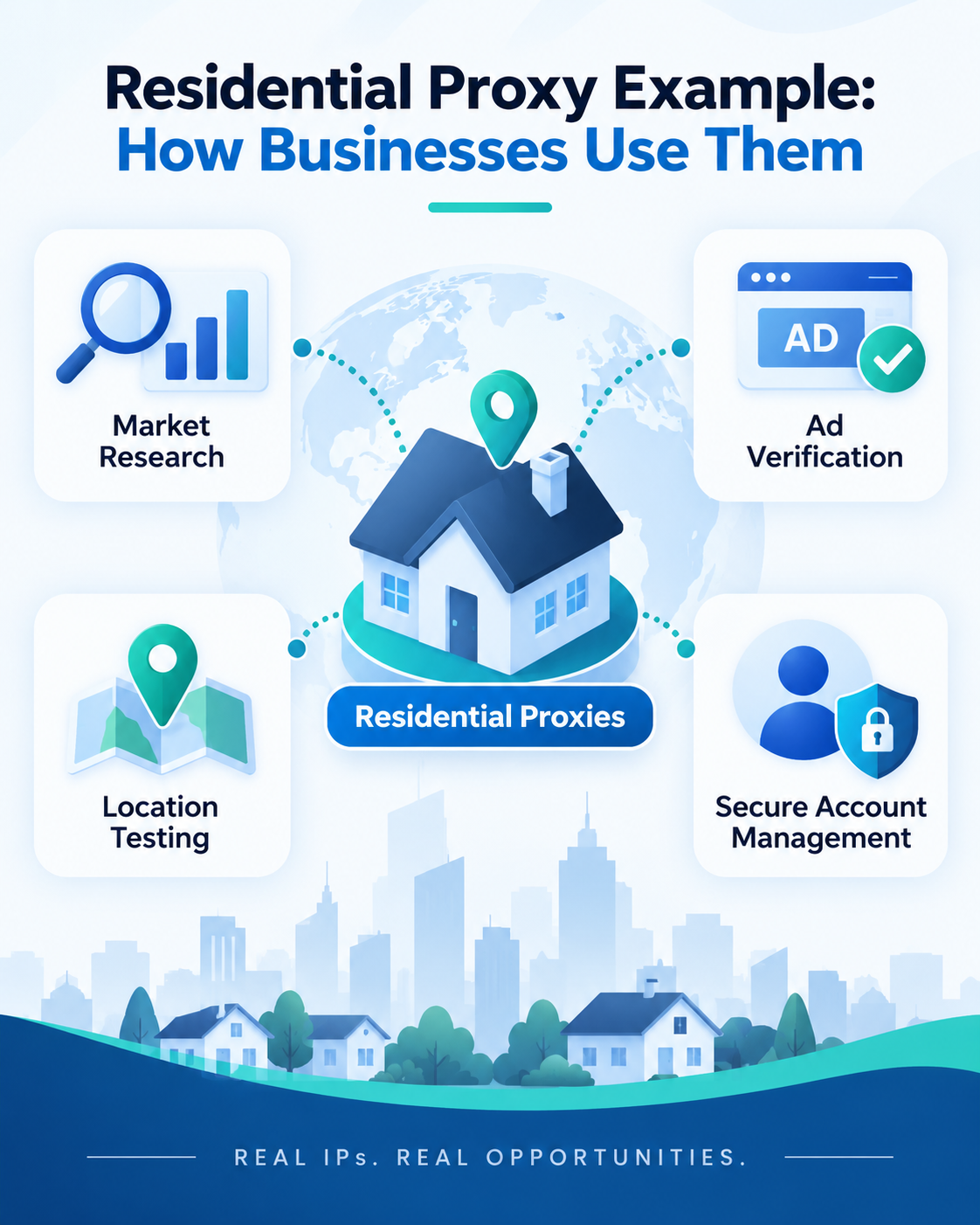
Definitions only go so far. Here's what the difference between having and not having a residential proxy actually looks like in practice.
Scenario: A sneaker company tracking Nike's prices across 20 countries
Say a mid-sized e-commerce retailer wants to monitor Nike's retail pricing across 20 international markets to stay competitive. Without a residential proxy, their scraper sends every request from the same one or two datacenter IP addresses. Nike's site, like most major retailers, has anti-bot systems that quickly notice dozens of rapid requests coming from a non-residential IP range. Within minutes, that IP gets rate-limited or outright blocked, leaving the retailer with incomplete, stale, or inaccurate pricing data, or no data at all.
With a rotating residential proxy network, that same scraper distributes requests across residential IPs located in each of the 20 target countries. Each request looks like it's coming from an ordinary shopper browsing Nike's site from their home connection in that country. The retailer sees accurate, localized pricing, including region-specific currency and promotions, and the scraping job runs to completion without triggering blocks.
Here's how that plays out across a few common business scenarios:
Scenario
Without Residential Proxy
With Residential Proxy
SEO rank tracking
Search engines flag repeated automated queries from the same IP, leading to CAPTCHAs or blocked results
Queries appear to come from real users in each target location, returning accurate, localized SERP data
Price monitoring
Retail sites detect and block bulk requests from datacenter IPs, resulting in missing or outdated competitor data
Requests blend in with normal shopper traffic, enabling consistent, region-accurate price collection
Ad verification
Ad networks may serve different (or no) ads to known datacenter IPs, making it impossible to confirm what real users see
Ads display as they would to a genuine local user, allowing accurate verification of placement and content
This pattern repeats across industries. A travel company comparing flight prices, a brand protection team hunting counterfeit listings, or a market research firm gathering regional search data all run into the same wall without residential IPs: they get blocked, served fake data, or shown a version of the internet that doesn't match what real users see.
Residential Proxy vs VPN vs Datacenter Proxy
This comparison comes up constantly, and for good reason. Choosing the wrong tool for your use case can mean wasted money or getting blocked entirely.
A VPN (virtual private network) encrypts your device's entire internet connection and routes it through a single server, primarily for privacy and security. A datacenter proxy uses an IP address generated from a cloud server, with no connection to an ISP or physical residence. A residential proxy uses a real IP tied to an actual home connection.
Best Use Cases
Web scraping, ad verification, geo-targeted research, brand protection
Personal privacy, secure browsing, bypassing basic geo-blocks
Bulk tasks where speed matters more than stealth
Choose a residential proxy if avoiding detection and mimicking genuine local user behavior matters more than raw speed. Choose a VPN if your priority is personal privacy and encrypting your own traffic. Choose a datacenter proxy if you need high-speed, high-volume access and the target site isn't actively blocking non-residential IPs.
Types of Residential Proxies
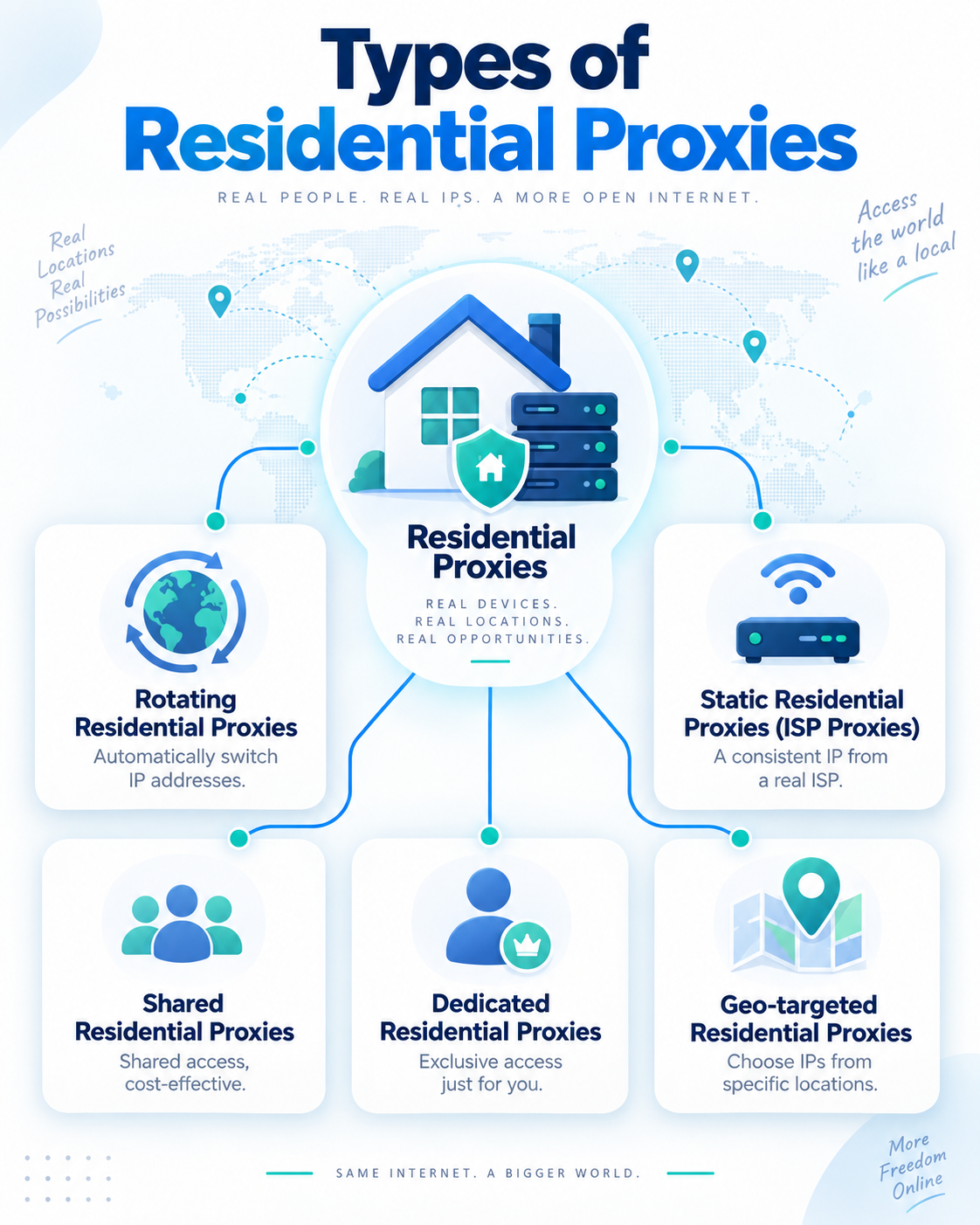
Not all residential proxies function the same way. Depending on your goals, one type may serve you far better than another.
[Diagram placeholder: Types of residential proxies — rotating, static, mobile]
Rotating Residential Proxies
A rotating residential proxy automatically switches your IP address after each request or at set time intervals. This makes it difficult for websites to track a single user pattern, which is why rotating proxies are popular for large-scale web scraping projects.
Static Residential Proxies (ISP Proxies)
Static residential proxies assign one fixed residential IP for an extended session. These work well when you need to maintain a consistent identity, such as managing a social media account or staying logged into a service without triggering security flags.
Mobile Residential Proxies
Mobile residential proxies route traffic through IP addresses assigned to mobile devices via cellular networks. Because mobile IPs are shared among many users and reassigned frequently by carriers, they carry a high trust level with websites, making them useful for tasks involving mobile apps or mobile-specific ad verification.
Why Do People Use Residential Proxies?
Residential proxies solve a specific problem: they let users and businesses access the internet in a way that appears normal to the websites they interact with. Here's where that capability gets put to work.
- Web scraping: Companies collecting large volumes of public data, such as pricing information or product listings, use residential proxies to reduce the chance of being blocked by anti-scraping systems.
- Market research: Analysts use residential IPs to view search results, ads, and websites the way a real user in a target location would see them.
- Ad verification: Advertisers confirm their campaigns display correctly and haven't been hijacked by fraud, viewing ads from real residential IPs in various regions.
- SEO research: SEO professionals check search rankings and SERP features from different geographic locations without triggering automated-query flags.
- Social media management: Agencies managing multiple accounts use static residential proxies to avoid triggering platform security systems that flag unusual login patterns.
- E-commerce monitoring: Retailers track competitor pricing and stock levels across regions without being blocked by anti-bot measures on shopping sites.
- Travel price comparison: Because airlines and hotel sites often show different prices based on location, residential proxies let travelers and travel companies compare rates as local users would see them.
- Brand protection: Companies monitor marketplaces for counterfeit listings or unauthorized brand use, browsing as genuine local users would.
How Do Google and Websites Identify Proxy Traffic?
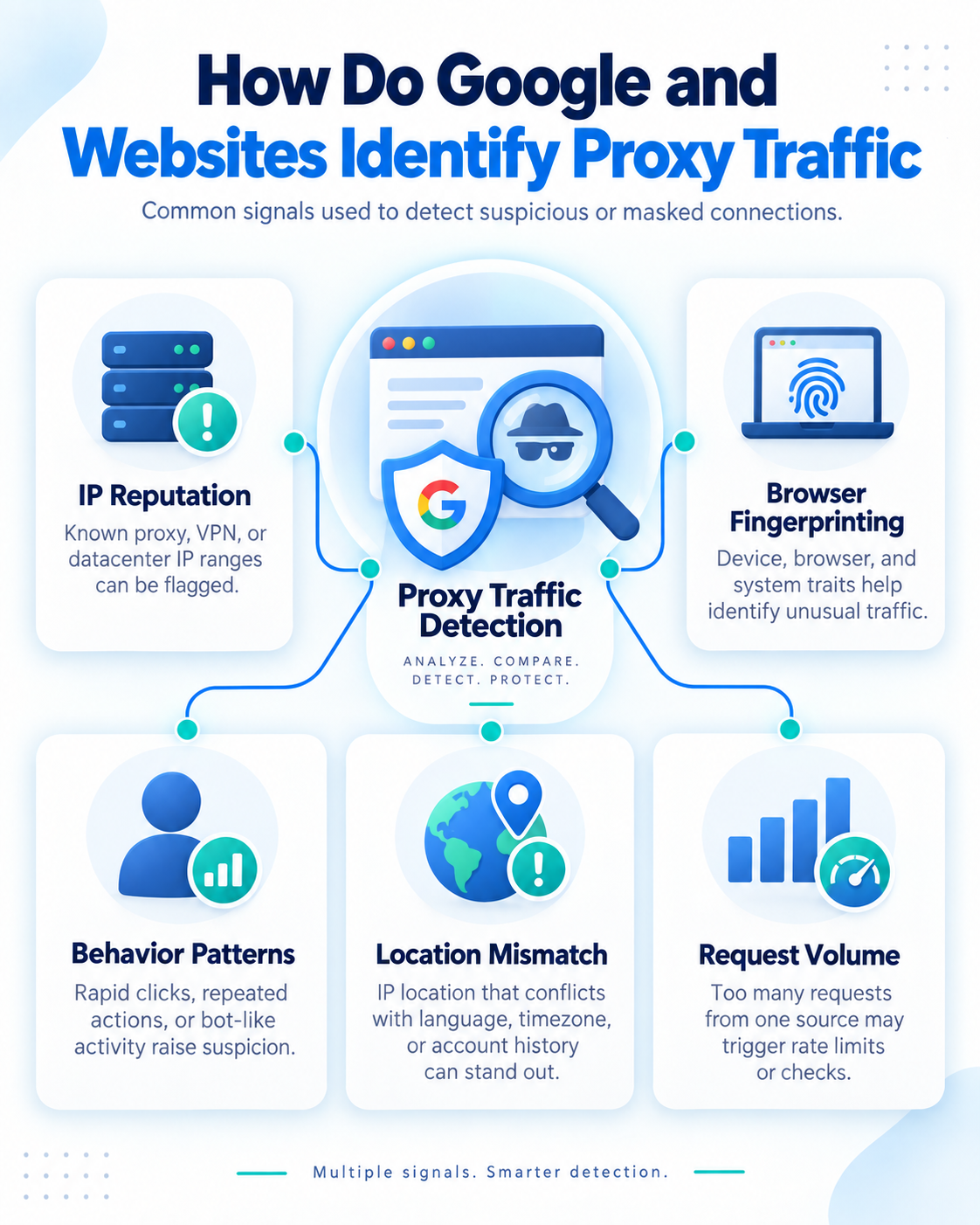
Websites and search engines use several layered techniques to flag traffic that looks automated or non-residential, even when the underlying IP is legitimate.
- IP reputation databases: Services like MaxMind and IPQualityScore maintain records of which IP ranges belong to known datacenter providers, VPNs, or flagged proxy networks.
- Behavioral analysis: Websites track request timing, mouse movement, scroll patterns, and click behavior. Traffic that moves too fast or too uniformly gets flagged regardless of IP type.
- Browser fingerprinting: Sites analyze browser and device characteristics, screen resolution, fonts, and installed plugins to detect inconsistencies that suggest automation.
- Rate and pattern analysis: An unusually high volume of requests from a single IP or a narrow IP range within a short window triggers rate-limiting or CAPTCHAs.
- TLS and header inconsistencies: Advanced detection systems check whether the technical signature of a request, like TLS handshake details, matches what's expected from a genuine browser.
Residential IPs reduce the risk of being caught by the first check, since they don't appear in known proxy or datacenter ranges. They don't eliminate risk from the other checks, which is why responsible use, respecting rate limits and mimicking natural browsing patterns, still matters.
Are Residential Proxies Legal?
Using a residential proxy is legal in the United States and most other countries. The technology itself is neutral; it's simply a method of routing internet traffic. What can create legal or ethical problems is how the proxy is used and how the residential IPs are sourced.
Reputable residential proxy providers obtain their IP pools through consent-based programs, often via apps where users knowingly opt in to share bandwidth in exchange for free services. Providers that source IPs without clear user consent raise serious ethical and legal concerns.
On the usage side, activities like scraping publicly available data are generally legal, but violating a website's terms of service, engaging in fraud, or accessing data without permission can create legal exposure regardless of whether a proxy is involved. The proxy doesn't grant legal permission for otherwise prohibited actions.
If data privacy and compliance matter to your business, choose a provider that's transparent about how it sources residential IPs, and review the terms of service for any website you access through a proxy.
Are Free Residential Proxies Safe?
Free residential proxies carry meaningfully more risk than paid options, and it's worth understanding why before using one for anything beyond casual testing.
Free proxy services need to fund their infrastructure somehow, and that often comes at a cost to the user. Some free providers monetize by logging and selling user browsing data. Others inject ads into web pages passing through their servers, or in more troubling cases, route traffic through devices whose owners never consented to having their connection shared, which raises the ethical sourcing concerns covered above.
Free residential proxies also tend to suffer from smaller IP pools, slower speeds, and higher rates of already-blacklisted IPs, since large volumes of users share the same limited set of addresses. For any task involving business data, account management, or sensitive research, a paid residential proxy provider with transparent sourcing practices is the safer choice.
Residential Proxy Pricing Explained
Residential proxies are typically priced by data usage (per gigabyte) rather than by the number of IPs or connections, since the cost structure reflects the bandwidth providers pay to route traffic through their residential IP networks.
Pricing generally falls into a few tiers:
- Cheap residential proxy plans (entry-level, smaller data allowances) often run in the range of a few dollars up to around $10-15 per GB for pay-as-you-go plans, suited to small-scale scraping or testing.
- Mid-tier plans with larger data pools and better location coverage typically bring the per-GB cost down through volume pricing, often landing in the $3-8 per GB range depending on the provider.
- Enterprise plans for large-scale scraping or continuous monitoring often use custom pricing based on committed monthly data volumes, sometimes dropping below $2-3 per GB at scale.
A business scraping a moderate amount of pricing data, say, 10-20 GB per month, could reasonably expect costs somewhere between $50 and $200 monthly, depending on the provider and required features like rotation frequency or city-level targeting. Costs can climb quickly for large-scale operations, so estimating expected data volume before committing to a plan is worth the time.
Residential Proxy Benefits and Limitations
Like any tool, residential proxies come with clear trade-offs.
How to Choose a Residential Proxy Provider
Not all residential proxy networks are built the same, and picking the wrong provider can lead to slow speeds, unreliable connections, or ethical red flags. Here's what actually matters when evaluating a residential proxy provider, and the qualities that separate the best residential proxy services from the rest.
IP Quality
Look for providers with genuinely diverse, high-quality IP pools rather than recycled or blacklisted addresses. Low-quality IPs get flagged fast, defeating the purpose of using a residential proxy.
Location Coverage
If your use case depends on geo-targeting, such as checking search results or ad placements in specific countries or cities, confirm the provider offers granular location targeting in the regions you need.
Speed
While residential proxies are inherently slower than datacenter options, some providers optimize routing better than others. Ask about average latency and test with a trial if one's available.
Reliability
Look at uptime guarantees and how the provider handles IP churn. A network with frequent, unpredictable dropouts will disrupt time-sensitive tasks like ad verification or price monitoring.
Pricing
Compare pricing tiers against your expected data volume, since costs can scale quickly for large scraping projects. A cheap residential proxy plan may work for testing, but check for hidden data caps before committing.
Customer Support
Responsive support matters, especially when troubleshooting connection issues during a time-sensitive business task.
Data Transparency
Choose providers that clearly explain how they source their residential IPs. Ethical sourcing, typically through opt-in consent programs, protects you from potential legal or reputational risk down the line.
Proxy Selection Checklist
- Does the provider disclose how it sources residential IPs?
- Does it offer coverage in the countries or cities you need?
- Are pricing tiers clear, with no hidden data caps?
- Does it support both rotating and static IP options?
- Is customer support available when you need it?
- Does it offer a free trial or money-back guarantee?
Common Mistakes When Using Residential Proxies
Even experienced users run into avoidable issues. Here are the mistakes that trip up beginners most often.
Using the wrong proxy type for the task. Choosing a rotating proxy when you need a consistent identity (or vice versa) leads to account flags or inefficient scraping.
Ignoring rate limits. Sending too many requests too quickly, even through residential IPs, can still trigger anti-bot systems on well-protected sites.
Overlooking provider ethics. Choosing the cheapest provider without checking how it sources IPs can expose your business to compliance risks.
Skipping session management. Failing to maintain consistent sessions when needed, like during account logins, can cause websites to flag activity as suspicious, even with a legitimate-looking IP.
Underestimating data costs. Since residential proxies bill by data volume, large scraping jobs can rack up unexpected costs if usage isn't monitored closely.
What We've Learned Evaluating Residential Proxy Networks
When evaluating residential proxy networks, three factors consistently matter more than any marketing claim:
IP reputation. Even within a large pool, a portion of IPs are typically already flagged by reputation databases from prior misuse. Providers with rigorous IP vetting and rotation policies tend to produce noticeably fewer blocks during scraping tasks than those with looser sourcing standards.
Connection stability. Because residential IPs depend on real household internet connections, speed and uptime naturally fluctuate more than with datacenter proxies. Providers that offer automatic failover to a fresh IP when a connection drops tend to deliver far more consistent results for time-sensitive tasks like ad verification.
Location accuracy. Some providers advertise city-level targeting that, in practice, sometimes resolves to a different city or even a different region than requested. Verifying actual location accuracy against advertised coverage, rather than trusting the marketing page, can make a measurable difference in tasks that depend on precise geo-targeting.
These factors point to a broader takeaway: the quality gap between residential proxy providers isn't primarily about price. It's about how rigorously a provider manages its IP pool and infrastructure.
Residential Proxy Terms You Should Know (Glossary)
Common Myths About Residential Proxies
Myth: Residential proxies are illegal. As covered earlier, using a residential proxy is legal in the U.S.; it's the misuse of data or violation of website terms that creates legal risk, not the proxy itself.
Myth: All residential proxies are the same. IP sourcing, pool size, rotation options, and location coverage vary significantly between providers, directly affecting performance and reliability.
Myth: Residential proxies guarantee complete anonymity. While they're generally harder to flag than datacenter proxies, sophisticated fingerprinting techniques can still identify unusual behavior patterns regardless of IP type.
Myth: More expensive always means better. Price doesn't always correlate with IP quality or ethical sourcing. It's worth researching a provider's reputation rather than assuming cost reflects value.
Future Trends in Proxy Technology
Proxy technology continues to evolve alongside the anti-bot systems designed to detect it. A few trends worth watching:
- AI-driven detection and evasion: Both websites and proxy providers are increasingly using machine learning, websites to spot non-human traffic patterns, and providers to make proxy traffic behave more like genuine human browsing.
- Growth of mobile residential proxies: As mobile internet usage continues to dominate, demand for mobile IP pools is expected to grow alongside it.
- Stricter regulations on IP sourcing: Expect increased scrutiny around how residential IP pools are built, pushing the industry toward more transparent, consent-based sourcing models.
- Integration with automation platforms: Residential proxies are increasingly built directly into scraping and automation tools, streamlining setup for non-technical users.
Choosing the Right Proxy for Your Needs
A residential proxy gives access to the internet through real, ISP-issued IP addresses, making traffic look like it's coming from an actual household rather than a server or automated system. That authenticity is why businesses rely on residential proxies for web scraping, ad verification, market research, and brand protection: tasks where getting blocked or served inaccurate, geo-filtered data would defeat the whole purpose.
If you're just getting started, define your specific use case first. Someone managing social media accounts needs a completely different setup than a team scraping e-commerce pricing data at scale. From there, use the checklist above to vet potential providers, paying close attention to how they source their IPs and how transparent they are about it.
The right residential proxy setup can open doors that would otherwise stay firmly shut: accurate regional pricing data, uninterrupted scraping, or a marketing team finally able to verify their ads look right in every market they serve.
Frequently Asked Questions
What is a residential proxy used for?
A residential proxy is used to route internet traffic through a real, ISP-assigned home IP address, primarily for web scraping, market research, ad verification, SEO research, social media management, and accessing geo-restricted content without triggering anti-bot detection systems.
Are residential proxies safe?
Yes, residential proxies are generally safe when sourced from reputable providers that use consent-based IP collection methods. Safety concerns typically arise from choosing low-quality or unethical providers, particularly free ones, rather than from the technology itself.
How much does a residential proxy cost?
Residential proxies are usually priced per gigabyte of data used, with costs ranging from a few dollars to several hundred dollars per month depending on data volume, provider, and features like location targeting or rotation frequency.
What is the difference between a VPN and a residential proxy?
A VPN encrypts all of a device's internet traffic and routes it through a single server for privacy, while a residential proxy routes specific traffic through a real residential IP address, primarily for appearing as a genuine local user rather than for full-device encryption.
Can websites detect residential proxies?
Websites can sometimes detect residential proxies through advanced fingerprinting and behavioral analysis, but detection rates are lower than with datacenter proxies since residential IPs closely resemble genuine user traffic.
Are residential proxies legal?
Yes, using a residential proxy is legal in the United States and most countries. Legal issues can arise from how the IPs are sourced (without user consent) or from using the proxy to violate a website's terms of service or commit fraud.
Why are residential proxies expensive?
Residential proxies cost more than datacenter proxies because providers must maintain large networks of genuine ISP-assigned IPs, often through consent-based partnerships or apps, which requires more infrastructure and ongoing management than simply renting server space.


