


Quick answer: Rotating residential proxies are IP addresses assigned by real ISPs to genuine consumer devices, which automatically change at set intervals or with each new request. They allow businesses to scrape websites, monitor competitors, verify ads, and track search rankings without triggering blocks because each request appears to come from a different real household rather than a data center or bot. They're widely used across the USA for market research, ecommerce intelligence, and SEO monitoring.
Anyone who has tried to scrape a website at scale, track competitor pricing, or manage multiple online accounts has hit the same wall: IP bans. Websites are increasingly aggressive about detecting and blocking automated traffic, and a single datacenter IP making hundreds of requests per minute is an easy target.
This is the core problem rotating residential proxies solve.
Rather than relying on a fixed IP that a website can flag and block, a rotating residential proxy network cycles through a large pool of real residential IP addresses. Each request or each session, depending on how you configure it appears to come from a different genuine household connection. That makes automated traffic far harder to distinguish from normal user behavior.
This guide covers everything: how rotating residential proxies work technically, where US businesses use them in practice, how to set them up, how they compare to other proxy types, what to look for in a provider, and which providers are worth evaluating. By the end, you'll have a clear framework for deciding whether rotating residential proxies fit your project and how to avoid the costly mistakes that trip up first-time buyers.
What Are Rotating Residential Proxies?
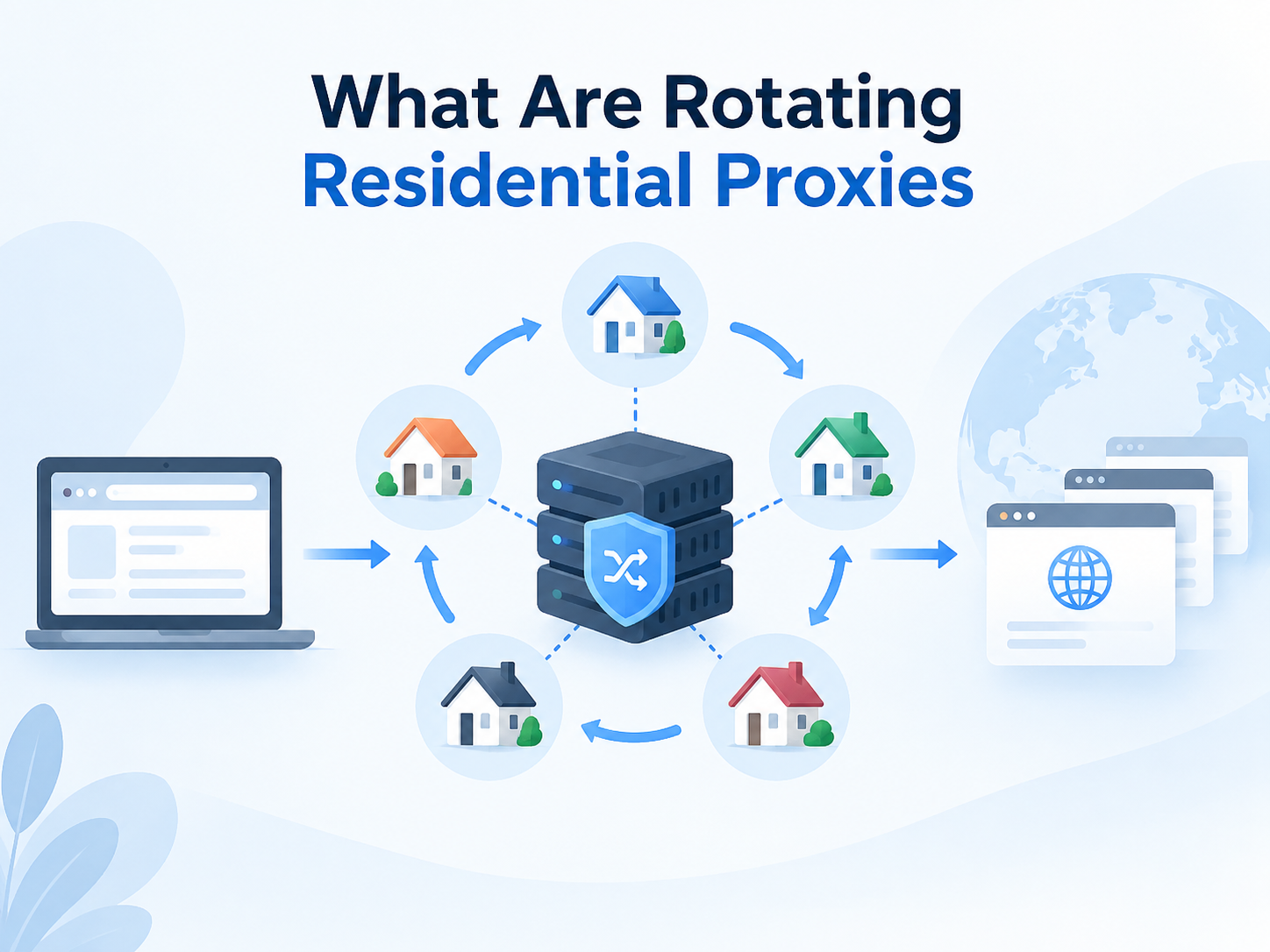
A rotating residential proxy is an IP address issued by an internet service provider (ISP) to a real residential device a home router, a smartphone, or a laptop that is temporarily shared through a proxy network and automatically swapped out for a different IP after a set interval or number of requests.
Because these IPs originate from actual consumer devices, websites treat the incoming traffic as genuine user activity. That's the fundamental distinction from datacenter proxies, which use IPs registered to hosting companies and are far easier for anti-bot systems to detect.
The word "rotating" describes how the network manages IP assignment. Instead of giving a single user one fixed IP indefinitely, the network cycles through its residential IP pool assigning a fresh address after a defined time window (say, every 5 or 10 minutes) or after every individual HTTP request. This process is also called proxy rotation or IP rotation.
Rotating residential proxies are one of several proxy types available alongside static residential proxies, datacenter proxies, and mobile proxies. Each fits different tasks, which we'll compare directly in the tables below.
Technical Components of a Residential Proxy Network
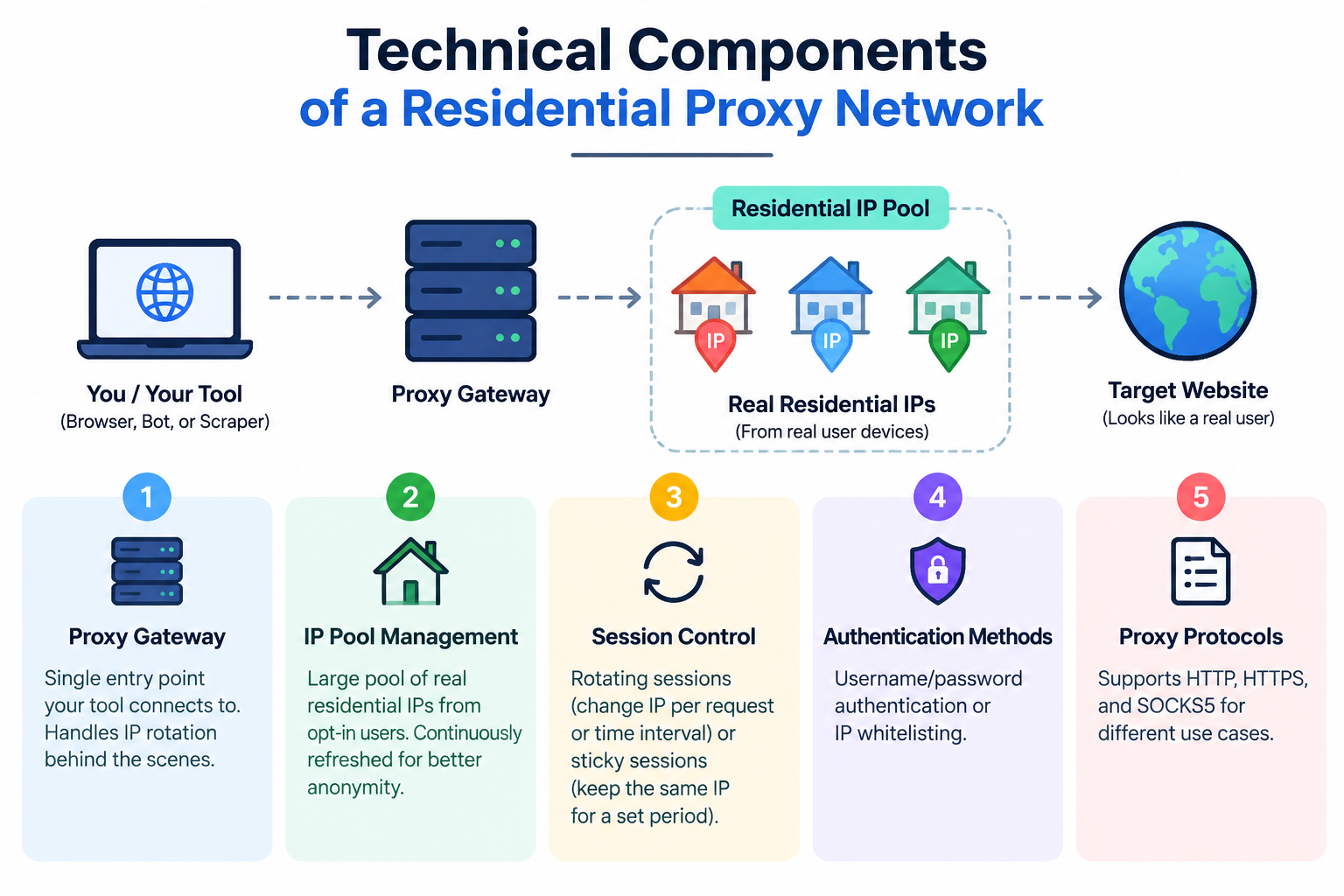
Most articles skim past the infrastructure. Understanding what's actually happening inside a rotating residential proxy network helps you configure it correctly and troubleshoot when things go wrong.
Proxy Gateway
The gateway is the single entry point your tool or browser connects to. You send requests to one endpoint address; the provider's infrastructure handles everything behind it. This is why you don't need to manage a list of thousands of IPs manually the gateway abstracts all of that.
IP Pool Management
The provider maintains a pool of residential IP addresses sourced from real user devices. Reputable providers acquire these through opt-in programs: users voluntarily share bandwidth in exchange for free app access or payment, with explicit consent. The pool is continuously refreshed as devices come online and go offline. Larger, well-managed pools mean less IP reuse and a lower chance of encountering a previously flagged address.
Session Control
Session control governs how long a particular residential IP stays assigned to your connection. Two main modes exist:
- Rotating sessions change the IP with every request or after a fixed interval. Best for high-volume scraping where each request is independent.
- Sticky sessions maintain the same IP for a defined window (often 1–30 minutes). Essential for tasks like multi-step logins or cart checkouts, where the target site expects the same IP across multiple page loads.
Authentication Methods
Most providers support two authentication approaches:
- Username/password authentication embeds credentials in the proxy endpoint URL. Works well with scraping frameworks and headless browsers.
- IP whitelisting allows requests from your server's IP address without embedded credentials. Simpler for server-to-server setups, but less flexible when your egress IP changes.
Proxy Protocols
The protocol you select affects compatibility with your tools and the types of traffic you can route:
For most web scraping and SERP tracking tasks, HTTP or HTTPS is sufficient. SOCKS5 is the right choice when you need to route non-browser traffic or require a lower-level connection.
How Do Rotating Residential Proxies Work?
When you send a request through a rotating residential proxy network, it doesn't go directly to the target website. Instead, it routes through the provider's gateway, which pulls a residential IP address from its pool and forwards the request from that IP. The target site sees the residential IP not your real IP, and not a recognizable datacenter address.
When the rotation interval expires or a new request is made, the gateway assigns a different residential IP from the pool for the next connection.
Time-Based vs. Request-Based Rotation
Time-based rotation swaps the IP after a fixed window every 5, 10, or 30 minutes. Useful when a task needs short-term session continuity, like completing a checkout flow or filling out a form.
Request-based rotation assigns a completely new IP with every HTTP request. This is the mode to use for high-volume scraping, SERP monitoring, or ad verification, where you're sending thousands of independent requests and want each to originate from a different address.
Behind the scenes, the provider's infrastructure also handles geographic targeting, load balancing across the IP pool, CAPTCHA avoidance, and session persistence all without you managing individual proxy addresses.
How to Set Up Rotating Residential Proxies
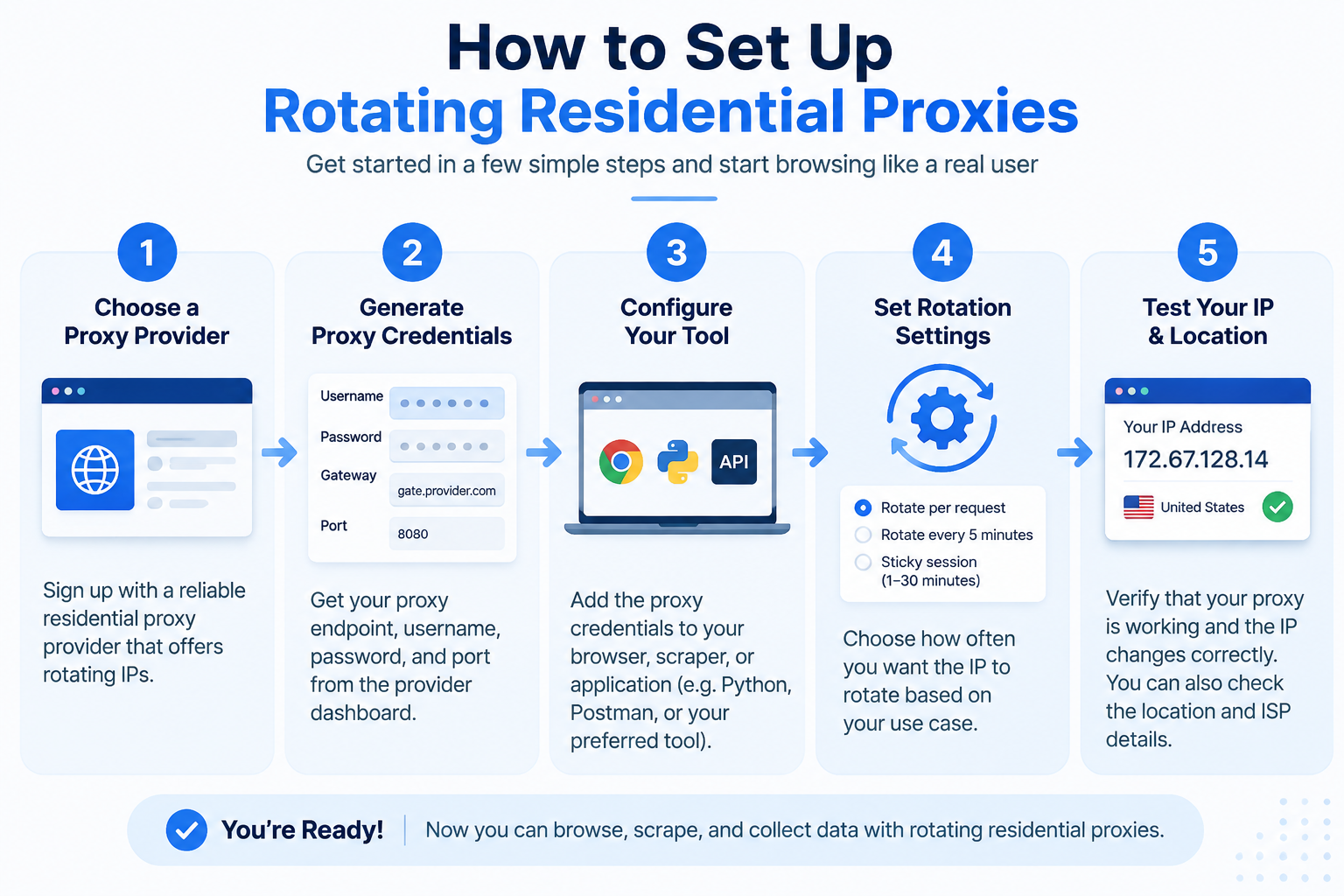
If you've never configured a rotating residential proxy before, here's the basic process most providers follow. Steps may vary slightly by platform.
Step 1: Choose a Provider
Match the provider's IP pool, location coverage, and pricing model to your specific use case. A US SEO agency tracking keywords across 50 cities needs granular state and city-level targeting. An ecommerce team scraping competitor pricing across five countries needs global coverage and high concurrency. Trial plans let you test performance before committing.
Step 2: Generate Proxy Credentials
After signing up, log in to the provider dashboard and create proxy credentials. You'll typically receive:
- A gateway hostname (e.g.,
proxy.provider.com) - A port number (e.g.,
7777) - A username and password for authentication
Some providers also offer session-specific parameters embedded in the username, such as location codes or session length.
Step 3: Configure Your Browser or Tool
For scraping frameworks (Python/Requests, Scrapy, Playwright):
proxies = { "http": "http://username:password@proxy.provider.com:7777", "https": "http://username:password@proxy.provider.com:7777"}response = requests.get("https://target-site.com", proxies=proxies)
For browser extensions or manual browser configuration, enter the gateway hostname and port in your browser's proxy settings, then authenticate with your credentials when prompted.
Step 4: Select Rotation Settings
In the provider dashboard or via username parameters, configure:
- Rotation type: per-request or time-based
- Session length: for sticky sessions, specify a duration (e.g., 10 minutes)
- Geographic targeting: country, state, city, ZIP, or ASN
Step 5: Test Your IP and Location
Use a site like ipinfo.io or whatismyip.com to confirm:
- The IP displayed is a residential address (not datacenter)
- The reported location matches your targeted region
- Requests rotate correctly by refreshing or sending multiple test requests
Run a small-volume test against your actual target website before scaling up to full production volume.
Benefits of Using Rotating Residential Proxies
Businesses adopt rotating residential proxies for concrete operational reasons:
Reduced block and ban rates. Traffic from genuine residential IPs spread across different networks is far less likely to be flagged than traffic from datacenter ranges.
Access to geo-restricted content. With IP pools spanning multiple countries, states, and cities, businesses can view search results, pricing, or content exactly as a local user sees it critical for accurate, region-specific market research.
Higher data collection accuracy. Web scraping proxies that rotate residential IPs return data that better reflects what an unblocked user would see, reducing skewed results from CAPTCHA challenges or throttled responses.
Improved anonymous browsing. Rotating IPs makes it significantly harder for websites to build a behavioral fingerprint tied to a single identity, supporting stronger online privacy for research and competitive intelligence tasks.
Scalability for high-volume tasks. A large rotating proxy network supports thousands of concurrent requests something a small pool of static IPs simply cannot handle without triggering rate limits.
Real-World Examples
Theory is useful; practical examples are better. Here's how US businesses actually put rotating residential proxies to work.
Example 1: SERP Tracking for a US SEO Agency
A mid-sized US SEO agency manages keyword tracking campaigns for 40 clients across different industries. Each client wants to know where their site ranks in specific cities a law firm in Chicago, a plumber in Houston, a retailer in Los Angeles.
The problem: Google actively rate-limits and blocks repeated search queries from the same IP address. If the agency uses a single static IP to check 5,000 keyword/location combinations per day, Google will start returning CAPTCHA pages or blocking responses within the first few hundred queries.
With rotating residential proxies: Each search query is sent from a different residential IP, targeting the specific city where that client operates. A Chicago search comes from a residential IP registered in Illinois. A Houston search comes from a Texas residential IP. Google sees what looks like thousands of different local users searching not an automated tool. The agency's SERP tracking tool runs uninterrupted, and the rankings data reflects what a genuine local user would actually see.
Example 2: Ecommerce Price Monitoring
An ecommerce retailer wants to track competitor pricing across three major platforms daily monitoring 10,000 product SKUs each morning before repricing decisions are made.
Without rotating residential proxies:
- One IP address → 500 requests → the target site detects the pattern → IP blocked → data pipeline fails → team starts the day with no pricing data.
With rotating residential proxies:
- 10,000 requests distributed across thousands of different residential IPs → no single IP makes more than a handful of requests to any one site → the target sees traffic that looks like thousands of different shoppers browsing products → the scraper runs to completion → the pricing team gets accurate, complete data every morning.
The difference isn't just about avoiding blocks. Ecommerce sites sometimes serve different prices or promotions to users they've identified as bots or competitors. Residential IPs that resemble genuine shoppers return the prices real customers see which is exactly what a competitor intelligence operation needs.
Common Use Cases in the USA
Web Scraping
Large-scale data collection pricing, product listings, job postings, real estate data depends on avoiding IP bans. Rotating residential IP proxies let scraping tools distribute requests across thousands of addresses, keeping web scraping proxies pipelines running without interruption.
Market Research
Analysts use geo-targeted browsing through residential proxies to see how search results, ads, and recommendations differ by region helping brands understand local consumer behavior across different US states and metro areas.
Ecommerce Intelligence
Retailers use ecommerce scraping to track competitor pricing, stock levels, and promotional activity in real time. Since many ecommerce platforms aggressively block scraping traffic, rotating residential proxies are often the only reliable way to collect this data at scale.
Ad Verification
Advertisers use residential proxies to confirm their ads display correctly in the right geographic markets and aren't being placed alongside inappropriate content verified from the perspective of a real local user.
SEO / SERP Monitoring
SERP tracking tools use rotating IPs to check keyword rankings from specific US cities without triggering Google's automated query detection. This produces rank data that reflects what genuine local searchers actually see.
Brand Protection
Companies scan marketplaces and social platforms for counterfeit listings or trademark misuse. Rotating IPs let this monitoring run continuously without getting blocked by the platforms under scrutiny.
Travel Price Comparison
Airlines and hotel booking sites adjust prices based on browsing location and history. Residential proxies allow travel aggregators and consumers to compare prices from different geographic vantage points on equal footing.
Social Media Management
Agencies managing multiple client accounts use residential IPs to avoid the account flags and suspensions that platforms trigger when multiple accounts share the same IP or a known datacenter range.
Competitive Analysis
Beyond pricing, businesses use competitor monitoring tools powered by rotating proxies to track competitor content changes, backlink profiles, and marketing campaigns across different US regions.
Rotating Residential Proxy vs Static Residential Proxy
Rotating Residential Proxy vs Datacenter Proxy
Bottom line: Choose rotating residential proxies when avoiding detection is the priority. Choose datacenter proxies when you need speed and cost efficiency for targets that don't aggressively block automated traffic.
Top Rotating Residential Proxy Providers Compared
The market for rotating residential proxies is crowded. Rather than listing every option, the table below focuses on providers that are well-established in the US market, with notes on who each is best suited for. This is a starting point for your evaluation not a definitive ranking.
What this table doesn't tell you: Advertised pool sizes don't always reflect usable unique IPs. Independent testing by proxy research outlets (such as Proxyway's annual market research) consistently shows that the number of unique IPs available per provider can differ significantly from the advertised pool size. Before selecting a provider, request a trial and test against your specific target websites success rates vary meaningfully by target.
Are Rotating Residential Proxies Legal?
Yes, using rotating residential proxies is legal in the United States when the provider sources its IP pool ethically and you use the proxies for lawful purposes such as market research, ad verification, or collecting publicly available data. The hiQ Labs v. LinkedIn case affirmed that accessing publicly accessible web data generally doesn't constitute a Computer Fraud and Abuse Act (CFAA) violation, though the legal landscape continues to evolve.
Legality depends heavily on two things: how the IPs are sourced and how they're used.
Reputable providers obtain consent from device owners through opt-in programs users voluntarily share bandwidth, usually in exchange for free app access, with explicit disclosure. Providers that can't or won't explain their IP sourcing should be treated with caution.
On the usage side, proxies used to access data behind authentication without permission, to violate a site's terms of service in ways that cause harm, or to facilitate fraud carry legal risk regardless of proxy type. The proxy technology itself is neutral the legal exposure comes from how it's applied.
If you're collecting data at scale for commercial purposes, consult a lawyer familiar with data privacy and computer fraud law before launching large operations.
How Businesses Choose High-Quality Rotating Residential Proxies
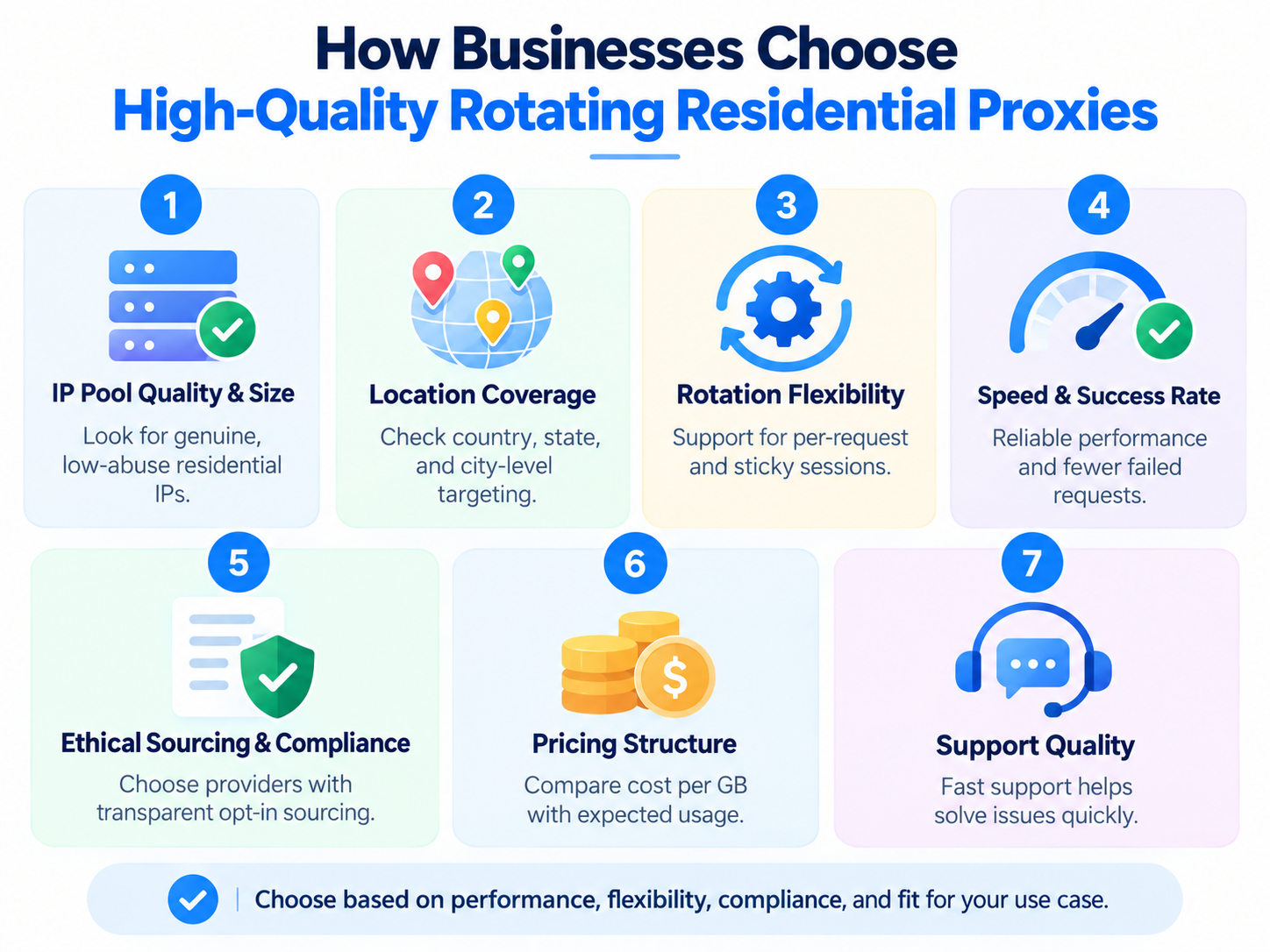
Here's what actually separates a good provider from a disappointing one:
IP pool quality and size. Pool size matters less than IP quality. A well-maintained pool of 50 million genuinely residential, low-abuse IPs will often outperform a larger pool with high reuse rates. Ask providers about their IP refresh methodology.
Location coverage. For US-focused projects, confirm the provider offers state and city-level targeting. National-level targeting is insufficient for use cases like local SERP tracking or city-specific ad verification.
Rotation flexibility. Look for both per-request rotation and configurable sticky sessions. Providers that only offer one mode will create friction for tasks that need the other.
Speed and success rate. Published success rates are a useful starting point. Third-party benchmark data from outlets that test providers independently is more reliable than provider-supplied numbers.
Ethical sourcing and compliance. For enterprise buyers, sourcing transparency matters for legal and reputational risk. Verify that the provider obtains informed consent from IP contributors and complies with relevant privacy regulations.
Pricing structure. Residential proxies are almost always billed per gigabyte. Calculate your expected monthly data volume across all use cases and compare total cost at that volume not just the entry-level price per GB.
Support quality. Proxy configuration issues can halt time-sensitive projects. Providers with 24/7 live chat support are significantly more useful than those with email-only support, especially for teams running automated pipelines.
Common Mistakes When Buying Rotating Residential Proxies
Choosing by price per GB alone. A cheaper provider with a lower success rate can end up costing more in total, once you factor in failed requests, retries, and the engineering time to work around blocks. Calculate cost per successful request, not just cost per GB.
Ignoring location granularity. A provider with country-level targeting only won't work for city-level SERP tracking or local ad verification. Confirm the targeting depth before buying.
Skipping the trial. Provider performance varies significantly by target website. A provider that works brilliantly for one target may struggle against another. Test against your actual targets before committing to a large plan.
Overlooking rotation flexibility. Getting locked into a fixed rotation mode that doesn't match your use case for example, needing sticky sessions for a login-based task but having only per-request rotation available creates real operational problems.
Not rotating user agents alongside IPs. Anti-bot systems analyze multiple signals, not just IP addresses. Rotating IPs while keeping the same browser fingerprint can still get you flagged. Pair IP rotation with user-agent rotation and proper header management.
Best Practices for Using Residential Proxy Networks
Match the rotation mode to the task. Use request-based rotation for independent, high-volume requests; use sticky sessions when a task requires session continuity across multiple page loads.
Respect rate limits even while rotating IPs. Sending too many requests too quickly from a single provider's IP range can still trigger blocks, even if each individual IP is new. Introduce realistic delays between requests.
Rotate user agents and headers alongside IP addresses. Anti-bot systems increasingly look at browser fingerprints, header patterns, and behavioral signals not just IP reputation.
Monitor your success rate over time. If block rates start climbing, it may signal that the provider's IP pool is becoming more heavily used or flagged on your target site. Switch rotation settings or test a different provider.
Stay compliant. Keep proxy usage within the bounds of the target website's terms of service and applicable law, particularly for large-scale commercial data collection.
Evaluating Proxy4U: One Option to Consider
Businesses comparing rotating residential proxy providers may want to include Proxy4U in their shortlist.
Proxy4U offers a residential IP pool of 90 million+ addresses across 195 countries, with targeting available at the country, state, city, ZIP code, and ASN level. The service supports rotating and sticky residential sessions, alongside datacenter and mobile proxy options. Supported protocols include HTTP, HTTPS, and SOCKS5, which covers most common scraping frameworks and automation tools.
Who Proxy4U may fit well: Small to mid-sized teams looking for a provider with a reasonable entry price, global coverage, and flexible session options particularly teams that don't yet need the enterprise-tier tooling that comes with providers like Bright Data or Oxylabs.
Who may need alternatives: Large-scale operations requiring a pool of 150M+ IPs, advanced compliance documentation, or dedicated account management would likely be better served by enterprise-tier providers. Teams needing the deepest possible benchmark data on network performance should also evaluate independent proxy market research before choosing.
A free trial is available, which is the best way to test whether the network performs well against your specific targets before committing to a paid plan.
Future of Rotating Residential Proxy Technology
Proxy networks are evolving alongside the anti-bot systems they're designed to work around. Expect continued investment in AI-driven rotation logic that adjusts IP switching patterns dynamically responding to real-time detection signals rather than fixed intervals.
Mobile proxy networks are growing in strategic importance, since carrier-assigned mobile IPs are harder to flag than fixed residential connections. Providers that offer seamless switching between residential and mobile IPs within a single plan will have a practical advantage.
Data privacy regulations across US states are also becoming a larger factor. Providers that clearly demonstrate informed-consent IP sourcing and can produce documentation to that effect will increasingly be the safer choice for enterprise buyers navigating compliance obligations.
Businesses that rely on proxy networks for compliance-sensitive data collection should treat sourcing transparency as a first-tier evaluation criterion, not an afterthought.
How to Choose the Right Provider for Your Use Case
Frequently Asked Questions
What is the difference between a rotating proxy and a regular proxy?
A regular (static) proxy uses the same IP address for the duration of a session. A rotating proxy automatically changes IP addresses at set intervals or with each request, which significantly reduces detection risk during high-volume tasks.
Are rotating residential proxies worth the cost?
For tasks involving websites with active anti-bot protection major ecommerce platforms, search engines, social networks yes, the higher cost compared to datacenter proxies is usually justified by significantly better success rates and more accurate data. For simpler, less-protected targets, datacenter proxies may be more cost-effective.
How fast are rotating residential proxies?
Speed varies by provider and residential connection quality. Leading providers typically deliver response times between 0.4 and 1.5 seconds. For tasks where raw speed is the top priority, datacenter proxies are faster but residential proxies offer better stealth.
How often do residential proxy IPs change?
It depends on your configuration. With per-request rotation, the IP changes with every single HTTP request. With time-based rotation, it changes after a set interval often configurable from every minute up to 30 minutes or more. Sticky sessions maintain the same IP for a defined window.
Can Google detect rotating residential proxies?
Google's systems analyze multiple signals beyond IP addresses, including query rate, behavioral patterns, and browser fingerprints. No proxy is completely undetectable but residential proxies are substantially harder to flag than datacenter IPs at equivalent request volumes. Combining IP rotation with realistic request pacing and user-agent rotation reduces detection risk further.
What is the best rotating residential proxy for web scraping?
There's no universal best answer it depends on the target website, required volume, location needs, and budget. Oxylabs and Bright Data consistently rank highly in independent performance benchmarks for enterprise scraping. Smartproxy/Decodo offers strong value for mid-market teams. For budget-focused buyers, DataImpulse and IPRoyal are worth evaluating.
What is the difference between a rotating proxy and a regular proxy?
A static proxy gives you one IP for the session. A rotating proxy cycles through a pool of IPs automatically, distributing your requests across many different addresses to prevent detection.
Do I need technical skills to use rotating residential proxies?
Basic setup entering a proxy endpoint into your tool or browser requires minimal technical knowledge. Advanced configurations, like embedding session parameters in the username string or building custom rotation logic, benefit from some scripting familiarity.
Is it legal to use residential proxies for web scraping in the USA?
Scraping publicly available data is generally legal in the US. Always review the target website's terms of service and avoid accessing data behind authentication without permission.
What's the difference between residential and mobile proxies?
Residential proxies use IPs assigned to home internet connections. Mobile proxies use IPs assigned by mobile carriers. Mobile proxies are often harder to flag because carrier IP reassignment is common and expected behavior.
How many residential IPs does a good provider need?
Pool size matters, but quality matters more. Providers with tens of millions of genuine, low-abuse residential IPs generally offer better rotation diversity and lower rates of encountering flagged addresses than providers with larger but lower-quality pools.


