The way agencies find new clients has fundamentally shifted. Cold-calling from outdated spreadsheets, paying monthly fees for stale contact databases, and manually searching directories are workflows that are quickly becoming liabilities. The agencies growing fastest in 2026 are pulling their prospecting data directly from where local businesses are most visible: Google Maps.
This guide covers how marketing agencies of every type SEO, web design, PPC, reputation management, and lead generation are using Leads Sniper as a lead intelligence platform to identify high-intent prospects, enrich contact data, and build outreach campaigns that actually convert.
Why Traditional Lead Databases Are Losing Value
For years, agencies relied on platforms like ZoomInfo, Apollo, or purchased CSV lists to fuel their business development pipelines. Those tools still have a role to play in enterprise B2B prospecting. But for agencies targeting local and regional businesses, they carry serious structural problems.
The core issues with legacy lead databases:
- Data decay is rapid. Local business contact information changes constantly owners change, phone numbers rotate, and emails go dead. A database compiled six months ago can have error rates above 30%.
- Everyone is using the same data. When thousands of agencies buy from the same data source, the same prospects are being bombarded by the same messages.
- No real-time context. Traditional databases don't tell you if a business recently opened, dropped its Google rating, or stopped maintaining its website all signals that indicate whether a prospect actually needs your service right now.
- Poor geographic granularity. If you're trying to reach every restaurant within 10 miles of downtown Austin that doesn't have a proper website, a national database gives you an imprecise blunt instrument.
Local businesses are the backbone of marketing agency client rosters. And Google Maps is where those businesses live in real time.
Google Maps as a Real-Time Business Intelligence Source
Most people treat Google Maps as a navigation tool. Marketing agencies should treat it as a prospecting database.
At any given moment, Google Maps contains millions of verified, self-reported business listings updated by the businesses themselves, enriched by Google's own data crawlers, and supplemented by customer reviews. This makes it arguably the most accurate real-time source of local business intelligence available.
What Google Maps data reveals about a prospect:
- Business name, category, and physical location
- Phone number and website URL
- Operating hours and service areas
- Star ratings and review volume
- Review recency indicating business activity and reputation health
- Whether a Google Business Profile is claimed or unclaimed
- Photos and service menus uploaded by the business
Each of these data points is a prospecting signal. An HVAC company with a 2.9-star rating and 47 reviews mentioning poor follow-up is a warm lead for a reputation management agency. A new dental practice listed on Google Maps with no website is a direct opportunity for a web design agency. A retail store with 300 reviews but zero ad presence is a natural fit for a PPC campaign pitch.
This is what separates local lead generation through Google Maps from static databases: the data isn't just contact information it's business intelligence with built-in intent signals.
AI-Powered Prospecting for Marketing Agencies
The term "AI lead generation" gets overused, but the underlying capability is real and worth understanding clearly.
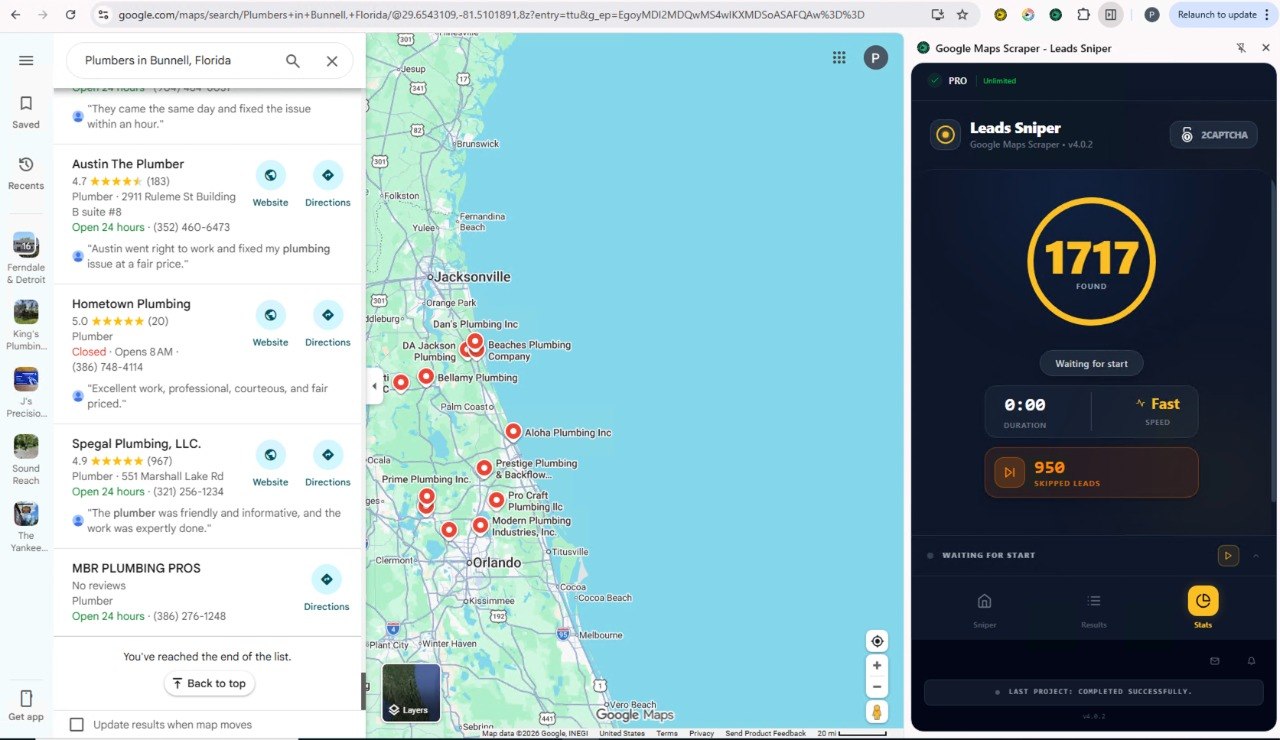
Agencies that previously spent hours manually scanning Google Maps search results for potential clients can now use tools like Leads Sniper to automate the extraction and initial qualification of that google maps scraper data. The intelligence comes from knowing which data points to extract, how to filter them, and what to do with them after extraction.
Where AI-driven thinking improves the process:
- Segmentation at scale. Instead of one generic outreach list, you can build micro-targeted segments for example, all landscaping companies in a specific metro area with fewer than 50 reviews and no visible website.
- Intent scoring. Businesses with recently claimed profiles, new reviews, or recent photo uploads are more active and therefore more receptive to outreach.
- Workflow automation. Once your leads are extracted and filtered, they can flow directly into a CRM or email automation sequence, reducing manual processing time.
Leads Sniper functions as the extraction and enrichment layer in this workflow pulling the raw Google Maps data, organizing it into structured fields, and exporting it in formats that slot into your existing sales stack.
How Agencies Use Leads Sniper to Find Clients Faster
Leads Sniper is a lead intelligence platform built specifically for the use cases that matter most to marketing agencies doing local prospecting. Here's how different agency types put it to work.
SEO Agencies
An SEO agency can use Leads Sniper to search Google Maps for businesses in target niches and locations, then cross-reference the extracted website URLs against basic SEO health signals. Businesses without websites, with thin site structures, or with poor local search visibility become prioritized outreach targets.
Example workflow: Extract all chiropractors in the Dallas-Fort Worth metro, filter for those with fewer than 20 reviews and no visible web presence, and build a cold email sequence positioning your agency's local SEO packages.
Web Design Agencies
Web designers benefit enormously from Google Maps prospecting because the platform often displays whether a business has a website and, if so, which one. Businesses with outdated, non-mobile sites or no web presence at all are prime candidates.
Example workflow: Pull Google Maps listings for independent restaurants in a 25-mile radius. Flag any with no website URL listed or phone-only contact information. Prioritize outreach around a website-in-a-week offer.
PPC Agencies
PPC agencies can identify businesses actively spending on Google Ads by searching for specific keywords and noting which businesses appear in both paid and organic positions versus those showing up organically but running no paid campaigns.
Example workflow: Search Google Maps for personal injury law firms in competitive metro areas. Identify those with strong reviews but low ad spend visibility. Pitch a Google Ads management package demonstrating missed search volume.
Reputation Management Agencies
This may be the most direct use case. Google Maps star ratings are visible in the listing data, and businesses with low ratings or a pattern of unaddressed negative reviews have an obvious, immediate pain point.
Example workflow: Use Leads Sniper to extract all auto repair shops in a region. Sort by average star rating. Any business below 3.8 stars with 20+ reviews is a warm lead for a reputation audit and management package.
Lead Generation Agencies
Agencies that sell leads to clients rather than managing campaigns directly can use Leads Sniper to build geography- and niche-specific lead packages. A plumbing contractor client in Phoenix needs Phoenix plumber leads not national data.
Example workflow: Build niche + city lead lists on a recurring basis, refreshing them monthly to account for new business openings and closings. Sell these as managed lead packages to clients who prefer done-for-you prospecting.
Building Automated Outreach Campaigns
Extracting leads is only valuable if those leads enter a structured follow-up process. Here's a practical outreach framework that agencies are using successfully in 2026:
Step 1: Extract and segment. Run Leads Sniper across your target niche and geography. Export the data into a structured format (CSV or direct CRM integration).
Step 2: Enrich and qualify. Cross-reference website URLs, check for active social profiles, and note review count and recency. Assign a priority tier based on how clearly the business needs your specific service.
Step 3: Personalize at scale. Use the business name, location, and category to build dynamic email templates. Reference their rating, their lack of a website, or their specific industry pain point in the opening line.
Step 4: Sequence and automate. Load your segmented list into an email automation tool (Instantly, Smartlead, or similar). Build a 3–5 step sequence with spaced follow-ups. Set triggers for replies and clicks.
Step 5: Track and optimize. Monitor open rates by niche, reply rates by message variation, and conversion rates by lead source. Leads extracted from Google Maps with specific intent signals consistently outperform generic database lists on reply rate.
This workflow turns Leads Sniper from a data collection tool into the first stage of a complete sales automation workflow.
How Lead Sources Compare: A Direct Comparison
Common Mistakes Agencies Make When Buying Lead Lists
Many agencies have experienced the frustration of purchasing a lead list only to find it full of disconnected numbers, bounced emails, and companies that closed two years ago. These mistakes are avoidable.
Mistake 1: Prioritizing volume over relevance. A list of 50,000 undifferentiated businesses is less useful than 500 businesses that clearly match your ideal client profile. Quality segmentation almost always beats raw volume.
Mistake 2: Not verifying web presence or digital footprint. Buying a list without knowing whether those businesses have websites, social accounts, or active Google profiles means you're missing the most important qualifying signals.
Mistake 3: Using the same list as competitors. When you and five other agencies are all emailing from the same Apollo export, your prospect's inbox reflects it. Using Google Maps as your prospecting source gives you fresher, less saturated data.
Mistake 4: Treating every lead the same. A business with 4 reviews and no website needs a completely different message than one with 200 reviews and a functioning but outdated site. Skipping segmentation kills conversion rates.
Mistake 5: One-and-done outreach. Most prospect replies come on the second or third follow-up. Agencies that send one cold email and move on are leaving the majority of their potential pipeline untouched.
The Future of Lead Generation in 2026
Several structural shifts are reshaping how agencies source and qualify prospects this year.
First-party data is becoming a competitive advantage. As third-party cookies phase out and data privacy regulations tighten, agencies that build their own prospecting workflows extracting data directly from public sources like Google Maps are less dependent on vendors and more in control of their pipeline.
Local business visibility is growing. Google continues to invest in the Business Profile ecosystem. More businesses than ever are actively managing their Google Maps presence, which makes the data richer and more reliable as a prospecting signal.
Speed-to-outreach matters more. When a new business opens and claims its Google Business Profile, there's a window usually the first 60 to 90 days where they're most receptive to agency outreach. Agencies using automated Google Maps lead generation workflows can identify and contact these businesses before competitors do.
Niche specialization is accelerating. Generic "we do everything" agency pitches are failing at higher rates. The agencies building the strongest pipelines are using tools like Leads Sniper to identify specific niches where they have case studies, extract all prospects in that niche within a target region, and run tightly focused outreach sequences.
The agencies that will grow most aggressively over the next 24 months are the ones treating data extraction not as a one-time task but as an ongoing intelligence function built into their business development process.
Frequently Asked Questions
What is Leads Sniper and how does it work for marketing agencies?
Leads Sniper is a lead intelligence platform that extracts business data from Google Maps, Google Search, and Yellow Pages. For marketing agencies, it provides a structured way to build targeted prospect lists by niche and geography, replacing manual search and outdated lead databases.
How accurate is Google Maps data compared to traditional lead databases?
Google Maps data is updated regularly by businesses and by Google's own systems, making it more current than most subscription databases. The trade-off is that you need to layer your own qualification logic on top of the raw data which is why filtering and segmentation matter.
Can I use Leads Sniper to find businesses that need SEO or web design services?
Yes. By extracting Google Maps listings and cross-referencing website presence, review count, and profile completeness, you can identify businesses that are likely underserving their digital presence making them strong candidates for SEO, web design, or local marketing services.
How does Leads Sniper differ from just manually searching Google Maps?
Manual Google Maps searching is limited to what's visible on screen. Leads Sniper automates bulk extraction across hundreds or thousands of listings simultaneously, exports structured data into usable formats, and saves hours of manual work per prospecting session.
What types of data does Leads Sniper extract from Google Maps?
The platform typically pulls business names, addresses, phone numbers, website URLs, email addresses, star ratings, review counts, and business categories all the core data points needed to qualify and contact a prospect.
Is Google Maps lead generation legal for business prospecting?
Google Maps business listings are publicly available information. Extracting and using this data for B2B prospecting is widely practiced. However, agencies should always comply with applicable email and data privacy regulations in their region, including CAN-SPAM and GDPR requirements.
How often should agencies refresh their Google Maps lead lists?
A monthly refresh cycle is a practical starting point for most niches. High-turnover sectors like restaurants, personal services, and retail may benefit from more frequent pulls to capture new openings and flag closed businesses.
Can Leads Sniper support outreach campaigns directly?
Leads Sniper handles the extraction and data structuring layer. For outreach automation, the exported data integrates with standard email tools and CRMs. The platform is designed to be the front end of a broader sales workflow rather than an all-in-one outreach tool.
Start Building a Smarter Prospecting Engine
If your agency is still relying on purchased lists, manual searches, or expensive database subscriptions to fill your pipeline, you're working harder than you need to. The data you need is already on Google Maps structured, current, and loaded with intent signals.
Leads Sniper gives you direct access to that data. Extract local business leads by niche and location. Filter by review count, rating, and web presence. Build segmented outreach lists that match your ideal client profile. And do it at a fraction of the cost of traditional B2B lead generation tools.