Quick Answer: A lead generation marketing strategy is a documented, multi-channel plan for attracting, qualifying, and converting prospects into customers. The most effective strategies combine a clearly defined ICP, funnel-stage content, lead nurturing, and clean prospect data. Companies that get this right generate 50% more sales-ready leads at 33% lower cost than those that don't.
Lead generation has always been competitive. But right now, it's a different game entirely.
Privacy regulations have reshaped what marketers can and can't track. Third-party cookies are nearly gone. Inboxes are saturated. Cold calling connects at a rate of just 3%, with 97% of calls going ignored entirely (Kanbox, 2026). And with AI flooding every channel with generic outreach, buyers have become sharper, more skeptical, and harder to reach.
Yet the pressure on revenue teams hasn't eased. According to HubSpot's 2026 benchmark data, the median cost-per-lead (CPL) in B2B now sits at $213, and MQL-to-SQL conversion rates have dropped from 13% in 2024 to just 9.8% today. That's a steep efficiency loss, and it's putting enormous strain on pipeline.
The businesses that still grow? They're not just running more campaigns. They're running smarter strategies.
This guide covers everything you need to build a lead generation marketing strategy that holds up in 2026, from the core components and funnel stages, to 12 proven tactics, common mistakes, data quality, AI, KPIs, and a 90-day roadmap you can actually use.
Whether you're a marketer, sales leader, startup founder, or agency, this is the framework.
What Is a Lead Generation Marketing Strategy?
A lead generation marketing strategy is a documented plan that defines how your business attracts, captures, qualifies, and moves prospects toward becoming customers.
It's important to separate the strategy from the tactics. Tactics are the actions: running a LinkedIn ad, publishing a blog post, sending a cold email. Strategy is the reasoning behind those actions: who you're targeting, what problem you're solving for them, which channels they use, how you'll qualify them, and what happens after they raise their hand.
Most businesses that struggle with lead generation don't have a tactics problem. They have a strategy problem. They're running disconnected campaigns, chasing vanity metrics, or generating leads that sales can't close. The result is wasted budget and a broken pipeline.
A documented lead generation strategy changes that. It creates alignment between marketing and sales, gives every tactic a clear purpose, and makes it far easier to diagnose what's working and what isn't.
Why Lead Generation Strategies Matter More Than Ever in 2026
The modern B2B buying journey looks nothing like it did five years ago. Buyers complete an estimated 70% of their research before engaging with a sales rep. They consult multiple channels, including organic search, LinkedIn, peer reviews, podcasts, and community forums, before making contact. And they expect personalized, relevant communication at every stage.
This has a direct revenue impact. Businesses that invest in a structured lead generation strategy aren't just generating more leads. They're generating better leads that convert faster and churn less. Companies excelling at lead nurturing generate 50% more sales-ready leads at 33% lower cost (Forrester). That's not a marginal improvement; it's a structural advantage.
Poor-quality leads, on the other hand, are expensive in ways that rarely show up in a single line of the budget. Wasted SDR time, low conversion rates, inflated CAC, demoralized sales teams, and inaccurate pipeline forecasts all trace back to the same root cause: leads that shouldn't have been in the funnel to begin with.
Here's a snapshot of where the industry stands in 2026:
The data tells a consistent story: precision beats volume, and strategy beats tactics.
What Are the Core Components of a Successful Lead Generation Marketing Strategy?
1. Ideal Customer Profile (ICP)
Your ICP defines the type of company most likely to buy from you, stay with you, and grow with you. It's built on firmographic data, including industry, company size, revenue range, geography, and tech stack, and informed by your best existing customers.
Example: A SaaS company selling project management software might define its ICP as B2B companies with 50–500 employees in the professional services industry, using tools like Slack and HubSpot, with a dedicated operations lead.
Implementation tips: Interview your top 10 customers. Find the patterns. Document the attributes that predict both fast conversion and long retention. Update your ICP quarterly as your market evolves.
2. Buyer Personas
Where the ICP describes the company, the buyer persona describes the individual. Job title, seniority, daily responsibilities, pain points, decision-making authority, preferred communication channels, and common objections all belong here.
Example: Within the ICP above, you might have two personas: the Operations Manager who evaluates tools day-to-day, and the VP of Operations who signs off on the budget. Each needs different messaging.
Implementation tips: Build personas from actual conversations, not guesswork. Sales call recordings, support tickets, and LinkedIn profiles are gold.
3. Value Proposition
Your value proposition answers a single question: why should this specific person choose you over every alternative, including doing nothing? It connects your capabilities to their most pressing problem, in language they'd actually use.
Implementation tips: Avoid generic claims like "scalable" or "all-in-one." Be specific. Quantify outcomes wherever you can ("reduce time-to-hire by 40%"). Test variations across channels and track which phrasing converts.
4. Channel Selection
Not every channel will reach your buyers at the right time. Channel selection should be driven by where your ICP actually spends time, your team's resources, and your position in the market.
Implementation tips: Start with two or three channels, go deep before going wide, and build in measurement from day one. Early-stage companies often over-invest in paid channels before proving their message in organic ones.
5. Lead Qualification Framework
Without a shared qualification framework, marketing and sales speak different languages. The most widely used frameworks are BANT (Budget, Authority, Need, Timeline) and MEDDIC (Metrics, Economic Buyer, Decision Criteria, Decision Process, Identify Pain, Champion). Adapt these to your sales cycle.
Implementation tips: Define what makes a Marketing Qualified Lead (MQL) and a Sales Qualified Lead (SQL) in writing. Get sales to sign off on those definitions. Revisit them every quarter.
6. Lead Nurturing Process
Most leads aren't ready to buy when they first engage. Lead nurturing is the process of building trust and staying relevant until they are. It typically involves email sequences, retargeting, content touchpoints, and personal outreach, all mapped to funnel stage.
Implementation tips: Map your nurture tracks to specific intent signals, not just time intervals. A prospect who downloads a pricing guide warrants a different response than one who reads a blog post.
7. Sales and Marketing Alignment
Misalignment between sales and marketing is one of the most common (and costly) failures in lead generation. When marketing optimizes for volume and sales optimizes for quality, the result is a blame cycle and a leaky pipeline.
Implementation tips: Establish a shared revenue target, a shared definition of lead quality, and a regular feedback loop between teams. Monthly pipeline reviews and lead quality audits are a practical starting point.
What Are the Stages of the Modern Lead Generation Funnel?
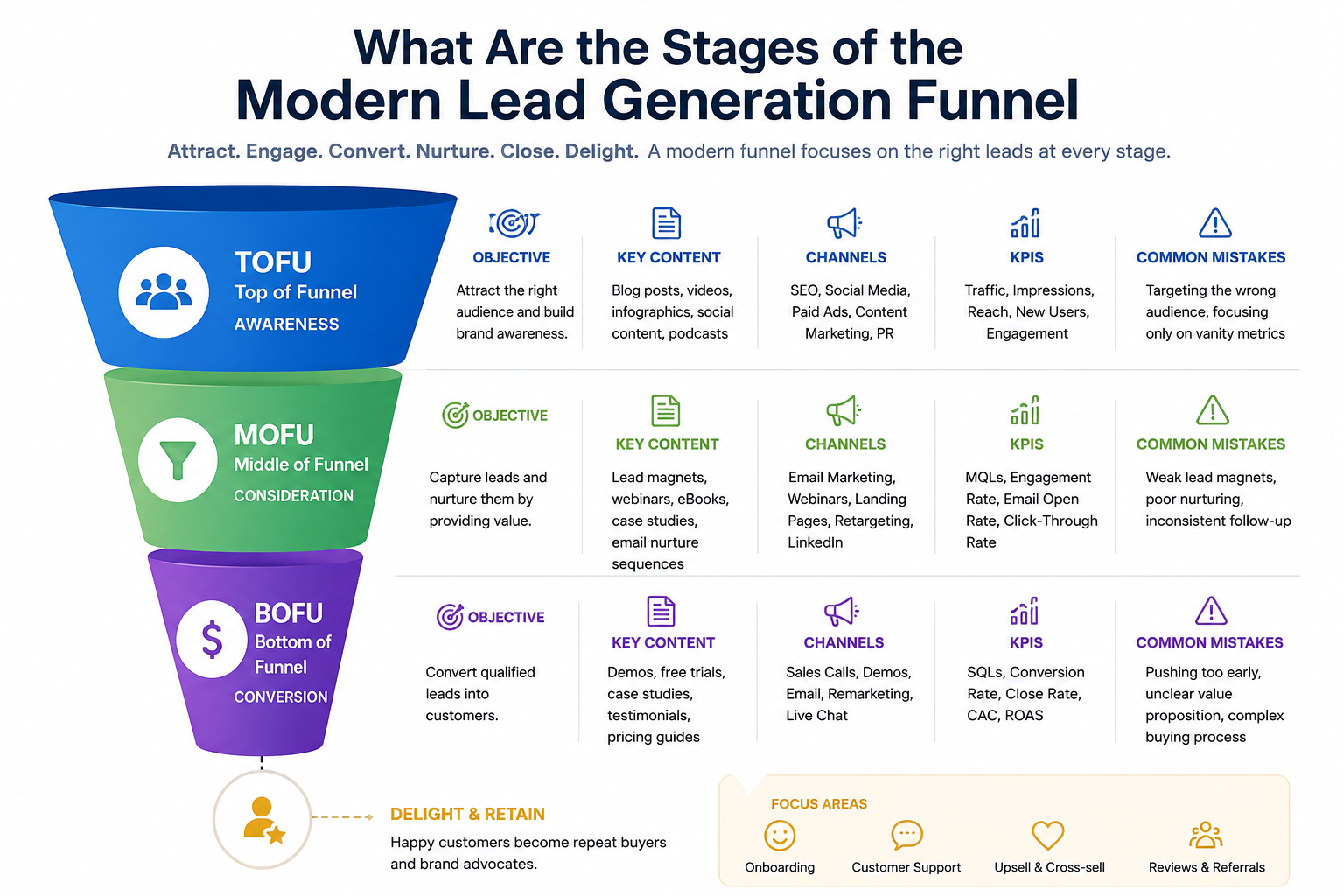
Top of Funnel (TOFU) - Build Awareness
Objectives: Reach potential buyers who match your ICP but aren't yet actively searching for a solution. Plant the brand, introduce the problem, and drive initial engagement.
Content types: Blog posts, social content, short-form video, podcasts, PR, thought leadership, organic SEO.
Channels: Google Search, LinkedIn, YouTube, niche communities, newsletters.
KPIs: Organic traffic, impressions, new visitors, social engagement, branded search volume.
Common mistakes: Prioritizing traffic volume over traffic quality; creating content without keyword intent research; skipping CTAs.
Middle of Funnel (MOFU) - Generate and Nurture Leads
Objectives: Convert interested visitors into leads and educate them through the consideration stage. Build trust and demonstrate fit.
Content types: Webinars, lead magnets (guides, templates, calculators), case studies, email nurture sequences, comparison content, product demos.
Channels: Email, LinkedIn, retargeting, SEO (comparison and problem-aware keywords).
KPIs: MQL volume, email open and click rates, lead magnet downloads, demo requests, webinar attendance.
Common mistakes: Moving too fast to pitch; weak follow-up sequences; using the same messaging for all leads regardless of behavior.
Bottom of Funnel (BOFU) - Convert to Customer
Objectives: Drive purchase decisions. Address final objections, reinforce ROI, and make it easy to say yes.
Content types: Free trials, product walkthroughs, ROI calculators, proposals, customer testimonials, case studies with measurable outcomes.
Channels: Direct sales outreach, email, retargeting, sales calls.
KPIs: SQL volume, MQL-to-SQL rate, close rate, deal velocity, CAC.
Common mistakes: Poor handoff from marketing to sales; too many friction points in the conversion flow; underestimating late-stage nurture.
What Are the 12 Most Effective Lead Generation Marketing Strategies in 2026?
1. SEO-Driven Content Marketing
How it works: Creating and optimizing content that ranks in search engines for terms your buyers use when researching solutions. It generates compounding organic traffic over time.
Best use cases: B2B SaaS, professional services, education, e-commerce.
Advantages: Lowest cost-per-opportunity of any channel at $860 (HubSpot, 2026); builds long-term authority; drives compounding returns.
Limitations: Slow to ramp; requires consistent investment; competitive keywords are hard to crack without domain authority.
Implementation steps:
- Research high-intent keywords using tools like Ahrefs or Semrush
- Build topic clusters around your core use cases
- Optimize for featured snippets and AI search with structured, direct answers
- Build internal links to guide readers toward conversion pages
- Update existing content regularly to maintain rankings
Real-world example: HubSpot built much of its early pipeline through SEO-driven content, targeting terms like "email marketing tips" and "CRM software," content that still generates millions of visits per month.
2. High-Intent Landing Pages
How it works: Dedicated pages designed around a single offer or conversion goal, with minimal distractions and a clear CTA.
Best use cases: Paid traffic, email campaigns, product launches.
Advantages: High conversion rates when matched to traffic intent; easy to A/B test; quick to deploy.
Limitations: Requires significant traffic to generate enough data; won't perform without a compelling offer.
Implementation steps:
- Match the headline to the ad or link copy exactly
- State the benefit in the first five seconds
- Include one CTA and remove navigation and competing links
- Add social proof (testimonials, logos, review scores)
- A/B test headline, CTA, and above-the-fold layout
Real-world example: Unbounce, which makes landing page software, uses hyper-targeted landing pages for each of its paid campaigns, consistently converting above the 4% industry average.
3. Lead Magnets
How it works: Offering a valuable resource (guide, template, checklist, calculator, mini-course) in exchange for contact information.
Best use cases: Email list building, content marketing programs, webinar funnels.
Advantages: Highly scalable; attracts prospects with specific intent; creates immediate value.
Limitations: Quality of leads varies; requires ongoing promotion; needs a strong follow-up sequence.
Implementation steps:
- Identify the most pressing problem in your ICP's workflow
- Create a resource that solves a specific part of that problem
- Build a landing page with a short form (name + email + company)
- Trigger a welcome and nurture sequence immediately upon sign-up
- Promote via blog posts, LinkedIn, paid ads, and email
Real-world example: Canva offers free templates as a lead magnet, attracting both B2C and B2B users who later convert to paid plans.
4. Email Marketing Automation
How it works: Using automated sequences to deliver the right message to the right person at the right time, based on their behavior and funnel stage.
Best use cases: Lead nurturing, post-download follow-up, re-engagement, upsell.
Advantages: Scales with zero marginal effort; highly personalized; 89% of marketers use it as a primary channel (Kanbox, 2026).
Limitations: Deliverability challenges exist, as 14.3% of emails are intercepted by spam filters; requires clean list hygiene; needs compelling copy.
Implementation steps:
- Segment your list by ICP, persona, and behavior
- Map out sequences for each funnel stage (welcome, nurture, re-engagement, sales)
- Personalize beyond first name by referencing the prospect's industry, role, or recent action
- Monitor open rates, click rates, and unsubscribes weekly
- Test subject lines on Tuesday and Wednesday, when engagement peaks (Kanbox, 2026)
Real-world example: Mailchimp uses a multi-step onboarding email sequence for new free-plan users, progressively introducing features and nudging toward paid conversion.
5. LinkedIn Prospecting
How it works: Using LinkedIn Sales Navigator or organic outreach to identify, connect with, and engage decision-makers directly.
Best use cases: B2B, enterprise sales, high-ticket services.
Advantages: LinkedIn accounts for 80% of B2B social media leads (HubSpot, 2026); 94% of B2B marketers use it; decision-makers are accessible.
Limitations: Time-intensive without automation; connection acceptance rates vary; InMail costs add up.
Implementation steps:
- Optimize your profile for credibility (headline, about section, featured content)
- Build a target list using Sales Navigator filters (industry, title, company size)
- Personalize connection requests by referencing something specific
- Lead with value before pitching (share insight, comment on their content)
- Follow up with a clear, low-friction CTA (a short call or resource)
Real-world example: Many B2B agencies have reduced their ad spend entirely by building SDR teams dedicated to LinkedIn, generating meetings for under $150 per booking with a disciplined sequence.
6. Account-Based Marketing (ABM)
How it works: Flipping the traditional funnel. Instead of generating leads and then finding the right company, you start with a defined list of high-value target accounts and run personalized campaigns for each.
Best use cases: Enterprise SaaS, professional services, companies with large deal sizes and long sales cycles.
Advantages: ABM leads convert to opportunity at 19.8%, significantly above average; focuses resources on accounts most likely to close.
Limitations: Expensive and resource-intensive; requires deep sales-marketing alignment; unsuitable for high-volume, low-ACV businesses.
Implementation steps:
- Define your target account list (typically 50–500 accounts)
- Research each account's priorities, tech stack, and buying committee
- Create personalized content, ads, and outreach for each account tier
- Use IP-targeting and LinkedIn matched audiences to serve ads only to these accounts
- Coordinate marketing and sales touchpoints into a unified account plan
Real-world example: Salesforce runs highly customized ABM campaigns for Fortune 500 accounts, including personalized landing pages, direct mail, and executive event invitations, all coordinated around a single account plan.
7. Webinar Marketing
How it works: Hosting live or on-demand educational sessions that attract prospects at the consideration stage, demonstrate expertise, and create a natural sales conversation.
Best use cases: B2B SaaS, consulting, financial services, education.
Advantages: Builds authority; creates qualified leads with high intent; on-demand replays generate leads passively.
Limitations: Requires significant production effort; attendance rates average around 44% of registrants; needs strong promotion.
Implementation steps:
- Choose a topic that solves a specific problem your ICP faces
- Promote 2–3 weeks in advance via email, LinkedIn, and paid channels
- Include a live Q&A and a clear next step (demo, free trial, consultation)
- Follow up within 24 hours with recording and CTA
- Repurpose content into blog posts, clips, and social content
Real-world example: SEMrush runs a consistent webinar program on SEO and digital marketing, registering thousands of prospects per session and converting a significant share to trial.
8. Strategic Partnerships
How it works: Co-marketing with complementary businesses to reach each other's audiences through joint content, referral agreements, product integrations, or shared campaigns.
Best use cases: SaaS (integration partnerships), agencies (referral programs), B2B service businesses.
Advantages: Extends reach without proportional cost; leverages trust from the partner's existing audience.
Limitations: Requires significant relationship management; outcomes depend heavily on partner quality and audience fit.
Implementation steps:
- Identify partners whose customers are your ICP (without being direct competitors)
- Propose a mutually beneficial arrangement (co-webinar, content swap, referral fee)
- Define success metrics and track attribution carefully
- Start with a pilot before committing to a formal agreement
- Build partner enablement materials so they can represent you accurately
Real-world example: HubSpot's Solutions Partner Program has generated significant pipeline through agency partners who bring HubSpot into client engagements in exchange for a commission.
9. Community-Led Growth
How it works: Building or contributing to a community of your target buyers, through Slack groups, Discord servers, LinkedIn groups, forums, or events, to generate organic demand and word-of-mouth.
Best use cases: Developer tools, SaaS with a strong user base, creator economy platforms.
Advantages: High trust; strong word-of-mouth; produces qualified leads organically.
Limitations: Slow to build; requires consistent human investment; doesn't scale through automation alone.
Implementation steps:
- Identify where your ICP already gathers online
- Contribute genuine value before promoting anything
- Build your own community hub if the market is underserved
- Use community engagement as a trigger for personalized outreach
- Recognize top contributors and foster peer-to-peer connections
Real-world example: Notion's early growth was largely community-led, with passionate users sharing templates and use cases in Reddit threads and Facebook groups, driving viral adoption with minimal paid spend.
10. Paid Search Campaigns
How it works: Running ads on Google or Bing that appear when prospects search for keywords related to your product, category, or competitors.
Best use cases: High-intent buyers, competitive markets, product launches.
Advantages: Immediate traffic; precise intent targeting; PPC traffic is 50% more likely to convert than organic traffic (Kanbox, 2026).
Limitations: Expensive at scale; CPCs in competitive B2B categories can exceed $50 per click; requires continuous optimization.
Implementation steps:
- Start with bottom-of-funnel, high-intent keywords (e.g., "[tool] alternative," "buy [product]")
- Create dedicated landing pages for each ad group
- Set up conversion tracking before spending a dollar
- Use negative keywords to eliminate irrelevant clicks
- Review search term reports weekly and reallocate budget toward top performers
Real-world example: Salesforce consistently bids on competitor terms like "HubSpot CRM alternative," capturing high-intent buyers actively evaluating a switch.
11. Intent Data Targeting
How it works: Using third-party intent data platforms (Bombora, G2, 6sense) to identify companies actively researching topics related to your product, then reaching out with timely, relevant messaging.
Best use cases: B2B with a clear buyer journey; ABM programs; SDR outreach prioritization.
Advantages: Intent-data leads convert 3.4x more than cold ICP-match leads (HubSpot, 2026); dramatically improves outreach efficiency.
Limitations: Data quality varies by provider; requires integration with CRM and sales tools; can feel intrusive if messaging is too direct about the intent signal.
Implementation steps:
- Select an intent data provider aligned with your ICP
- Define the topics and signals most relevant to your buyers
- Build an alert system that notifies SDRs when a target account shows intent
- Craft messaging that's relevant to the topic they're researching, without being overly direct about it
- Layer intent data over your ABM account list for maximum precision
Real-world example: A B2B cybersecurity firm using Bombora saw a 40% improvement in email reply rates after shifting outreach to companies showing active intent for "data breach prevention" content.
12. AI-Powered Prospecting and Sales Intelligence
How it works: Using AI tools to automate parts of the prospecting workflow, including researching accounts, enriching contact data, personalizing outreach, and prioritizing leads based on fit and behavior.
Best use cases: SDR-heavy teams, agencies, high-volume outbound programs.
Advantages: Hybrid AI-SDR models have dropped cost-per-meeting to $94, a 70% decrease from $312 (HubSpot, 2026); scales research without adding headcount.
Limitations: AI-generated outreach that lacks genuine personalization gets flagged and ignored; requires human oversight to maintain quality.
Implementation steps:
- Identify the bottlenecks in your current prospecting workflow
- Automate data collection and enrichment (account research, contact info, technographics)
- Use AI to draft outreach templates, then have humans personalize the final send
- Build predictive lead scoring into your CRM to surface the highest-priority accounts
- Review AI-generated outputs regularly to catch errors and drift
Real-world example: Many sales teams now use AI to generate a first draft of a personalized cold email based on a prospect's LinkedIn activity, company news, and job description, cutting research time from 20 minutes per prospect to under two.
What Are the Most Common Lead Generation Mistakes and How Do You Fix Them?
- Skipping ICP definition - Result: leads that don't convert. Fix: define your ICP before any campaign launches.
- Ignoring funnel stage in content - Result: mismatched messaging that confuses buyers. Fix: map every asset to TOFU, MOFU, or BOFU.
- Treating all leads the same - Result: poor lead quality and SDR burnout. Fix: implement lead scoring and segmented nurture tracks.
- No lead nurturing after capture - Result: leads go cold. Fix: build automated follow-up sequences within 24 hours of capture.
- Over-relying on a single channel - Result: fragile pipeline. Fix: diversify across at least three channels with different intent levels.
- Misaligned MQL definition - Result: sales rejects marketing leads, friction builds. Fix: create shared definitions in writing and review quarterly.
- Optimizing for quantity over quality - Result: high volume, low conversion, inflated CPL. Fix: track pipeline value and revenue attribution, not just lead count.
- Ignoring data hygiene - Result: wasted outreach effort and poor deliverability. Fix: clean and enrich your prospect database regularly.
- No A/B testing - Result: stagnant performance. Fix: test one variable at a time across landing pages, emails, and ads.
- Weak or vague CTAs - Result: low conversion rates. Fix: make the CTA specific, low-friction, and benefit-driven ("Get my free audit" beats "Submit").
- Buying lists without verification - Result: high bounce rates, spam complaints, damaged sender reputation. Fix: verify all purchased contacts before outreach.
- Skipping attribution modeling - Result: marketing decisions made on incomplete data. Fix: implement UTM parameters and CRM attribution from day one.
How Does Data Quality Affect Lead Generation Success?
Here's a reality that many teams avoid discussing: the quality of your lead generation is only as good as the quality of your prospect data.
Outdated contact information leads to email bounces and disconnected calls. Inaccurate firmographics mean your ICP matching is off from the start. And when SDRs spend hours manually researching accounts, verifying addresses, finding emails, and confirming company details, that's time they're not spending on conversations.
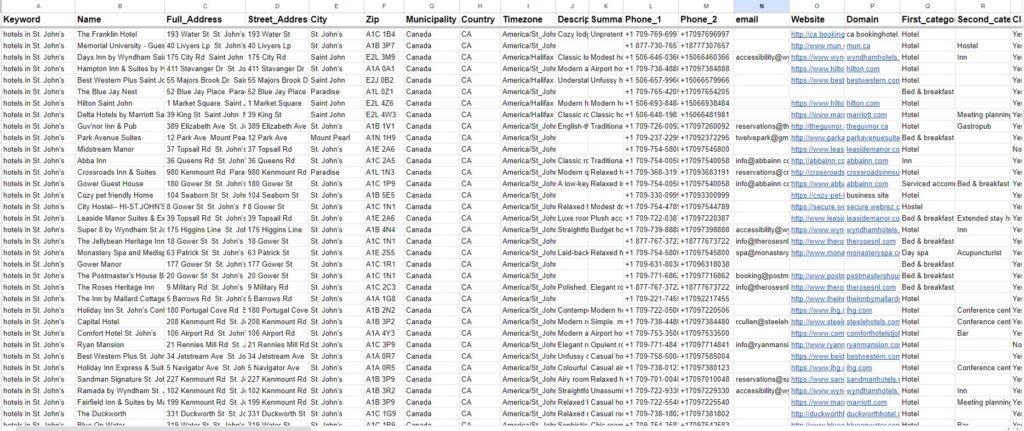
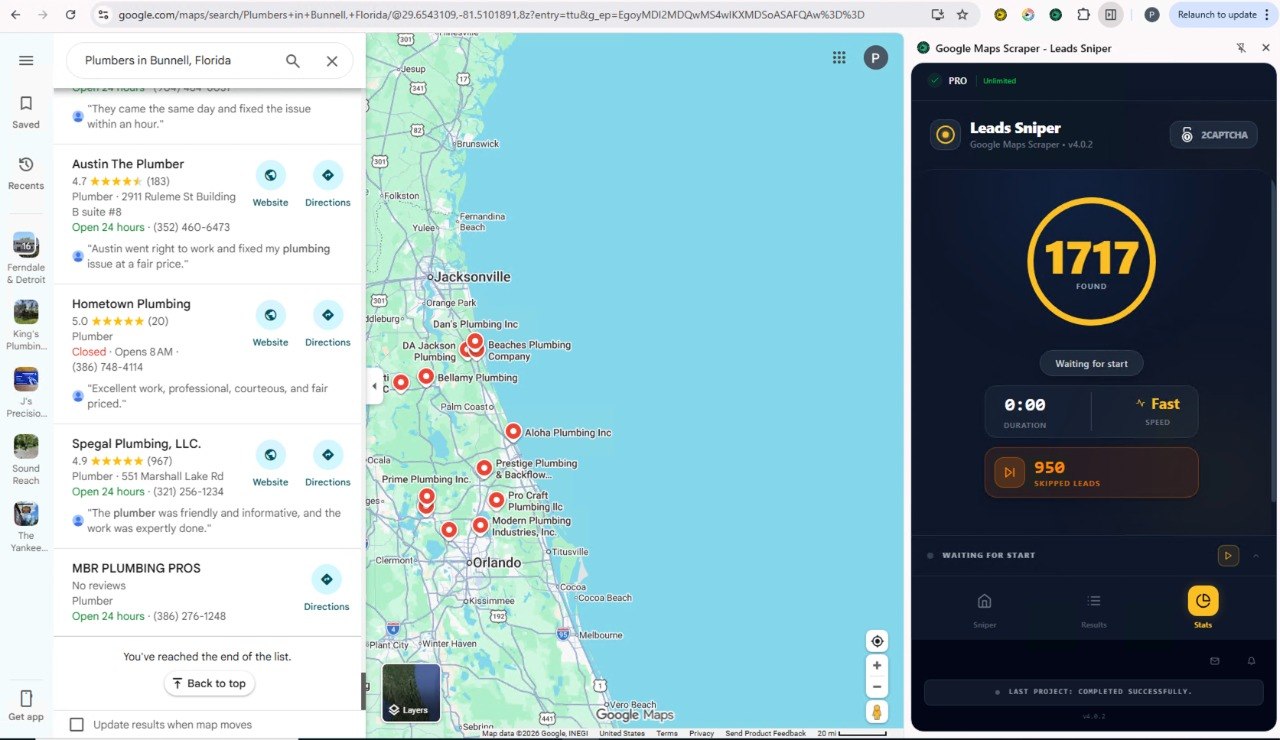
This is where structured data collection tools can make a significant difference. Leads Sniper is a web scraping and sales intelligence platform used by more than 12,000 businesses to collect and organize publicly available prospect data from sources like Google Maps, Google Search, and Yellow Pages. Its AI-powered Google Maps Scraper, launched in June 2026, automates the collection of business names, phone numbers, websites, physical addresses, categories, and ratings, exporting results in CRM-ready formats.
For agencies, B2B sales teams, and consultants who rely on local or regional prospecting, tools like Leads Sniper reduce the manual overhead that typically dominates the early stages of outreach preparation. Rather than maintaining aging, static lead lists, teams can pull current, verified data as needed, reducing bounce rates and keeping pipelines clean.
Good data practices also support:
- Lead scoring accuracy: You can't score leads correctly if the firmographic data is wrong
- Email deliverability: Clean lists mean fewer bounces and better sender reputation
- Personalization at scale: Enriched data makes AI-generated outreach more accurate and relevant
- Segmentation: Accurate company size, industry, and location data enables tighter audience targeting
The broader point is this: data quality is not a back-office function. It's a strategic asset. Teams that treat prospect data as a living resource, refreshed, verified, and enriched, consistently outperform those that treat it as a one-time purchase.
How Is AI Changing Lead Generation Marketing Strategies?
Artificial intelligence isn't replacing lead generation; it's restructuring it. Here's where AI is having the most measurable impact:
Prospect Research: AI tools can now research a target company in seconds, pulling recent news, job postings, product launches, and LinkedIn activity to help SDRs personalize outreach without hours of manual work.
Predictive Lead Scoring: Machine learning models analyze behavioral signals, firmographic fit, and historical conversion data to rank leads by likelihood to convert, helping sales teams focus where it matters most.
AI-Personalized Outreach: Generative AI drafts personalized email sequences at scale, using data points like the prospect's role, company stage, and recent activity. Human review is still essential, but the productivity gain is significant.
Automated Segmentation: AI can segment your database in real-time based on behavior, reducing the manual work required to maintain accurate nurture tracks.
Intent Signal Analysis: AI processes large volumes of behavioral data, including page visits, content downloads, and search patterns, to identify which accounts are in an active buying cycle.
Limitations to keep in mind:
- AI-generated outreach that isn't reviewed often sounds generic
- Predictive models are only as accurate as the data they're trained on
- Over-automation in outreach can damage brand reputation
- Compliance with data privacy laws (GDPR, CCPA) must be built into any AI workflow
The hybrid model, AI for research and first drafts and humans for judgment and relationship building, currently delivers the best results. The 70% drop in cost-per-meeting seen in hybrid AI-SDR models validates this approach.
Which KPIs Should You Track for Lead Generation Marketing?
Track these weekly at the individual channel level and monthly in aggregate. The goal isn't to optimize every KPI simultaneously; it's to find the metric most responsible for pipeline gaps and fix it first.
What Does a 90-Day Lead Generation Marketing Strategy Roadmap Look Like?
Days 1–30: Foundation
- Define or audit your ICP and buyer personas
- Document your value proposition per persona
- Audit existing content against funnel stages and identify gaps
- Set up or audit CRM, UTM tracking, and lead source attribution
- Define MQL and SQL criteria with sales and get written agreement
- Identify two to three primary channels based on ICP behavior
- Start a weekly sales-marketing sync
Days 31–60: Activation
- Launch or optimize lead magnets for MOFU capture
- Build or refresh two to three email nurture sequences (welcome, education, re-engagement)
- Begin publishing SEO content targeting high-intent BOFU and MOFU keywords
- Launch LinkedIn prospecting with a defined ICP list
- Test one paid channel with a focused landing page
- Set up lead scoring in CRM based on behavior and fit
- Conduct first lead quality audit: review MQL-to-SQL rate with sales
Days 61–90: Optimization
- Review CPL and pipeline value by channel and reallocate budget to top performers
- A/B test landing page headlines, email subject lines, and CTAs
- Add intent data layer to outreach prioritization
- Begin ABM pilot with a list of 50–100 target accounts
- Introduce webinar or live event to generate MOFU leads
- Formalize lead quality feedback loop with sales
- Build a monthly lead generation reporting dashboard
By the end of 90 days, you should have a functioning multi-channel system, a clear picture of your cost-per-opportunity by channel, and a documented feedback loop between marketing and sales.
Frequently Asked Questions About Lead Generation Marketing Strategy
What is the difference between lead generation and demand generation?
Demand generation builds awareness and creates interest in your category; it often doesn't involve capturing contact information. Lead generation converts that interest into an identifiable prospect, typically through a form, sign-up, or direct outreach. The two work best together: demand generation fills the top of the funnel, and lead generation captures and qualifies what flows through.
How many leads does a B2B business typically need per month?
The number depends on your average deal size, close rate, and revenue target. A simple formula: monthly revenue goal divided by average deal size equals deals needed. Divide that by your SQL-to-close rate to find the SQLs needed, then divide by your MQL-to-SQL rate (9.8% median in 2026) to find MQL volume required. Working backward from revenue prevents the mistake of setting arbitrary lead volume targets.
What are the best lead generation channels for B2B in 2026?
The highest-performing channels vary by company stage and ICP, but the data points to SEO/content (lowest cost-per-opportunity at $860), LinkedIn (80% of B2B social leads), email marketing (89% of marketers' primary tool), and intent data-driven outreach (3.4x higher conversion than cold ICP match). ABM delivers the highest opportunity conversion rate at 19.8% for teams with the resources to support it.
How long does it take to see results from a lead generation strategy?
Paid and outbound channels can generate leads within days. SEO and content take 6–12 months to build