Quick Answer: Lead generation for SaaS means attracting, qualifying, and converting prospects into paying customers through a repeatable system. The most effective strategies in 2026 combine intent-data targeting, AI-assisted outreach, content marketing, and product-led growth motions. Top-performing SaaS teams achieve cost-per-leads as low as $84 by focusing on qualification over volume.
SaaS companies live and die by their pipeline. Without a steady, predictable flow of qualified leads, even the best product stalls: revenue flatlines, burn accelerates, and growth targets become guesswork. Yet most SaaS teams still treat lead generation as a collection of disconnected tactics rather than a compounding system.
The landscape has shifted sharply. The median B2B cost-per-lead reached $213 in 2026, up from $198 in 2025, according to HubSpot's State of Marketing 2026, but the top quartile of programs achieves CPLs of $84. That 4.7x gap isn't luck. It's the result of better targeting, tighter qualification criteria, and smarter use of intent data and AI tooling.
This guide covers every dimension of SaaS lead generation: what it is, why it's uniquely difficult for SaaS businesses, the top strategies that actually produce qualified pipeline, the tools that power them, and the metrics that tell you whether your system is working. We'll also introduce Leads Sniper, a lead data and web scraping platform trusted by 12,000+ businesses, as one practical way to source and scale high-quality prospect lists.
Whether you're a SaaS founder building your first growth motion, a marketing manager refining your demand generation strategy, or a sales leader looking to scale pipeline, you'll find specific, evidence-backed answers here.
What Is Lead Generation for SaaS?
Lead generation for SaaS is the process of identifying, attracting, and converting potential buyers into qualified prospects who are likely to purchase a subscription product. It spans every activity, from a blog post that brings a new visitor to your site to an SDR sequence that books a demo, that moves a stranger closer to becoming a paying customer.
How SaaS Lead Generation Differs from Traditional Lead Generation
Traditional lead generation often targets one-time buyers. SaaS lead generation is different in three important ways.
First, SaaS products sell subscriptions. A single converted lead generates recurring revenue, which means lead quality directly affects LTV, not just first-month revenue. Second, SaaS buying cycles are longer and involve more stakeholders. The median B2B buying committee now has 9.3 members, up from 6.8 in 2022 (Forrester, 2026). Third, SaaS buyers evaluate multiple solutions simultaneously and rely heavily on peer reviews, free trials, and product demos before committing.
These differences demand a specialized approach: one that nurtures leads over time, educates buying committees, and reduces friction at every stage of the funnel.
Why SaaS Companies Struggle with Lead Generation
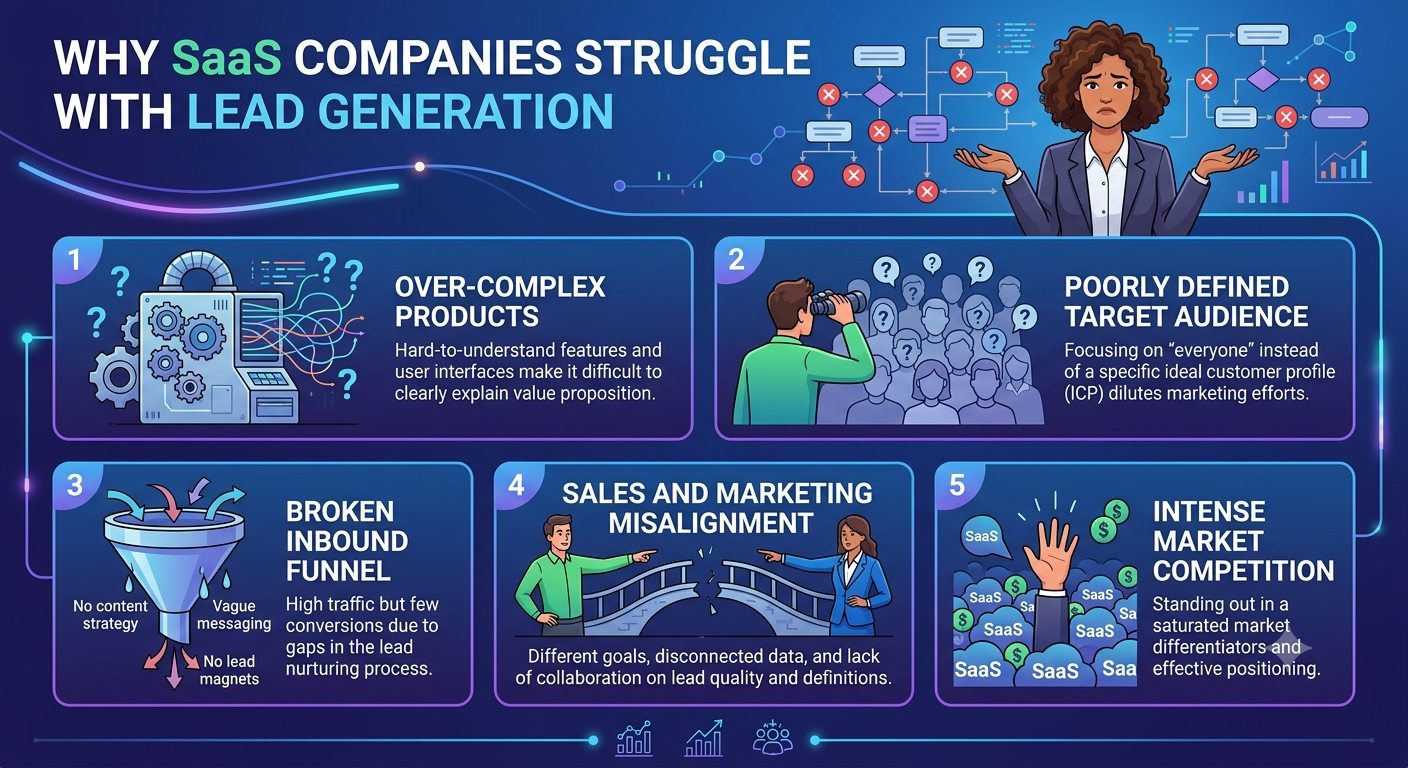
Most SaaS companies hit predictable walls. Knowing where the problems are makes them easier to solve.
- Long sales cycles. Enterprise SaaS deals under $50K take a median of 94 days to close. Deals over $100K take 238 days (Forrester, 2026). Without deliberate nurture, leads go cold.
- Market saturation. The SaaS market is growing at a CAGR of 13.32% through 2034 (Zylo). More products mean more noise and higher paid-channel competition.
- Low conversion rates. Across all channels, the median lead-to-closed-won rate is just 0.94%, meaning roughly one in 106 captured leads becomes revenue (Digital Applied, 2026).
- Poor targeting. Teams that skip ICP definition generate high lead volume at high cost but low close rates. The MQL-to-SQL rate for programs without intent scoring sits at 6.4%, versus 22.8% for teams running a full signal stack.
- Weak messaging. Generic value propositions fail to differentiate. Buyers can't explain why your product is the right choice if your messaging doesn't tell them.
- Lack of personalization. Buyers 73% of the time complete significant research before identifying themselves to vendors. Generic outreach arrives after the shortlist has already formed.
- Scaling issues. What works at 50 leads a month breaks at 500. Systems, scoring, and handoffs need to be built for scale before they're needed.
The SaaS Lead Generation Funnel
Every lead passes through six stages. Each stage has a distinct goal, the right channels, and the KPIs that matter.
The MQL-to-SQL gap is where most funnels break. The median 2026 MQL-to-SQL rate is 9.8%, down from 13% in 2024, a 24% decline in two years (Forrester and Demand Gen Report). Programs adding behavioral and third-party intent signals to MQL criteria run at 16.4%, nearly 70% above the unfiltered median.
Top SaaS Lead Generation Strategies
1. Content Marketing
How it works: Content marketing attracts organic traffic by answering the questions your buyers are already searching. Blog posts, guides, templates, case studies, and comparison pages all serve different stages of the funnel.
Benefits: SEO-driven content has the best cost-per-opportunity of any lead generation channel, at $860 per opportunity, and CPL inflation held at just 2.8% year-over-year in 2026 (Digital Applied). It compounds over time, unlike paid advertising.
Common mistakes: Publishing for volume rather than intent. A post that ranks for a high-traffic keyword with zero purchase intent brings visitors, not leads.
Best practices: Map content to funnel stage. Top-of-funnel posts answer broad questions; bottom-of-funnel content compares your product against alternatives or addresses common objections. Add clear calls to action: a demo request, a free trial link, or a relevant lead magnet.
Example: A SaaS HR platform publishes a guide titled "How to Build an Employee Onboarding Checklist" targeting HR managers, their ideal buyer. A content upgrade (downloadable template) captures email addresses. An automated nurture sequence follows.
2. SEO
How it works: SEO positions your product pages, blog content, and comparison pages to rank in search results when buyers search for solutions like yours.
Benefits: Organic content delivers leads at a median CPL of $98, the lowest of any channel. Combined with strong on-page conversion, it's the most capital-efficient lead source available to SaaS teams.
Common mistakes: Targeting only high-volume keywords without considering conversion intent. "Project management software" is high-traffic; "Asana alternative for small teams" is high-intent.
Best practices: Build clusters of content around your core value propositions. Target competitor comparison and alternative keywords, as these capture buyers already in evaluation mode. Prioritize page speed, mobile experience, and structured data to maximize AI search visibility.
3. LinkedIn Outreach
How it works: LinkedIn gives SaaS teams direct access to professional buyers. Outreach combines connection requests, direct messages, and InMail with content publishing to build awareness and generate conversations.
Benefits: LinkedIn paid leads convert at 6.3% to opportunity, above the average for paid social, and the platform provides precise targeting by job title, company size, industry, and seniority.
Common mistakes: Leading with a pitch. Buyers ignore cold pitches; they respond to relevant, problem-focused conversations.
Best practices: Use Sales Navigator to build an ICP-matched list. Sequence outreach across connection request, warm message, and value-add follow-up over 10-14 days. Combine with a content strategy, as accounts that post regularly generate inbound connection requests and reduce cold outreach volume needed.
4. Cold Email Campaigns
How it works: Cold email contacts prospects who haven't raised their hand but match your ICP. It's outbound by nature, and effectiveness depends almost entirely on list quality, personalization, and message relevance.
Benefits: Email delivers a median ROI of $42 per $1 spent for B2B services. Reply quality has improved even as reply rates stabilized: 64% of cold-email replies in 2026 result in a meeting booked, compared to 41% in 2024 (Digital Applied).
Common mistakes: Sending generic messages to purchased lists. Spam rates rise, deliverability falls, and domain reputation suffers.
Best practices: Start with verified, ICP-matched contact data. Personalize the opening line to a specific trigger, such as a recent funding round, a new hire, or a competitor switch. Keep sequences to 4-6 touches over 14 days. Respect GDPR and CAN-SPAM requirements.
5. Account-Based Marketing (ABM)
How it works: ABM flips traditional lead generation by targeting a defined set of high-value accounts with coordinated, personalized campaigns across multiple channels simultaneously.
Benefits: ABM leads convert to opportunity at 19.8%, the highest of any channel tracked in 2026. The cost-per-opportunity ($2,460) beats paid search ($4,250) and paid social ($4,341) despite higher CPL (Digital Applied, 2026 LinkedIn B2B Institute data).
Common mistakes: Treating ABM as a high-volume email blast to a "target account list." True ABM involves coordinated, multi-channel engagement tailored to each account.
Best practices: Select accounts based on firmographic fit plus buying-signal activity. Coordinate sales and marketing around a shared account plan. Use direct mail, custom landing pages, and executive-level content to break through.
6. Webinars
How it works: Webinars attract leads by offering genuine education or insight on a topic your buyers care about. They create a live, interactive experience that builds trust faster than most other formats.
Benefits: Webinar leads convert to opportunity at 14.2%, nearly 3.5x the paid social rate. Including a webinar in a nurture path lifts sales-accepted leads by 43% (Demand Gen Report, 2026).
Common mistakes: Product-pitching instead of teaching. Webinars that lead with a demo lose the audience before they reach the call to action.
Best practices: Lead with education. Use a co-presenter or guest speaker to expand reach. Follow up within 24 hours with a recording, key takeaways, and a relevant next step, not just "thanks for attending."
7. Referral Programs
How it works: Referral programs incentivize existing customers to recommend your product to their network in exchange for a reward: credits, cash, discounts, or upgrades.
Benefits: Referral leads convert to opportunity at 27.5%, the highest lead-to-opportunity rate of any tracked channel. Customer referrals aren't cheap (median CPL: $314), but the cost-per-opportunity ($1,142) is second only to SEO and email (Digital Applied, 2026).
Best practices: Make the referral process effortless: a simple link, clear reward, and frictionless sign-up. Trigger referral asks at peak satisfaction moments: immediately after a successful onboarding, a positive support interaction, or a milestone in the product.
8. Product-Led Growth (PLG)
How it works: PLG uses the product itself as the primary acquisition and conversion vehicle. Free trials, freemium tiers, and self-service onboarding let users experience value before talking to sales.
Benefits: According to a ProductLed benchmark study, 58% of B2B SaaS companies now operate some form of product-led motion. OpenView's 2024 benchmark found 60% of SaaS companies identify as product-led, up from 35% in 2021.
Best practices: Design onboarding to deliver a clear "aha moment" within the first session. Use in-app behavior as a lead scoring signal, as product-qualified leads (PQLs) who reach activation milestones convert at significantly higher rates than MQLs from other channels.
9. Partnerships and Co-Marketing
How it works: Partnerships let you reach established audiences through integration partners, technology alliances, resellers, or co-authored content with complementary brands.
Benefits: A well-chosen integration partner gives you access to warm leads who are already using adjacent software, buyers already familiar with the problem your product solves.
Best practices: Identify integration partners whose customer base overlaps with your ICP. Co-create a joint asset, such as a guide, a webinar, or a co-branded tool, that generates leads for both parties.
10. Paid Advertising
How it works: Paid channels, including Google Ads, LinkedIn Ads, Meta Ads, and retargeting, generate immediate traffic by bidding for placement in front of defined audiences.
Benefits: Paid advertising is the fastest channel for generating leads. It produces volume quickly and can be tested, adjusted, and scaled without waiting for organic traction.
Common mistakes: Optimizing for lead volume over lead quality. Paid social has a cost-per-lead of $178 but a lead-to-opportunity conversion of only 4.1%, resulting in a cost-per-opportunity of $4,341 (Digital Applied, 2026). Volume isn't pipeline.
Best practices: Layer intent signals onto paid targeting. Use retargeting to re-engage high-intent visitors. Match ad creative and landing page message precisely, as headline-to-page consistency lifts conversion by 27%.
Inbound vs. Outbound SaaS Lead Generation
Both motions have a place. The right balance depends on your stage, budget, and sales cycle.
Best SaaS Lead Generation Tools
Common SaaS Lead Generation Mistakes
Avoiding these mistakes is often faster than optimizing existing tactics.
- Chasing volume over quality. A pipeline full of misfit leads wastes sales time. Tighten your ICP before scaling.
- Skipping lead scoring. Programs with no scoring route 6.4% of MQLs to SQL. Programs using a full signal stack reach 22.8%.
- Ignoring intent signals. Intent-sourced leads close at 18.7% versus 5.5% for cold ICP-match leads (6sense and Demandbase, 2026).
- Contacting leads too slowly. 53% of MQLs go uncontacted past 24 hours. Leads contacted within an hour are 7x more likely to qualify (Digital Applied, 2026).
- Using too many form fields. A 7-field form converts at 3.6%. A 2-field form converts at 12.2%.
- Siloing marketing and sales. Misaligned MQL definitions create friction at handoff. Define SQLs together and review weekly.
- Stopping nurture too soon. Top performers run 11-touch nurture sequences over 90 days. The median is 7 touches over 60 days.
- Optimizing for CPL instead of cost-per-opportunity. SEO costs $98 per lead and $860 per opportunity. Paid social costs $178 per lead and $4,341 per opportunity.
- Ignoring review platforms. G2, Capterra, and TrustRadius leads convert at 11.8% lead-to-opportunity. They're underused relative to their ROI.
- Not testing landing pages. Video on a landing page lifts conversion by 86%. A single CTA lifts it by 59%. Most teams never run these tests.
- Buying generic lead lists. Unverified, low-fit contact data wastes outreach budget and damages deliverability.
- Running campaigns without feedback loops. If sales doesn't report back on lead quality, marketing keeps optimizing for the wrong signals.
How to Measure SaaS Lead Generation Success
Track these metrics to know whether your system is working and where it's breaking.
How Leads Sniper Helps SaaS Companies Generate More Qualified Leads
Outreach is only as good as the data behind it. Leads Sniper is a web scraping platform built to help businesses extract verified prospect data from Google Maps, Google Search, Yellow Pages, and domain email sources, fast, at scale, and at a one-time cost.
Over 12,000 companies and professionals use Leads Sniper to build targeted contact lists without paying per-lead fees or locking into expensive monthly subscriptions. The platform is rated Excellent on Trustpilot with 100+ reviews and has been featured in AP, Business Insider, MarketWatch, and Yahoo Finance.
What Leads Sniper Does
- Google Maps Scraper: Extract business names, addresses, phone numbers, emails, and website URLs from Google Maps listings based on keyword and location parameters.
- Google Search Scraper: Pull structured data from Google SERP results, bypassing hours of manual research.
- Yellow Pages Scraper: Access Yellow Pages directory data to surface contact information for local and regional B2B prospects.
- Domain Email Extractor: Scrape verified email addresses directly from any domain, useful for building targeted outreach lists from a curated set of company websites.
Why SaaS Companies Choose Leads Sniper
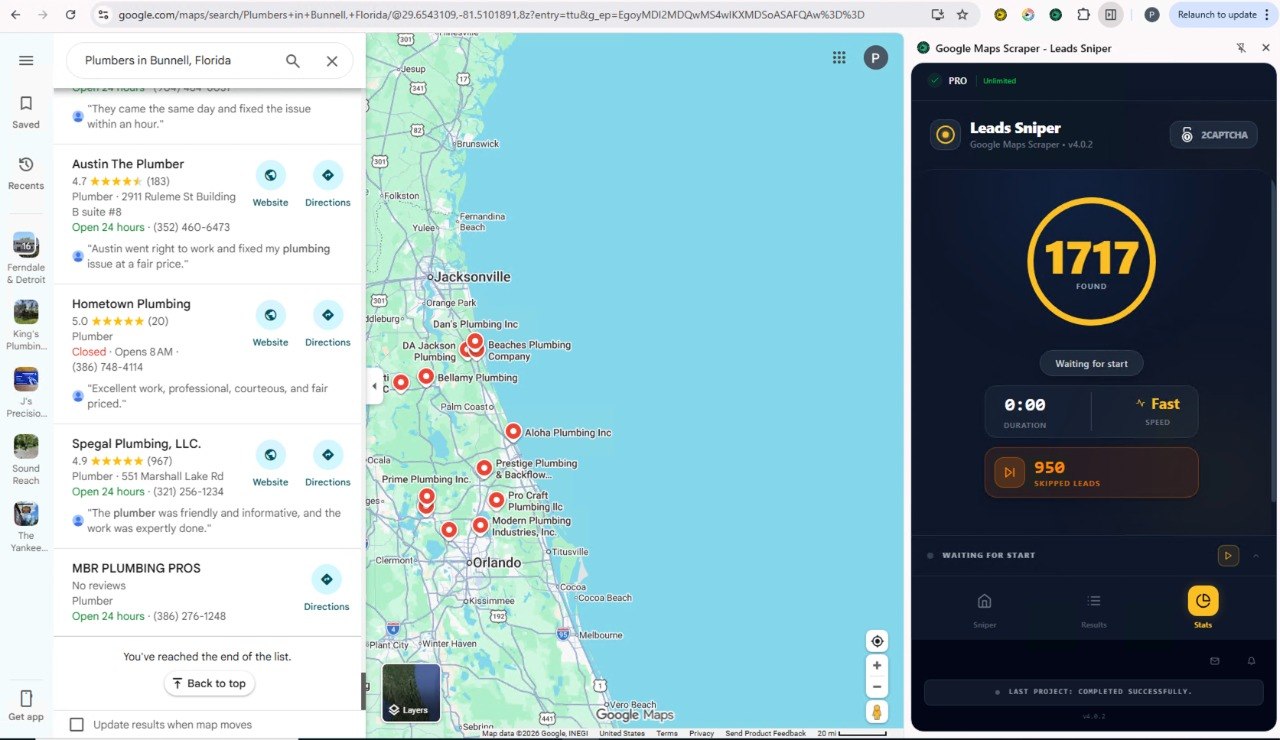
SaaS teams doing outbound prospecting, particularly those targeting SMBs, local businesses, or specific verticals, often struggle with two problems: list quality and list cost. Leads Sniper addresses both.
The platform allows users to filter searches by location, keyword, and business type, making it straightforward to build ICP-aligned prospect lists without relying on third-party data vendors charging per-contact fees. A one-time payment model means no ongoing subscription cost eating into CAC.
It's a practical fit for SaaS sales teams doing cold email campaigns, SDRs building outreach sequences, and founders prospecting their early customer base. You can get started with a free trial at leads-sniper.com.
Future Trends in SaaS Lead Generation
Three shifts are already underway. They'll define how pipeline gets built through 2027.
AI-Driven Prospecting and SDR Programs
Hybrid AI-SDR programs reduced cost-per-meeting from $312 in early 2025 to $94 in 2026, a 70% reduction. By Q4 2026, hybrid AI-human SDR programs are expected to become the median approach, not the vanguard. Cost-per-meeting is projected to fall further, to $61 by Q4 2027 (Digital Applied, 2026).
Intent Data as Standard Practice
Intent-data adoption among B2B SaaS companies sits at 31% in 2026, projected to reach 58% by Q4 2027. Today, intent-sourced leads close at 3.4x the rate of cold ICP-match leads. As adoption grows, that advantage will narrow, but teams that don't adopt intent data will find themselves at a structural disadvantage.
Conversational AI on Landing Pages
Forrester projects that 62% of B2B websites will deploy conversational AI lead capture by Q2 2027, up from just 14% in early 2026. Early data shows chat-driven lead capture lifts qualified meeting bookings by 38% on the same traffic. Static forms won't disappear immediately, but adaptive qualification is quickly becoming the higher-performing default.
Hyper-Personalization at Scale
Buyers tune out generic outreach. AI tools now enable SaaS teams to personalize messaging at the account, persona, and timing level, not just merge-tag personalization, but dynamic content that adapts based on firmographic and behavioral signals.
Signal-Based Lead Scoring
Rule-based scoring (points for job title + company size) is being replaced by signal stacks combining behavioral data, technographic signals, intent data, and predictive AI. Programs using a full signal stack achieve a 22.8% MQL-to-SQL rate, nearly 3.5x the no-scoring baseline.
Frequently Asked Questions
What is lead generation for SaaS?
Lead generation for SaaS is the process of identifying and attracting potential customers for a software-as-a-service product, then converting them into qualified prospects through inbound and outbound channels. It covers every activity from publishing content that drives organic traffic to running cold outreach sequences targeting specific accounts.
What are the best lead generation strategies for SaaS companies in 2026?
The highest-ROI SaaS lead generation strategies in 2026 are content marketing and SEO (best cost-per-opportunity at $860), customer referral programs (27.5% lead-to-opportunity conversion), account-based marketing (19.8% lead-to-opportunity conversion), and hybrid AI-SDR outbound programs (70% reduction in cost-per-meeting vs. traditional SDRs). The best approach combines inbound and outbound motions aligned to your ICP and sales cycle length.
How much does SaaS lead generation cost?
The median cost-per-lead for B2B SaaS is $237 in 2026, with top-quartile programs achieving $112 (Digital Applied, HubSpot State of Marketing 2026). Channel costs range from $84 (house email list) to $487 (ABM). Evaluate cost-per-opportunity, not cost-per-lead, to compare channels accurately. SEO produces the lowest cost-per-opportunity at $860; paid social produces the highest at $4,341.
What is the difference between inbound and outbound SaaS lead generation?
Inbound lead generation attracts buyers through content, SEO, and product-led motions, where buyers initiate contact. Outbound lead generation proactively reaches prospects through cold email, LinkedIn outreach, and SDR calls. Inbound has a lower long-term CPL and compounds over time; outbound produces results faster and works well for targeting specific accounts or verticals. Most effective SaaS teams run both.
What is a good MQL-to-SQL conversion rate for SaaS?
The median MQL-to-SQL rate in 2026 is 9.8%, down from 13% in 2024. Top-quartile SaaS programs achieve 16.4% by adding behavioral and third-party intent signals to MQL qualification criteria. If your rate is below 6%, prioritize lead scoring improvements over top-of-funnel volume.
What are the best tools for SaaS lead generation?
Effective SaaS lead generation typically combines a CRM (HubSpot or Salesforce), an email outreach platform (Apollo.io or Lemlist), a data provider (ZoomInfo or Leads Sniper), and an analytics platform (Google Analytics 4 or Clearbit). For teams building outbound prospect lists efficiently, Leads Sniper's Google Maps, Google Search, and domain email scraping tools are a cost-effective option with a free trial available.
How long does it take to see results from SaaS lead generation?
Paid advertising and cold outreach generate leads within days. Content marketing and SEO typically take 3-6 months to produce meaningful organic traffic. Full-funnel results, including closed-won revenue, depend heavily on sales cycle length. The median lead-to-closed-won timeline for SaaS deals under $50K is 192 days (Forrester, 2026).
What is intent data, and how does it improve SaaS lead generation?
Intent data identifies companies that are actively researching solutions in your category, before they fill out a form on your site. According to 6sense and Demandbase 2026 cohort analysis across 2,400 B2B accounts, intent-sourced leads convert to closed-won at 18.7% versus 5.5% for cold ICP-match leads. They also carry 23% higher average contract values because they enter the funnel with budget already approved.
How do I measure SaaS lead generation ROI?
Track cost-per-lead, cost-per-opportunity, and cost-per-acquired-customer by channel. Compare each channel's cost-per-opportunity rather than CPL alone, since cheap leads often convert poorly. Layer in pipeline value, LTV, and LTV:CAC ratio to assess whether your lead generation spend is generating sustainable growth. A healthy SaaS LTV:CAC ratio is 3:1 or higher.
What is product-led growth and how does it relate to SaaS lead generation?
Product-led growth (PLG) is a go-to-market strategy where the product itself drives acquisition, conversion, and expansion, typically through free trials or freemium tiers. 58% of B2B SaaS companies now operate some form of PLG motion (ProductLed benchmark). PLG reduces sales friction and generates product-qualified leads (PQLs), users who have already experienced value, which typically convert at higher rates than MQLs sourced through marketing channels alone.
Take Your SaaS Pipeline from Guesswork to System
The gap between SaaS companies that scale predictably and those that churn through tactics without results comes down to one thing: treating lead generation as a system, not a set of one-off campaigns.
The best-performing teams in 2026 aren't spending more on leads. They're spending smarter: tighter ICP targeting, intent-signal scoring, AI-assisted outreach, and multi-touch nurture sequences calibrated to real buying cycles. Every benchmark in this guide points to the same conclusion: quality beats volume at every stage of the funnel.
Start with your ICP. Build a sourcing process that finds verified, fit-matched contacts. Test one or two outbound channels with proper personalization. Nurture relentlessly. Score based on behavior, not job title.
If you need better prospect data to fuel your outbound motion, Leads Sniper gives you a practical, affordable way to extract targeted contact lists from Google Maps, Google Search, Yellow Pages, and domain sources, without a recurring subscription. Start your free trial at leads-sniper.com.