Google Maps has quietly become one of the most powerful business intelligence databases on the internet. In 2026, it hosts over 200 million business listings each packed with names, phone numbers, categories, reviews, and operating hours. For marketers, that's a goldmine.
It's no surprise that agencies, SaaS founders, and growth teams have turned to Google Maps scraping as a shortcut to local lead generation. Automated tools can extract thousands of business records in hours without paying for expensive data subscriptions.
But here's where the confusion starts: Is any of this actually legal?
The answer isn't a clean yes or no. It sits in a legally murky zone governed by platform policies, federal computer law, and evolving court precedents. This guide cuts through the noise explaining exactly where the legal lines are drawn, what risks you're actually taking, and what smarter alternatives exist.
This is not legal advice. Always consult a qualified attorney before making business decisions based on data extraction practices.
What Is Google Maps Scraping?
Web scraping is the automated extraction of data from websites using bots, scripts, or specialized software. When applied to Google Maps, it means programmatically pulling structured business data without using Google's official API.
A typical scraping workflow looks like this:
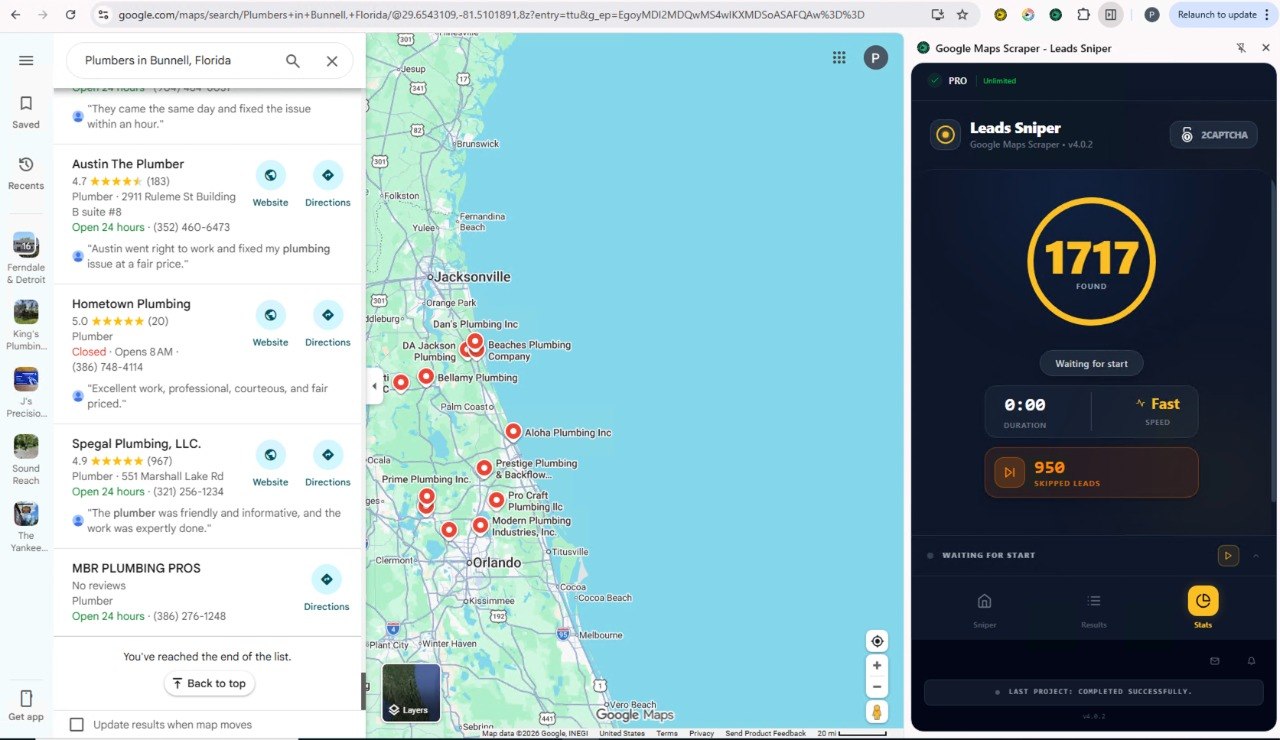
- A bot sends search queries to Google Maps (e.g., "plumbers in Houston")
- The tool parses the HTML or JavaScript-rendered page
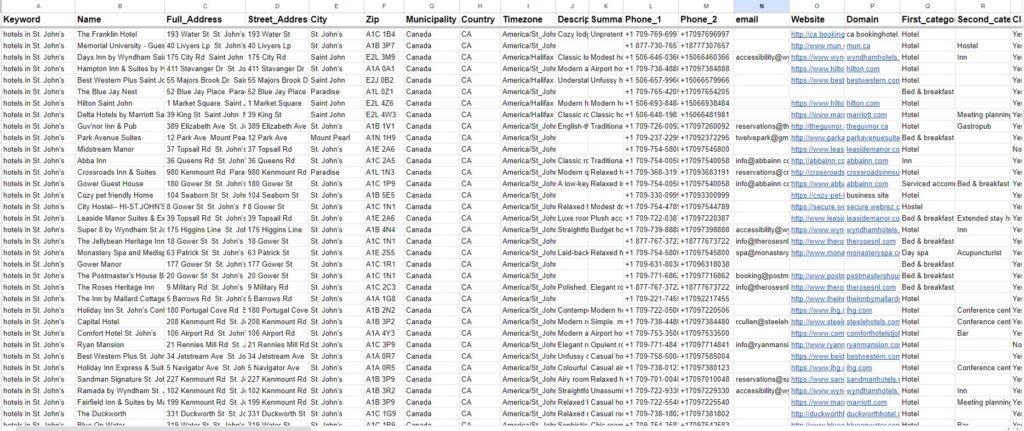
- Business names, phone numbers, addresses, website URLs, star ratings, and review counts are extracted
- Data is exported to a spreadsheet or fed into a CRM
Some advanced tools go further capturing business categories, hours of operation, photo counts, Q&A sections, and even individual review text. The result is a structured local business dataset built entirely without Google's permission or official access.
Key distinction: Scraping bypasses Google's official data access channels. The Google Places API is the sanctioned, paid method for accessing this data programmatically. Scraping attempts to replicate that access for free which is where legal complications arise.
Why Marketers Use Google Maps Data
The commercial demand for Google Maps data is enormous and understandable. Here's why so many professionals reach for scraping tools:
Local Lead Generation: Agencies and sales teams use Maps data to build hyper-targeted prospect lists by city, industry, and service type. Finding 500 dental practices in Chicago used to take days. A scraper can do it in minutes.
Agency Prospecting: SEO and digital marketing agencies identify businesses with weak online presence low review counts, missing websites, poor ratings and pitch their services directly. Maps data powers the entire prospecting workflow.
B2B Sales Automation: Sales development reps feed Maps data into outreach sequences, pairing business contact details with email automation tools to build semi-automated cold outreach pipelines.
SEO Outreach & Link Building: Local SEO specialists extract business data to find relevant link-building partners, citation opportunities, and directory submission targets within specific niches and geographies.
AI-Driven Lead Intelligence: In 2026, the most sophisticated teams combine Maps data with AI enrichment scoring leads by revenue signals, review velocity, and competitive positioning. The raw data is a starting point for deeper intelligence layers.
The use cases are legitimate. The method unauthorized automated extraction is where legal and operational risk enters the picture.
Is Google Maps Scraping Legal in the USA?
This is the question everyone asks, and the honest answer is: it depends. There is no single federal law that says "scraping is illegal" nor one that says it's fully permitted. The legality is determined by a combination of factors.
Public Data vs. Platform-Controlled Data
One key argument scrapers make is that Google Maps displays publicly available business information names, addresses, phone numbers that businesses have published themselves. In theory, publicly accessible information carries fewer legal protections than private data.
However, courts have consistently distinguished between data being public and access to a platform being unrestricted. Google controls the platform. Its servers, systems, and presentation of that data are proprietary regardless of whether the underlying business facts are publicly known.
Google's Terms of Service
Google's Terms of Service explicitly prohibit scraping. Section 5.3 of Google's general ToS states that users may not access Google services through automated means without explicit permission. The Google Maps Platform Terms of Service go further, restricting data extraction, redistribution, and commercial use outside the approved API.
Violating a platform's ToS is not automatically a criminal offense but it can constitute breach of contract, opening the door to civil litigation and account termination.
Contract Violation vs. Criminal Law
This is a critical distinction many scraping guides miss. Most ToS violations are civil matters Google could sue for damages. But they rarely rise to criminal conduct unless they involve intentional system access violations, which brings us to federal law.
Key US Laws That Affect Google Maps Scraping
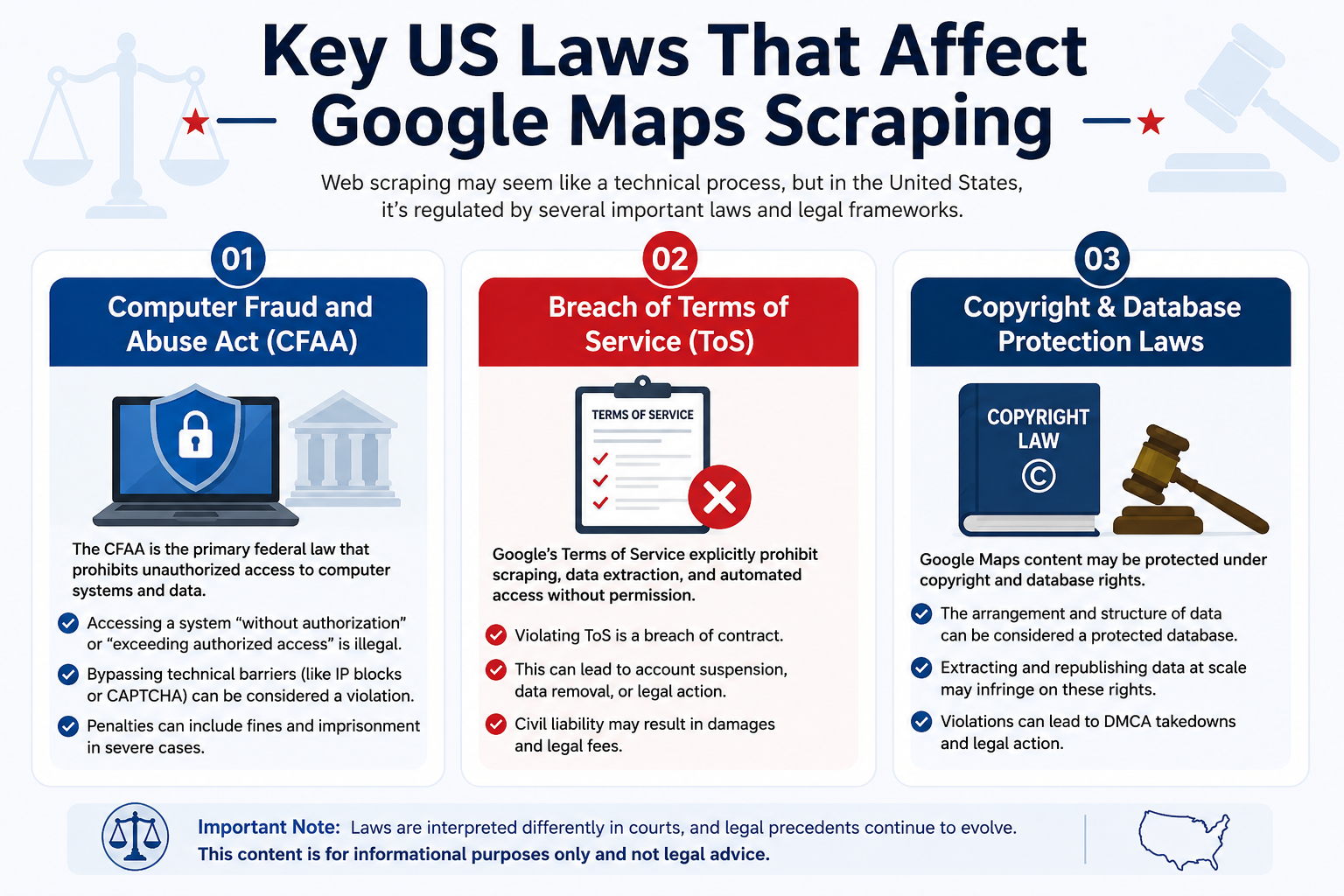
Three primary legal frameworks shape the risk landscape for anyone extracting data from Google Maps in the United States.
The Computer Fraud and Abuse Act (CFAA)
The CFAA enacted in 1986 and updated multiple times is the primary federal law governing unauthorized computer access. It makes it illegal to access a computer system "without authorization" or in a way that "exceeds authorized access."
For scraping, the key question is: does automated scraping constitute unauthorized access? Courts have debated this extensively. A landmark case, hiQ Labs v. LinkedIn, initially suggested that scraping publicly accessible data does not violate the CFAA. However, subsequent rulings have added nuance particularly where a platform has deployed technical restrictions (like CAPTCHAs or rate limiting) that the scraper deliberately bypasses.
The practical takeaway: bypassing Google's anti-bot systems significantly elevates CFAA exposure.
Breach of Contract (Terms of Service Violations)
When you use Google Maps even as an anonymous visitor you agree to Google's Terms of Service. Those terms prohibit automated data extraction. Violating them creates potential civil liability for breach of contract.
Google can pursue damages, seek injunctions, and has done so against large-scale scrapers. While individual scraping operations rarely face litigation, commercial operations that build products or services on scraped Google Maps data are at meaningful risk.
Anti-Bot Enforcement & Technical Countermeasures
Beyond formal law, Google actively deploys technical countermeasures IP blocking, CAPTCHAs, rate limiting, and fingerprinting. Scrapers that use proxy rotation, CAPTCHA-solving services, or browser emulation to circumvent these systems are taking deliberate steps to overcome access controls.
Courts have viewed such deliberate circumvention more severely under the CFAA than passive scraping of openly accessible data. It shifts the activity from a grey area toward clearer unauthorized access territory.
Important: This section is educational and does not constitute legal advice. Consult a qualified attorney before making compliance decisions.
When Google Maps Scraping Becomes Risky
Not all scraping carries equal risk. The legal exposure scales dramatically based on how, how much, and what you do with the data.
Large-Scale Automated Extraction: Scraping a handful of listings for personal research is unlikely to draw attention. Running a script that harvests hundreds of thousands of business records is a different matter. At scale, the impact on Google's servers becomes measurable and courts treat high-volume unauthorized access more seriously.
Bypassing Anti-Bot Protections: If your scraping tool rotates proxies, solves CAPTCHAs programmatically, or mimics human browser behavior specifically to defeat Google's access controls, you are taking deliberate steps to overcome technical barriers. This is the clearest path toward CFAA exposure.
Data Resale or Redistribution: Selling or licensing scraped Google Maps data to third parties dramatically increases legal risk. It potentially violates Google's intellectual property in the database compilation itself, and it creates commercial harm that Google's legal team is more likely to pursue.
Building Products on Scraped Data: Creating a SaaS product, directory, or lead database built primarily on scraped Google Maps data is one of the highest-risk activities. It commercializes the violation and creates an ongoing infringement rather than a one-time extraction.
Extracting Personal Data: While most Google Maps business data is organizational, some listings contain individual names and contact details. Automated extraction of personal data may implicate additional laws and privacy frameworks depending on the data subjects' locations.
Risk Summary: Scale + deliberate circumvention + commercial use = the highest risk profile. Small, one-off extractions for personal research occupy a different risk category than industrialized commercial scraping operations.
Safe & Legal Alternatives to Scraping Google Maps
The good news: the purpose behind Google Maps scraping finding qualified local business leads is completely achievable through compliant channels.
Google Places API: The official path. Google's Places API provides structured access to business data names, addresses, phone numbers, categories, ratings, and more with documented rate limits and pricing tiers. It's the legally sanctioned method for the same data extraction use case. Yes, it costs money. But it eliminates legal risk entirely and comes with reliable, clean data.
Licensed Data Providers: Several data providers have licensed agreements to distribute business directory data. These suppliers provide structured datasets with compliance documentation important for organizations that need to demonstrate data provenance in regulated industries or enterprise sales environments.
Intent-Based Lead Intelligence Platforms: Rather than raw directory data, intent-based platforms identify businesses actively searching for specific services. The leads are warmer, better qualified, and the data acquisition is fully compliant.
CRM + Data Enrichment Workflows: Start with compliant seed data and enrich it programmatically using enrichment APIs. This approach builds prospect lists with verified contact data without relying on unauthorized extraction.
AI-Powered Lead Generation: Platforms like Leads-Sniper represent a modern approach to this problem. Rather than raw data extraction, Leads-Sniper uses AI-powered workflows to deliver qualified, intent-aligned leads giving marketers the commercial outcome they need without the legal exposure that comes with unauthorized scraping.
Best Practices for Compliance
If your work involves any form of automated data collection from web platforms, these principles should guide your approach:
- Use official APIs first. Google provides the Places API for exactly this purpose. When an official access channel exists, use it the data quality is better and the legal standing is clear.
- Respect rate limits. Any automated system accessing external data should honor rate limits and avoid behavior that mimics denial-of-service patterns.
- Review terms of service before building. Before automating data collection from any platform, read the ToS. Pay attention to sections on automated access, data use, and redistribution rights.
- Avoid bypassing access controls. CAPTCHA-solving services, proxy rotation, and browser spoofing to overcome technical restrictions significantly increase legal exposure under the CFAA.
- Don't resell without licensing. Data redistribution requires explicit rights. Operating as a data provider using scraped content without licensing is high-risk territory.
- Focus on intent over volume. More leads isn't better. Higher-quality, intent-aligned leads convert better and require no questionable extraction methods.
- Keep records of data provenance. Know where your data comes from and be able to demonstrate compliance. This matters in enterprise sales and is increasingly important for data-driven businesses.
Final Verdict So Is It Legal?
Google Maps scraping exists in a legal grey zone in the USA but the risks are real, scalable, and increasingly enforced.
Scraping publicly visible data is not automatically criminal. Courts, including in the hiQ v. LinkedIn line of cases, have recognized nuance in how the CFAA applies to publicly accessible information. But "publicly visible" does not mean "freely extractable at scale without consequence."
Google's Terms of Service clearly prohibit automated scraping. Violating those terms creates civil liability. Deliberately circumventing anti-bot protections to enable that scraping adds potential federal law exposure. And commercializing the resulting data through resale, product development, or redistribution escalates the risk further.
The technical possibility of scraping and the legal permissibility of scraping are two entirely different questions. Most scraping tools work until they don't. The legal consequences, when they arrive, tend to be more serious than the technical barrier ever was.
For marketers, agencies, and SaaS founders who need local business data, the smarter question isn't "can I scrape this?" it's "what's the most efficient compliant path to the leads I need?" In 2026, that answer increasingly points toward AI-powered lead intelligence platforms, licensed data workflows, and intent-based prospecting rather than raw extraction.
Bottom line: If you're using Google Maps data at scale for commercial lead generation, the combination of ToS violations, potential CFAA exposure, and platform enforcement action creates a risk profile that most serious businesses should not accept. Compliant alternatives exist and increasingly outperform raw scraping on lead quality.
Frequently Asked Questions
Is Google Maps scraping illegal in the USA?
It's not categorically illegal, but it exists in significant legal grey territory. Scraping publicly visible data isn't automatically criminal, but it violates Google's Terms of Service and can constitute civil breach of contract.
At scale especially when anti-bot protections are deliberately bypassed it may also implicate the Computer Fraud and Abuse Act (CFAA). The risk level depends heavily on scale, method, and commercial use.
Can I get sued for scraping Google Maps?
Yes, Google can pursue civil action for ToS violations and unauthorized platform access. While Google rarely sues individual small-scale scrapers, it has taken legal action against operators running large-scale automated extraction particularly those building commercial products or services on scraped data. The risk grows with scale and commercial activity.
Does Google allow scraping in its Terms of Service?
No. Google's Terms of Service explicitly prohibit accessing Google services through automated means without explicit permission.
The Google Maps Platform Terms of Service additionally restrict data extraction, redistribution, and commercial use outside the official Places API. Scraping violates these terms.
What is the safest way to extract Google Maps data?
The Google Places API is the officially sanctioned, fully compliant method for programmatic access to Google Maps business data.
For lead generation workflows that go beyond raw data extraction, AI-powered platforms like Leads-Sniper offer compliance-friendly google maps scraper tool that deliver qualified leads without unauthorized scraping.
Is Google Maps data considered public information?
The business information displayed on Google Maps names, addresses, phone numbers is generally publicly visible and often originated from businesses themselves. However, "publicly visible" does not mean "freely extractable at scale." Courts distinguish between data being public and platform access being unrestricted.
Google's compilation and presentation of that data carries its own protections.
What happens if I violate Google's scraping policies?
Consequences range from technical (IP blocking, CAPTCHA enforcement, account suspension) to legal (civil action for breach of contract and potential CFAA claims for deliberate circumvention of access controls).
For commercial operations, Google can pursue injunctions and damages. At minimum, expect disruption to your data access and potential account bans across Google services.
Does the hiQ v. LinkedIn ruling mean scraping public data is legal?
Not entirely. The hiQ v. LinkedIn case established that scraping publicly accessible data may not automatically violate the CFAA a significant finding.
However, the ruling was specific to its facts, and it does not override Google's ToS rights, nor does it protect scrapers who deliberately bypass technical access controls. Courts continue to interpret this area of law.
Are there scraping tools specifically built for Google Maps?
Yes, numerous tools exist for this purpose. Their availability doesn't make using them legally safe many operate in direct violation of Google's ToS.
For compliant lead generation at scale, purpose-built platforms that use licensed data sources or official API access provide the same commercial outcome without the legal exposure.