
In today's data driven landscape, the ability to efficiently gather relevant information is paramount for business growth. Email extractors, powerful digital tools, play a crucial role in this process, particularly for lead generation and targeted marketing campaigns. However, the seemingly magical ability of these tools to unearth contact details from the vast expanse of the internet can often obscure the complex mechanics that power them.
This guide offers a comprehensive deep dive into how email extractors function, moving beyond surface level descriptions to explore the foundational technologies, intelligent algorithms, and practical applications that define their operation.
By understanding the intricate workings of web crawling, data acquisition, pattern recognition, and ethical considerations, you will gain a more profound appreciation for these tools. This knowledge empowers you to utilize email extractors more effectively, responsibly, and strategically, ultimately enhancing your lead generation efforts and optimizing your marketing campaigns.
What you will achieve by following this guide is a mastery of the principles behind email extraction, enabling you to select the right tools, implement best practices, and navigate the evolving technological and ethical landscape with confidence. No specific prerequisites are necessary to begin, only a curiosity to understand the digital prospecting process.
Introduction: Demystifying the Digital Prospector
The Information Capture and Data Extraction market is projected to reach $14.66 billion by 2025, exhibiting a CAGR of 13.5% over the forecast period Information Capture and Data Extraction Decade Long Trends, Analysis and Forecast 2026-2034. This significant growth underscores the increasing reliance on automated methods to gather data, with email addresses being a prime target for many businesses.
At their core, email extractors are sophisticated software applications designed to scan digital content, primarily websites and web pages, to identify and collect email addresses and other contact details. They act as digital prospectors, sifting through the vastness of the internet to find valuable leads for various business objectives, from B2B sales to email marketing initiatives.
What is an Email Extractor? A Foundational Understanding
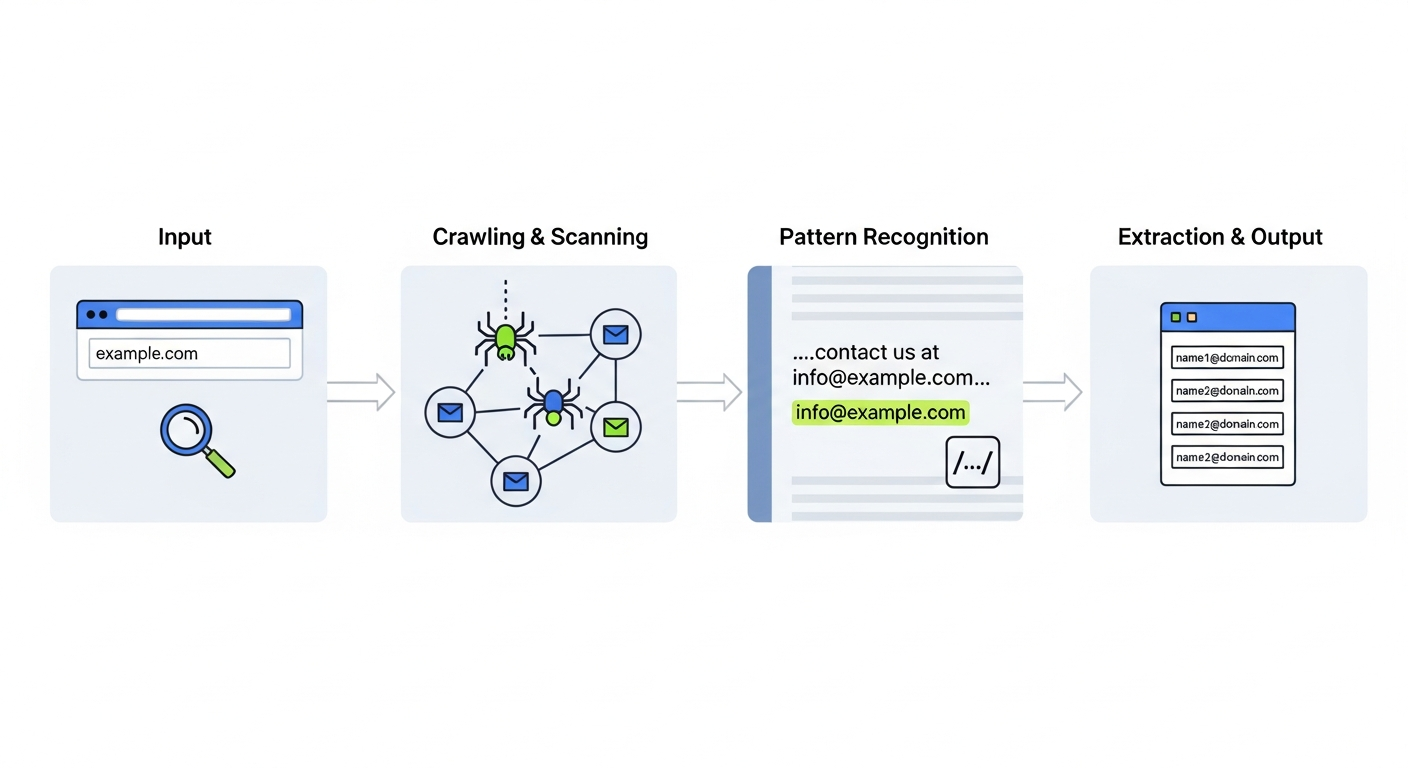
An email extractor is essentially a specialized web scraper. Its primary function is to automate the process of finding and collecting email addresses from online sources. Instead of manually browsing countless websites and blogs to locate contact information, an email extractor can systematically crawl through specified URLs, analyze the content of web pages, and identify patterns that signify an email address.
This extraction tool automates a tedious and time consuming manual task, making it an indispensable asset for businesses focused on lead generation and customer outreach. These tools range from simple browser extensions to complex, enterprise-level software solutions.
Why a Deep Dive? Understanding the Mechanics Behind the Magic
While the output of an email extractor—a clean list of email addresses—might appear straightforward, the underlying processes are complex. A deep dive into these mechanics is crucial for several reasons. Firstly, understanding how these tools work allows for more effective and targeted usage. Knowing the limitations and capabilities of different extraction methods helps users refine their search parameters and increase the quality of the data obtained.
Secondly, it illuminates the critical importance of data cleaning and verification, as raw extracted data is often incomplete or inaccurate. Finally, a thorough understanding is vital for navigating the legal and ethical considerations surrounding data privacy, such as GDPR, ensuring compliance and avoiding substantial penalties. For instance, in 2025, $2.3 billion in GDPR fines were issued across Europe, up 38% year over year. 202highlighting the critical need for responsible data handling.
Scope of This Article: Beyond the Surface Level
This article will move beyond a basic definition of email extractors to provide an in depth exploration of their functionality. We will dissect the foundational principles of web crawling and data acquisition, delve into the core intelligence of email detection and pattern matching, and examine the essential processes of data structuring, cleaning, and exporting.
Furthermore, we will explore the evolving role of Artificial Intelligence (AI) and Machine Learning (ML) in enhancing extraction capabilities, categorize different types of email extractors and their operational models, and critically address the ethical considerations and best practices essential for responsible use. By the end of this guide, you will possess a comprehensive understanding of what email extractors are, how they operate, and how to leverage them effectively and ethically.
The Core Intelligence: Email Detection and Pattern Matching
.jpg)
Identifying a valid email address amidst a sea of text requires more than just recognizing the "@" symbol. Email extractors employ sophisticated logic and pattern matching techniques to accurately detect and validate email addresses.
Regular Expressions (Regex): The Precision Tool for Email Patterns
Regular expressions, often shortened to regex, are a fundamental tool in an email extractor's arsenal. Regex is a sequence of characters that defines a search pattern. For email extraction, specific regex patterns are crafted to match the standard structure of an email address. A common, albeit simplified, regex pattern might look for characters followed by an "@" symbol, followed by more characters, and then a domain extension (like ".com" or ".org").
However, the RFC 5322 standard for email addresses is complex, and robust regex patterns must account for various valid characters, subdomains, and internationalized domain names. While powerful, regex alone can sometimes misidentify strings that resemble emails but are not, leading to noise in the extracted data.
Context Aware Parsing: Differentiating Valid Emails from Noise
To overcome the limitations of simple pattern matching, sophisticated email extractors utilize context aware parsing. This involves analyzing the surrounding text and the structure of the web page to determine if a detected string is genuinely an email address intended for contact, rather than a stray string that merely matches the pattern.
For example, an extractor might look for common labels like "Email:", "Contact Us:", or specific HTML tags that typically contain contact information. It can also employ heuristics to assess the legitimacy of a domain name or identify role based addresses (e.g., info@, support@) versus personal ones, refining the accuracy of the collected email addresses.
Advanced Detection Techniques: Beyond Simple String Matching
Beyond regex and context analysis, some email extraction tools employ advanced techniques to improve detection accuracy and efficiency. This can include:
- Heuristic Analysis: Using rules of thumb and probabilistic methods to identify potential email addresses based on common usage patterns and anomalies.
- Machine Learning Models: Training algorithms on large datasets of both valid and invalid email strings to recognize complex patterns that are difficult to define with fixed rules. These models can learn to distinguish subtle differences that indicate a legitimate address.
- Obfuscation Detection: Identifying and de obfuscating email addresses that have been intentionally disguised to prevent simple scraping (e.g., using JavaScript to piece together an address, or replacing characters with HTML entities).
Identifying and Avoiding Spam Traps: A Critical Challenge
A significant challenge in email extraction is the identification and avoidance of "spam traps" or "honeypots." These are email addresses intentionally set up by anti spam organizations or Internet Service Providers (ISPs) to lure spammers. When an email extractor collects addresses from compromised or blacklisted sources, it risks adding these trap addresses to its list.
Sending emails to these addresses can severely damage sender reputation, leading to emails being marked as spam and reduced deliverability for legitimate marketing campaigns. Advanced extraction tools incorporate mechanisms to identify potential spam traps by cross referencing against known lists or analyzing address characteristics that are common among traps.
From Raw Data to Usable Information: Structuring, Cleaning, and Exporting

Once an email extractor has identified potential email addresses, the process is far from complete. The raw data must be meticulously cleaned, structured, and prepared for actionable use. This stage is crucial for ensuring the quality and utility of the extracted contact details.
Data Cleaning and Deduplication: Ensuring Quality and Uniqueness
The output of an email extractor often contains duplicates, malformed entries, or irrelevant information. Data cleaning is the process of identifying and correcting or removing these inaccuracies. This includes standardizing formats (e.g., ensuring all email addresses use lowercase), removing extra spaces, and correcting any character errors.
Deduplication is a critical aspect of cleaning, ensuring that each unique contact detail appears only once in the final list. This can be achieved through exact matching (identifying identical entries) or fuzzy matching techniques that can detect similar but not identical entries, preventing redundant contacts and streamlining subsequent marketing campaigns.
Data Structuring: Organizing Extracted Information for Action
Raw extracted data is rarely organized in a way that is immediately useful for business purposes. Data structuring involves organizing the collected information into a logical format. This might include grouping emails by website source, by domain, by the type of contact (e.g., individual vs. company wide), or by any other relevant categorization.
This organized data forms the foundation for targeted lead generation and segmented email marketing campaigns. For example, a sales team might want to focus on emails from specific industries or companies, requiring data to be structured accordingly.
Export Formats and Integrations: Preparing Data for Workflow
To be practically useful, extracted and cleaned data must be exportable in formats compatible with existing business workflows and software. The most common export format is Comma Separated Values (CSV), which can be easily opened and manipulated in spreadsheet software like Microsoft Excel.
Other formats include JSON, XML, or direct integrations with Customer Relationship Management (CRM) systems or other marketing automation platforms. This seamless integration allows businesses to quickly incorporate new leads into their sales pipelines or email marketing lists, enabling rapid follow up and campaign deployment.
Email Verification: A Crucial Post Extraction Step
Even after rigorous cleaning and structuring, not all extracted email addresses are guaranteed to be valid or active. Email verification is a critical post-extraction step that confirms the deliverability of each email address. This process typically involves checking the validity of the domain's Mail Exchanger (MX) records, which direct email traffic, and then performing a simulated SMTP (Simple Mail Transfer Protocol) transaction to verify that the address exists on the server without actually sending an email.
Verified email addresses ensure higher deliverability rates for marketing campaigns, reduce bounce rates, protect sender reputation, and ultimately improve the ROI of email marketing, which has an impressive 3600% ROI Demand Sage, 2026.
The Evolution of Email Extraction: The Role of AI and Machine Learning

The field of email extraction is rapidly evolving, driven by advancements in Artificial Intelligence (AI) and Machine Learning (ML). These technologies are moving beyond traditional rule-based methods to offer more intelligent, accurate, and efficient solutions. Almost 90% of marketers expect that over three-quarters of their email marketing operations will be AI-supported by the end of 2026 Cognism, 2025.
How AI Enhances Accuracy and Efficiency in Extraction
AI algorithms can analyze vast datasets to identify complex patterns in email addresses and their surrounding context that traditional methods might miss. Machine learning models can be trained to recognize subtle nuances that indicate a legitimate email address, even if it's presented in an unusual format or on a poorly structured web page.
This leads to higher accuracy in detection and fewer false positives. Furthermore, AI can process information much faster than manual methods or even rule-based scripts, significantly speeding up the extraction process and allowing for the analysis of larger volumes of data. This enhanced efficiency is critical in competitive markets where timely lead acquisition is key.
Predictive Email Generation and Intelligent Formatting
AI is also transforming the post-extraction process. Advanced AI models can predict potential email addresses based on common naming conventions within an organization and available contact details like phone numbers or names. This predictive capability can help fill gaps in extracted data.
Additionally, AI can intelligently format extracted information, standardizing it consistently and even suggesting categorization or segmentation based on the content and context of the source, further streamlining the preparation of contact lists for marketing campaigns. AI-driven email personalization, for example, delivers a 41% revenue increase VerifiedEmail, 2026.
The Future Landscape: AI-Driven Insights and Automation
The future of email extraction is intrinsically linked to AI. We can expect AI-powered tools to become even more sophisticated in identifying not just email addresses but also valuable insights about prospects. This could include analyzing website content for buying intent, identifying key decision-makers, or even predicting the best time to contact an individual.
Full automation, from initial crawling to data cleaning, verification, enrichment, and even initial outreach segmentation, will become increasingly common. This will allow businesses to focus their efforts on high-value activities like relationship building and closing deals, rather than on the laborious task of data acquisition and management.
Types of Email Extractors and Their Operational Models
Browser Extensions: Ease of Use and On-Demand Extraction
Browser extensions, such as those available for Google Chrome, are typically the most accessible and user-friendly email extractors. They are installed directly within the web browser and can be activated on demand as a user browses the web.
These extensions are excellent for individual users or small teams who need to extract email addresses from specific web pages or smaller sets of URLs. Their primary advantage is convenience and the ability to extract contextually as you discover leads. However, they often have limitations in terms of scalability, speed, and the complexity of websites they can effectively scrape compared to more robust solutions.
Desktop Software: Robustness and Offline Processing Capabilities
Desktop email extractor software is installed on a user's computer and generally offers more power and flexibility than browser extensions. These applications can often handle larger-scale extraction tasks, process data offline, and provide more advanced filtering and configuration options.
They are suitable for users who require more control over the extraction process, need to process significant volumes of data, or operate in environments with intermittent internet connectivity. However, they require installation and can consume system resources, potentially impacting computer performance during intensive extraction tasks.
Cloud-Based APIs: Scalability, Automation, and Integration
Cloud-based email extraction tools, often accessed via APIs, represent the most scalable and automated solutions. These services run on remote servers, allowing them to process vast amounts of data concurrently without taxing local hardware. APIs enable seamless integration with other business systems, such as CRMs, marketing automation platforms, and data enrichment services.
This model is ideal for enterprises and businesses that require high-volume data acquisition, automated workflows, and deep integration into their existing technological infrastructure. While offering maximum scalability, they often come with subscription costs and require a degree of technical expertise for implementation.
Specialized Extractors: Tailoring for Specific Platforms and Data Sources
Beyond general-purpose email extractors, there are specialized tools designed for specific platforms or data types. These might be tailored to extract data from LinkedIn, specific e-commerce sites, or particular industry directories. Such extractors often have a deeper understanding of the target platform's structure and are optimized to navigate its unique challenges.
While highly effective for their intended purpose, they may lack the versatility of general-purpose tools and are typically used when targeting a very specific niche or data source.
The Power of Leads Sniper Google Maps Scraper
The Leads Sniper Google Maps Scraper is a game-changer for businesses and marketers alike. It allows you to search for businesses globally and extract a wealth of information quickly and efficiently. With the ability to gather data such as email addresses, phone numbers, and even YouTube URLs, this tool is essential for anyone serious about lead generation.
For example, let’s say you’re looking for roofers in Canada. Instead of spending weeks collecting data manually, you can use the Leads Sniper tool to extract thousands of relevant contacts in just minutes. This efficiency is a key feature of how an email extractor works—automating the process to save you time and effort.
How It Works
Using the Leads Sniper Google Maps Scraper is straightforward. You start by entering a specific keyword related to your target niche. In our example, that would be "roofers" in Canada. The tool then searches Google Maps to pull business leads based on your criteria.
Upon initiating the search, you can run multiple queries simultaneously, which maximizes your results. The tool quickly compiles the data and presents it in an easy-to-export format, such as CSV. This means you can have your leads organized neatly in Google Sheets, ready for your outreach campaigns.

Features of Leads Sniper
- Time-Saving: What once took a team of 30 staff nearly a week can now be accomplished in mere minutes.
- Unlimited Leads: With a one-time payment, you gain access to unlimited leads, making it a cost-effective solution.
- Fresh Data: The tool provides updated data directly from Google Maps, ensuring that the information you collect is current.
Benefits of Using an Email Extractor
So, why should you consider using an email extractor like Leads Sniper? Here are some compelling reasons:
- Efficiency: Automating the extraction process saves you countless hours that can be better spent on other business activities.
- Quality Leads: The tool pulls fresh, laser-targeted leads, ensuring you are reaching out to potential clients who are likely to engage with your offerings.
- Comprehensive Data: In addition to email addresses, you can also extract phone numbers, social media profiles, and more, giving you a well-rounded view of your prospects.

Ethical Considerations and Best Practices in Email Extraction
The power of email extractors comes with significant ethical responsibilities. Harvesting email addresses without regard for privacy or consent can lead to legal repercussions, damage sender reputation, and erode customer trust. Adhering to ethical guidelines and best practices is not just a matter of compliance but a cornerstone of sustainable business operations.
Data Privacy Laws: GDPR and Beyond
Global data privacy regulations, most notably the General Data Protection Regulation (GDPR) in Europe, place strict rules on the collection and processing of personal data, including email addresses. These regulations often require explicit consent for data collection and marketing communications.
Other regulations like the California Consumer Privacy Act (CCPA) also mandate transparency and control for consumers over their data. Businesses using email extractors must understand the specific requirements of these laws in the regions they operate and for the individuals whose data they collect. Failing to comply can result in severe penalties, as evidenced by the $2.3 billion in GDPR fines issued across Europe in 2025, a 38% year-over-year increase Partisia, 2025.
Responsible Extraction: Consent, Transparency, and Data Minimization
Responsible email extraction involves a commitment to ethical data handling. This means prioritizing obtaining consent before adding individuals to marketing lists, even if their email was found publicly.
Transparency is key; individuals should be aware that their data might be collected and how it will be used. Data minimization, collecting only the necessary information, is also a vital principle. Instead of mass harvesting, focus on collecting data that is relevant and will be used for specific, legitimate purposes.
Building Compliant Lists: Opt-in vs. Opt-out
When building contact lists, the distinction between opt-in and opt-out is critical. Opt-in models require individuals to actively agree to receive communications (e.g., by ticking a box on a form), which is generally considered the gold standard for compliance.
Opt-out models, where individuals are included by default and must actively unsubscribe, are often insufficient under strict privacy regulations. Email extractors can assist in gathering leads, but the subsequent process of obtaining consent and managing preferences must be handled meticulously through compliant opt-in mechanisms.
Avoiding Spamming: Content Quality, Segmentation, and Sender Reputation
Even with a compliant list, the act of sending unsolicited or irrelevant emails constitutes spamming. This can severely damage sender reputation, leading to emails being filtered into spam folders or even causing email accounts to be blocked. To avoid this, extracted email data should be segmented based on inferred interests or demographics, allowing for personalized and relevant marketing campaigns.
Providing valuable content, maintaining high sender reputation scores, and making unsubscribe options clear and easy to use are all essential components of responsible email marketing, maximizing the positive impact of lead generation efforts that email extractors support.
Practical Applications
The applications for an email extractor are vast. Whether you're in sales, marketing, or any field that requires outreach, this tool can enhance your strategy:
- Cold Emailing: Use the collected emails to reach out to potential clients directly.
- Lead Generation: Build targeted lists based on specific criteria to improve your marketing efforts.
- Market Research: Gather data to better understand your target audience and their needs.
Conclusion
Understanding how an email extractor works is essential for anyone looking to enhance their marketing efforts and streamline lead generation. The Leads Sniper Google Maps Scraper not only simplifies this process but also provides a wealth of information that can significantly impact your outreach success. Why spend weeks gathering data when you can start your free trial today and explore the benefits for yourself?
Ready to take your lead generation to the next level? Start your Leads Sniper FREE Trial today and unlock the potential of automated email extraction!