
Have you ever stared at a massive spreadsheet of 10,000 local businesses and thought, “What do I even do with this?” I remember downloading my first massive batch of raw local data years ago. It was overwhelming, stale within a week, and frankly, a bit of a nightmare to sort through!
Today, that old playbook is completely dead. We are no longer just scraping data; we are extracting rich, actionable, and intent-driven intelligence! In 2026, the landscape of Google Maps Lead Generation has fundamentally shifted. With the integration of advanced large language models (LLMs) and AI agents, we are moving from basic data extraction to highly sophisticated AI-powered prospecting.
If you want to outpace your competition this year, you need to understand exactly how AI is changing the game. Let’s dive into the fascinating world of AI Business Data Collection and explore how you can turn a simple map into your most powerful revenue engine!
The AI Revolution in Local SEO Data Mining (By the Numbers)
To truly grasp how AI is changing Google Maps scraping, we have to look at the staggering scale of the ecosystem we are dealing with. Google Maps isn't just a navigation app; it's the largest, most dynamic B2B database on the planet!
Consider these incredible statistics that highlight why Local Business Data Scraping is so vital in 2026:
- Google Maps now boasts more than 2 billion monthly active users.1
- An astounding 46 percent of all Google searches carry local intent, and 76 percent of those searches result in a store visit within 24 hours!2
- To power its new AI features, Google Maps analyzes information from over 300 million places and processes reviews from more than 500 million contributors.3
With this volume of data, manually filtering through businesses is impossible. That’s why traditional Google Maps scraping is changing. You can no longer rely on simple scripts that pull business names and phone numbers. You need AI to filter the noise and find the gold!
Google’s AI Transformation: The New Local Search Ecosystem
The biggest catalyst for change in our industry is Google itself. In March 2026, Google officially rolled out "Ask Maps," a revolutionary conversational local search feature powered by their Gemini AI model.3 Currently rolling out in the U.S. and India on Android and iOS—with desktop access coming soon—Ask Maps allows users to ask highly complex, real-world questions like, "Where can I find a cozy vegan restaurant with a table for 4 tonight?"3
This Gemini integration in Google Maps introduces AI-generated business summaries and conversational local search, which completely alters the local search ecosystem.
Here is how these updates change the game for us:
- Local Search Visibility: Businesses no longer rank just for keywords. They surface based on conversational context and AI-driven discovery experiences.
- Lead Discovery: As a growth marketer, you can now scrape the AI-generated summaries Google creates to instantly understand a business’s core strengths and operational focus.
- Prospecting Workflows: Instead of manually reading a Google Business Profile, your AI Google Maps Scraper can pull Google's own AI categorizations to qualify leads instantly!
The 2026 Lead Intelligence Pyramid
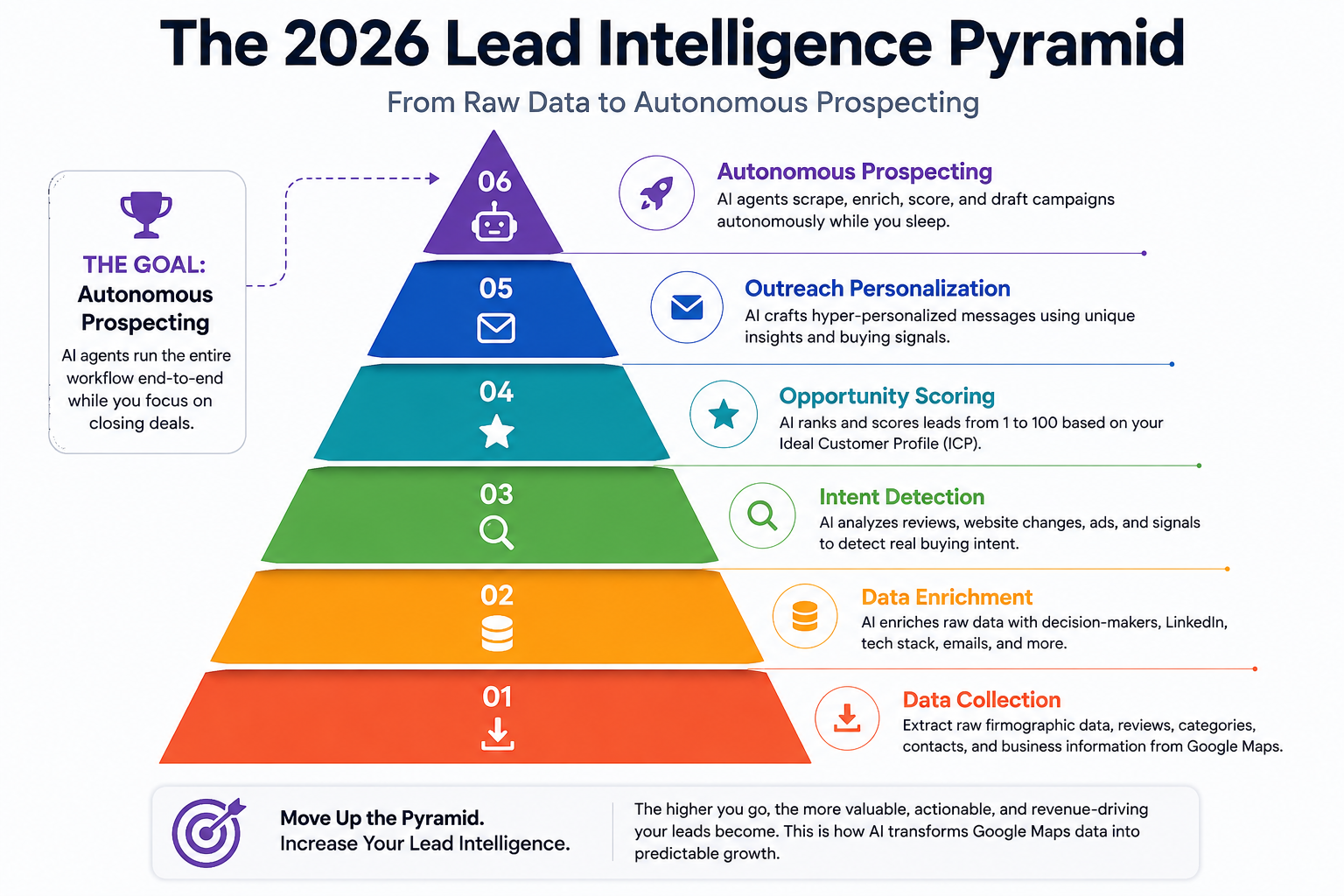
When I talk to SaaS founders and cold email agencies, I always introduce them to a specific framework I developed to explain this massive shift. I call it The 2026 Lead Intelligence Pyramid.
If you want to master AI Lead Generation Tools, you must understand how to move up these six distinct layers:
- Data Collection: This is the foundational layer. It involves extracting the raw firmographic data (names, addresses, phone numbers, website URLs, and raw reviews) from Google Maps.
- Data Enrichment: Raw data isn't enough! In this layer, we cross-reference the extracted URLs with LinkedIn, local registries, and tech-stack analyzers to build a complete profile of the business and its decision-makers.
- Intent Detection: This is where AI truly shines! We use LLMs to analyze recent reviews, website changes, or ad spend to detect if a company is actively experiencing a problem you can solve.
- Opportunity Scoring: Not all leads are created equal. The AI ranks the enriched, high-intent prospects from 1 to 100 based on your exact Ideal Customer Profile (ICP).
- Outreach Personalization: We take the specific insights gathered (like a recent negative review about pricing) and use AI to draft hyper-personalized, highly relevant outreach emails.
- Autonomous Prospecting: The pinnacle of the pyramid! At this stage, AI agents run the entire workflow end-to-end without human intervention. They scrape, enrich, score, and draft campaigns while you sleep!
This framework is the clearest way to understand the shift from simple data scraping to true Google Maps Lead Intelligence!
The Competitive Landscape: AI vs. Traditional Lead Databases
I often get asked, “Why scrape Maps when I can just buy a list from ZoomInfo or Apollo?” That is a great question! Traditional B2B databases are wonderful for enterprise software sales, but they are notoriously weak when it comes to local, main-street businesses.
Let's look at a direct comparison:
Strategic Implications:
If you are an agency selling local SEO or a SaaS company selling to plumbers, Apollo and ZoomInfo won't give you the operational insights you need. Traditional Maps scrapers give you a list, but zero context. AI-Powered Maps Intelligence gives you high-quality data, detects why they need you based on real-time customer feedback, and provides the exact angle you need for high personalization. It’s a complete game-changer!
AI Review Mining: The Ultimate Competitive Advantage
This is my absolute favorite part of the modern workflow! If you take nothing else away from this article, remember this: Google Reviews are the most underutilized source of B2B intent data on the internet.
Instead of just looking at star ratings, we use AI Review Mining. By passing thousands of reviews into an LLM, AI can extract incredible, hidden insights.
Here is what AI Review Mining can automatically extract:
- Customer complaints: Discover exactly what a business's customers are unhappy about.
- Pricing concerns: Identify businesses where customers feel they are being overcharged.
- Staffing issues: Spot reviews mentioning "understaffed" or "rude employees" to pitch HR or hiring software!
- Reputation drops: Automatically flag businesses whose average rating plummeted in the last 30 days.
- Service gaps: Find out what services a business is missing that competitors offer.
- Competitor mentions: See how often customers compare a business to the guy down the street.
This structural advantage makes Google Maps data vastly superior to generic lead databases. You aren't just pitching a service; you are offering a targeted solution to a public, documented problem!
AI Agents and Autonomous Prospecting
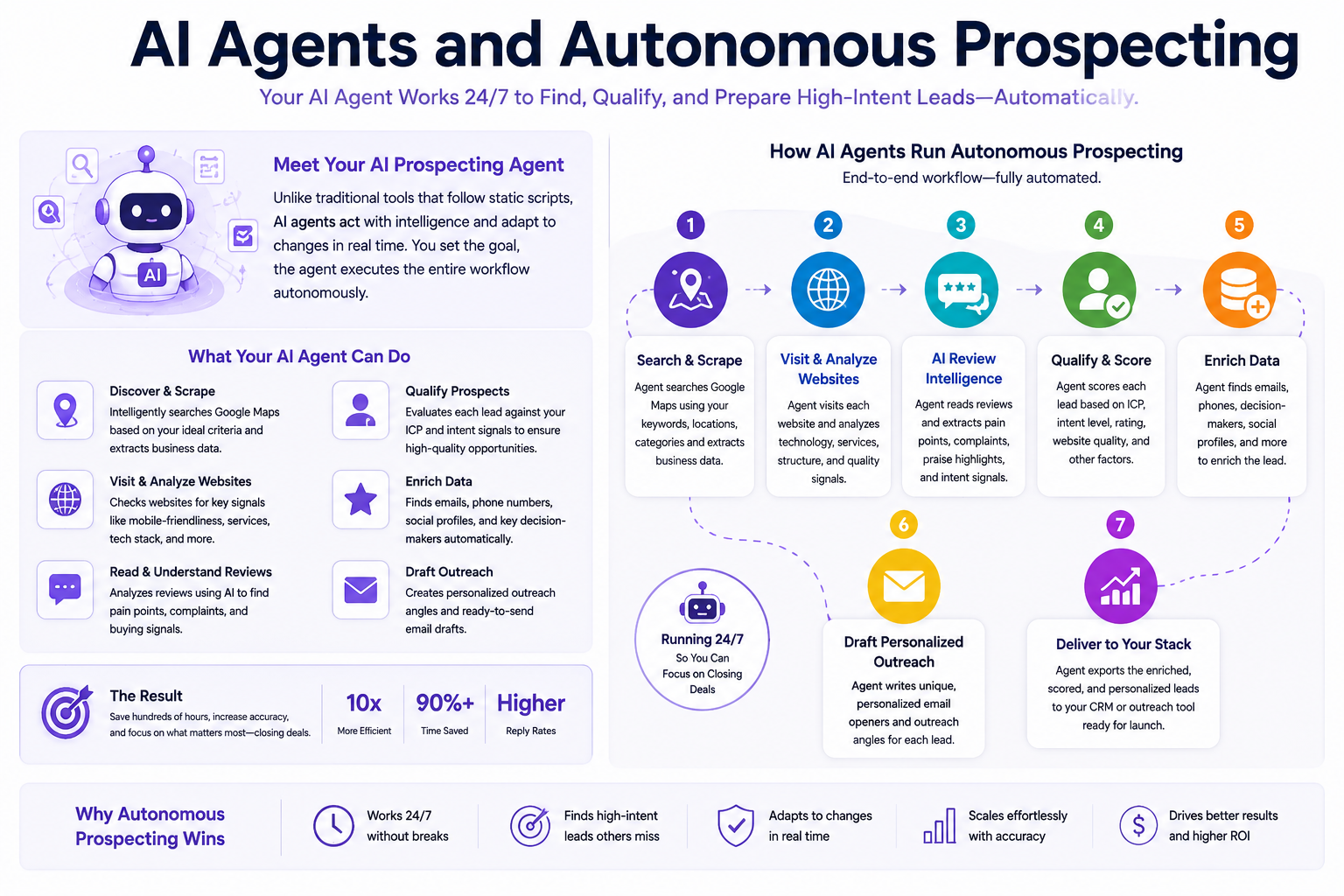
Are you ready to meet your new best employee? AI agents are rapidly replacing manual scraping processes.
An AI agent doesn't just follow a static script; it acts with agency. You can give an agent a prompt like, "Find me 200 HVAC companies in Texas that have terrible mobile websites and recent bad reviews about slow response times."
The agent will autonomously navigate the map, scrape the businesses, visit their websites to check for mobile responsiveness, read their reviews, qualify the prospects, and format the data perfectly for your CRM. 2026 is the year of Google Maps Automation, and businesses that embrace agentic workflows will operate with the efficiency of a team ten times their size!
The New Google Maps Lead Generation Stack
To make this actionable, here is the exact step-by-step workflow you should implement today.
Step 1: Scrape Google Maps data
Deploy an intelligent scraper to pull foundational data, ensuring you capture business names, contact info, and, crucially, the raw text of their reviews.
Step 2: Enrich business information
Pass the URLs to an AI enrichment tool to find the owner's LinkedIn profile, verify the email address, and check their current tech stack.
Step 3: Analyze reviews with AI
Do not skip this! Run the raw reviews through an LLM (like Gemini or ChatGPT) using the AI Review Mining techniques we discussed to extract pain points.
Step 4: Score leads automatically
Let the AI score the leads based on your ICP. A business with a 3.2 rating and no website should score a 99 for a web design agency!
Step 5: Generate personalized outreach angles
Prompt the AI to write an opening line based on the extracted data. For example: "I noticed a few recent reviews mentioned your front desk misses calls on weekends..."
Step 6: Launch campaigns
Push your highly enriched, perfectly scored, and uniquely personalized list into your sending tool and watch your reply rates skyrocket!
Turning Google Maps Data Into Actionable Leads
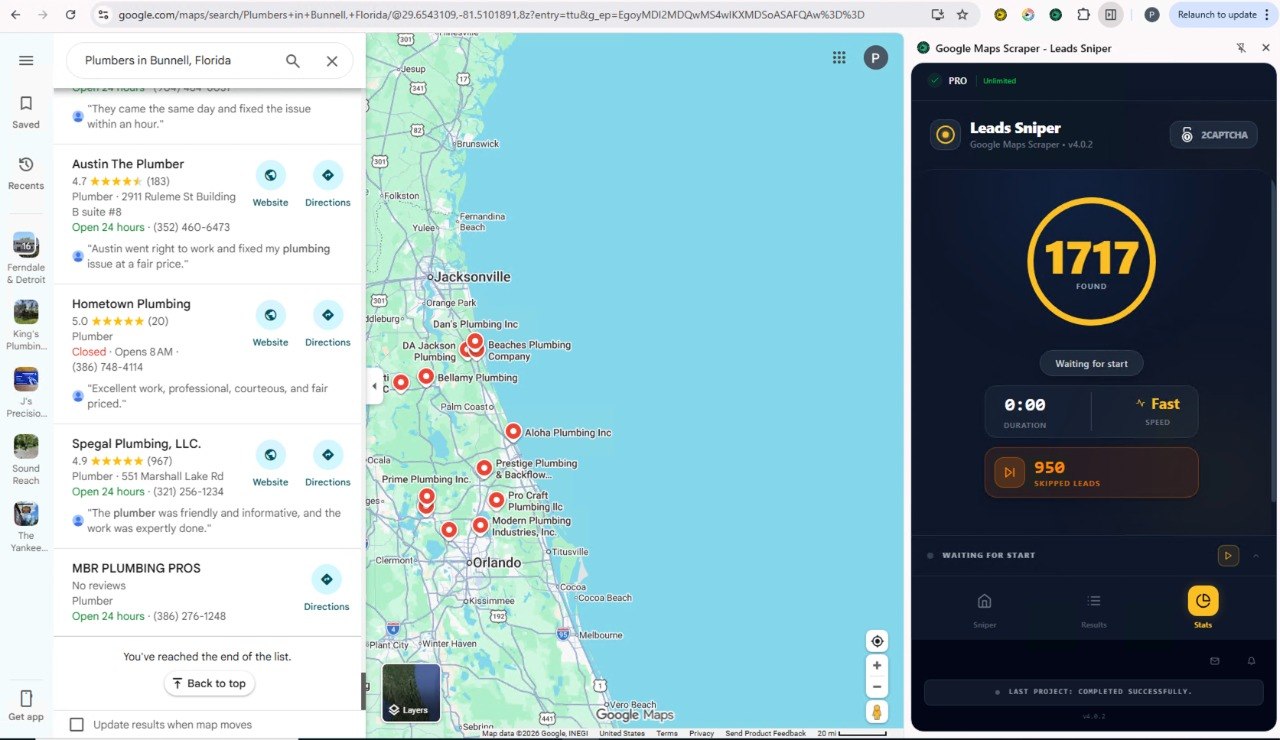
As we've discussed, simply holding a massive list of raw data is useless. You have to turn it into actionable intelligence. This is where using the right foundation makes all the difference.
A fantastic example of a modern solution built for this era is Leads Sniper google maps scraper. Leads Sniper provides incredible workflow value by enabling targeted business extraction and local lead discovery without the headache of proxies and IP bans. It gives you clean, scalable business data exports so you can focus on the intelligent parts of the workflow!
Let’s look at two mini scenarios of how this works in practice:
- Scenario 1: A local SEO agency uses Leads Sniper to extract all dentists in Miami. Instead of cold-calling them blindly, they pass the extracted reviews into an AI workflow. The AI identifies 45 clinics with declining ratings over the last six months and a poor review response rate. The agency then reaches out with a highly specific pitch: "I saw your rating dipped recently because of unreturned calls; we can help automate your review responses and recover your reputation."
- Scenario 2: A B2B sales team selling a virtual receptionist SaaS extracts home service businesses (plumbers, electricians). They use AI Review Mining to flag any business with recurring complaints about missed calls, slow follow-up, or rude dispatchers. The sales team now has a hyper-qualified list of prospects experiencing the exact pain point their software solves!
The Future of AI-Driven Prospecting
The future of AI-driven prospecting is incredibly exciting! As Google continues to roll out Gemini-powered features, the map will become even more conversational. AI-Powered Prospecting tools will become standard, and manual list building will be viewed the same way we view a rotary phone today.
Agencies and B2B marketers who integrate AI to analyze local market dynamics, interpret conversational search data, and deploy autonomous agents will dominate their local markets.
Key Takeaways
- Move up the pyramid! Shift your focus from simple Data Collection to Opportunity Scoring and Autonomous Prospecting.
- Reviews are a goldmine! Use AI Review Mining to extract customer complaints and competitor mentions to craft irresistible sales pitches.
- Context beats volume! AI-powered maps intelligence offers far better intent detection than traditional databases like Apollo or ZoomInfo for local businesses.
- Google is evolving! With the rollout of Ask Maps and Gemini, local search is becoming conversational, changing how businesses are discovered.
- Actionable tools win! Use modern tools like Leads Sniper for targeted business extraction so you can focus on AI enrichment and personalized outreach.
FAQ
1. What is an AI Google Maps Scraper?
An AI Google Maps Scraper goes beyond basic data extraction. It uses artificial intelligence to read, enrich, and categorize data—such as summarizing reviews and scoring leads based on intent.
2. How does AI improve data quality in Google Maps Lead Generation?
AI cleans and normalizes raw data, dynamically enriches it by cross-referencing other web sources, and filters out irrelevant businesses based on contextual understanding rather than just keyword matching.
3. What is the 2026 Lead Intelligence Pyramid?
It is a six-layer framework detailing the evolution of prospecting: Data Collection, Data Enrichment, Intent Detection, Opportunity Scoring, Outreach Personalization, and Autonomous Prospecting.
4. How does AI Review Mining work?
You feed raw Google reviews into an LLM and prompt it to extract specific operational insights, such as customer complaints, pricing concerns, or staffing issues, giving you an incredible angle for sales outreach.
5. How are Gemini and Ask Maps changing local search?
Google is integrating Gemini to create conversational search experiences and AI-generated business summaries, meaning AI scrapers can now evaluate businesses based on how Google’s own AI perceives them.
6. Why is Google Maps data better than traditional B2B databases for local leads?
Databases like Apollo are great for enterprise, but lack deep operational data for local businesses. Google Maps provides real-time customer sentiment (reviews) which AI can use for high-level intent detection.
7. Can AI agents really replace manual scraping?
Yes! Agentic workflows can autonomously search the map, evaluate websites, read reviews, qualify the prospect, and format the data without human intervention.
8. Is it legal to scrape Google Maps data for lead generation?
Extracting publicly available business data is generally accepted, but you must ensure your subsequent email or phone outreach complies with local privacy laws like GDPR or CAN-SPAM. Always target B2B contacts with legitimate interest!
9. How do I start with AI-powered prospecting?
Begin by using a reliable extraction tool like Leads Sniper, then push that raw data into an AI tool like ChatGPT or Claude to perform review mining and lead scoring before sending your campaigns.
10. What is the biggest mistake people make with Google Maps Scraping Trends 2026?
The biggest mistake is treating the data like a static list. If you just scrape emails and send a generic template, you will fail. You must use AI to personalize the outreach based on the unique data extracted.
Conclusion
The era of blasting thousands of generic emails to a raw, unfiltered list of local businesses is over, and frankly, we should all be celebrating! As Google Maps transforms into a dynamic, Gemini-powered AI discovery engine, the tools and strategies we use to navigate it must evolve as well. By adopting the 2026 Lead Intelligence Pyramid and leveraging AI Review Mining, you can uncover hidden buying signals that your competitors are completely blind to.
Remember this: the winners in 2026 will not be the businesses collecting the most data, but the businesses extracting the most intelligence from that data. Embrace the AI revolution, upgrade your tech stack, and watch your prospecting results reach heights you never thought possible!