The way businesses collect local lead data has changed dramatically. What used to require a team of developers writing custom scrapers now has a growing range of options from powerful APIs to drag-and-drop no-code platforms. But with more tools comes a harder decision.
If you're trying to figure out whether a Google Maps Scraper API vs no-code tools is the right call for your workflow, you're not alone. Teams across sales, marketing, and growth face this exact crossroads every day. Get it wrong and you're either stuck with a system your team can't manage, or one that can't scale when you need it to.
This guide breaks it all down. We'll cover what each approach actually is, how they perform in real-world 2026 workflows, what they cost, where AI has changed the game, and how to make the right call for your specific situation. Whether you're a solo founder, a growth agency, or a sales opAs lead at a scaling SaaS company, there's a clear answer for you here.
What Is a Google Maps Scraper API?
A Google Maps Scraper API is a developer-facing tool that programmatically extracts data from Google Maps listings at scale. You send requests to an endpoint, define your search parameters business category, city, radius, keywords and receive structured data back in JSON or CSV format.
Typical data points include:
- Business name, address, and phone number
- Website URL
- Star rating and total review count
- Business hours
- Category and subcategory tags
- Coordinates (latitude/longitude)
- Place ID for further enrichment
How It Works Under the Hood
Modern Google Maps scraping APIs handle the complexity you'd otherwise have to build yourself. That includes rotating proxy networks to avoid IP bans, headless browser rendering for JavaScript-heavy pages, CAPTCHA solving layers, anti-bot fingerprint spoofing, and request retry logic.
The top API-first tools in the Google Maps scraping tools 2026 market platforms like Scrape.do, Bright Data, Apify, and ScraperAPI have invested heavily in infrastructure that achieves success rates above 95% even on highly protected environments. You bring the logic; they handle the connection.
Who Builds With APIs?
APIs suit developers and technical teams who need full control over:
- Data schema and output format
- Scraping frequency and scheduling
- Integration with internal databases or CRMs
- Custom filtering, deduplication, and validation pipelines
They're the right choice when your scraping needs are non-standard, high-volume, or deeply embedded in a larger data workflow.
Pros of Google Maps Scraper APIs
- Maximum flexibility: You define the data structure, logic, and downstream use.
- Scalability: Can handle millions of requests per month when infrastructure is properly configured.
- Customizability: Filter, transform, and route data exactly as needed.
- Integration-ready: Connects to any system that accepts API data.
- Anti-detection infrastructure: Enterprise-grade proxy networks and fingerprint rotation built in.
Cons of Google Maps Scraper APIs
- Steep learning curve: Requires technical knowledge to implement and maintain.
- Setup time: Days or weeks to build a reliable pipeline from scratch.
- Ongoing maintenance: Google changes its front-end; your scraper may need regular updates.
- Cost complexity: Pricing based on requests, proxies, and bandwidth can be hard to predict.
- No built-in enrichment: Raw scraping gives you business data, not decision-maker contacts.
What Are No-Code Scraping Tools?
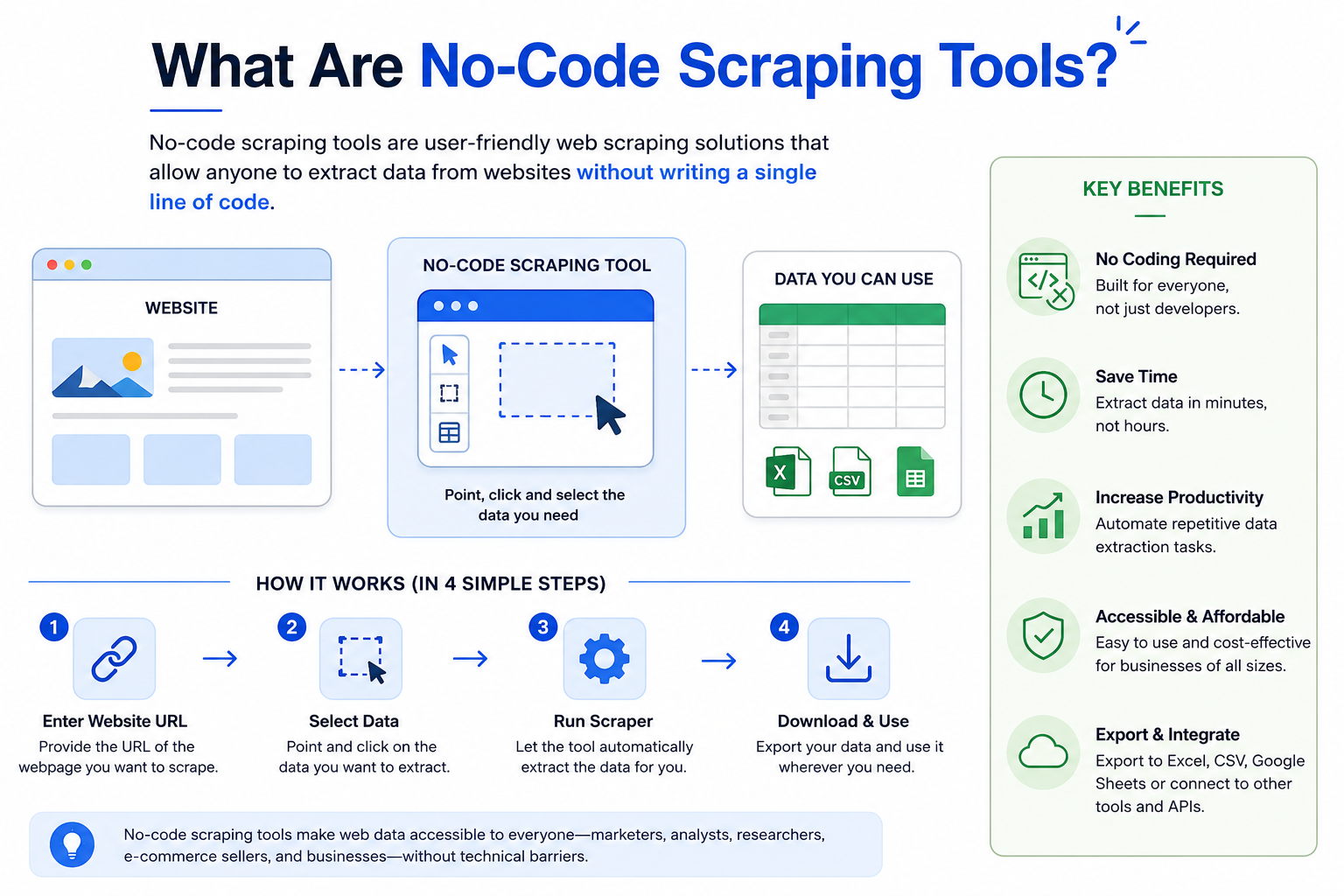
No-code scraping tools let you collect data from Google Maps and other sources without writing a single line of code. You typically interact through a visual interface, pre-built templates, or a guided setup wizard. Define your search, click run, and download your results.
In 2026, the best no-code scraping tools go beyond basic extraction. Many now include built-in enrichment layers, email verification, CRM export, and AI-assisted data cleaning. Platforms like Octoparse, PhantomBuster, and newer specialized tools bridge the gap between raw data collection and actionable lead intelligence.
How They Work
Most no-code Google Maps scrapers work through one of these models:
- Extension-based: A browser extension highlights elements and builds a scraping recipe visually.
- Template-based: Pre-built scrapers for Google Maps that you configure with search terms and location inputs.
- Credit-based cloud execution: You define parameters; the platform runs the job on cloud infrastructure.
Who Uses No-Code Tools?
No-code tools are designed for:
- Sales development reps building prospect lists manually
- Marketing teams running local outreach campaigns
- Small agencies delivering lead generation as a service
- Founders and solopreneurs without technical resources
They prioritize speed to launch over customization depth.
Pros of No-Code Scraping Tools
- Fast setup: Go from zero to a working scraper in under an hour.
- No technical barrier: Any team member can run scrapes independently.
- Lower initial cost: Many tools offer free tiers or low-cost credit bundles.
- Built-in exports: One-click CSV, Google Sheets, or CRM push.
- Templates reduce friction: Pre-built Google Maps scrapers handle common formats.
Cons of No-Code Scraping Tools
- Limited customization: Can't always control output schema or add custom logic.
- Scalability ceiling: Credit limits and execution throttles kick in at higher volumes.
- Data freshness issues: Scheduled runs may lag behind real-time changes.
- Accuracy trade-offs: Some tools miss dynamic fields or inconsistently format results.
- Vendor dependency: If the tool goes down or changes pricing, you're stuck.
Key Differences: Google Maps Scraper API vs No-Code Tools
The core philosophical difference is this: APIs give you a building block; no-code tools give you a finished room. Both are useful but only one is right for your situation.
Here's a detailed comparison across the dimensions that matter most:
Performance, Scalability & Accuracy Comparison
Performance
In head-to-head performance, API-first tools consistently outperform no-code tools on raw throughput. A well-configured Google Maps scraper API can process tens of thousands of listings per hour, handle dynamic page rendering, and retry failed requests automatically without manual intervention.
No-code tools perform well for smaller or medium-volume jobs. But their architecture is optimized for usability, not raw speed. Many run jobs sequentially or with soft throttles to stay within shared infrastructure limits.
Scalability
Scalability is where the gap widens most. APIs scale horizontally you can spin up more concurrent requests, add proxy bandwidth, or increase rate limits as your needs grow. The cost increases, but so does capability.
No-code tools typically tier their plans by usage caps. Once you exceed your monthly row limit, credit pool, or workflow execution count, you either upgrade your plan or wait for the next billing cycle. For agencies running multiple campaigns simultaneously, these caps become a real bottleneck.
Accuracy
Accuracy depends on three factors: how current the data is, how well the tool handles Google Maps' dynamic elements, and how robust the post-processing validation is.
API tools, when properly maintained, can deliver very high accuracy because you control exactly what gets captured and how it's validated. You can build custom logic to flag duplicates, verify phone number formats, and cross-reference results.
No-code tools vary widely. Premium platforms invest in data quality layers and update their scraping templates when Google changes its UI. Budget tools may lag, producing inconsistent results especially for fields like business hours, categories, or secondary phone numbers.
The honest verdict: For high-volume production workloads where accuracy is mission-critical, APIs win. For small to mid-scale campaigns where speed matters more than perfection, no-code tools are more than sufficient.
Use Cases in 2026
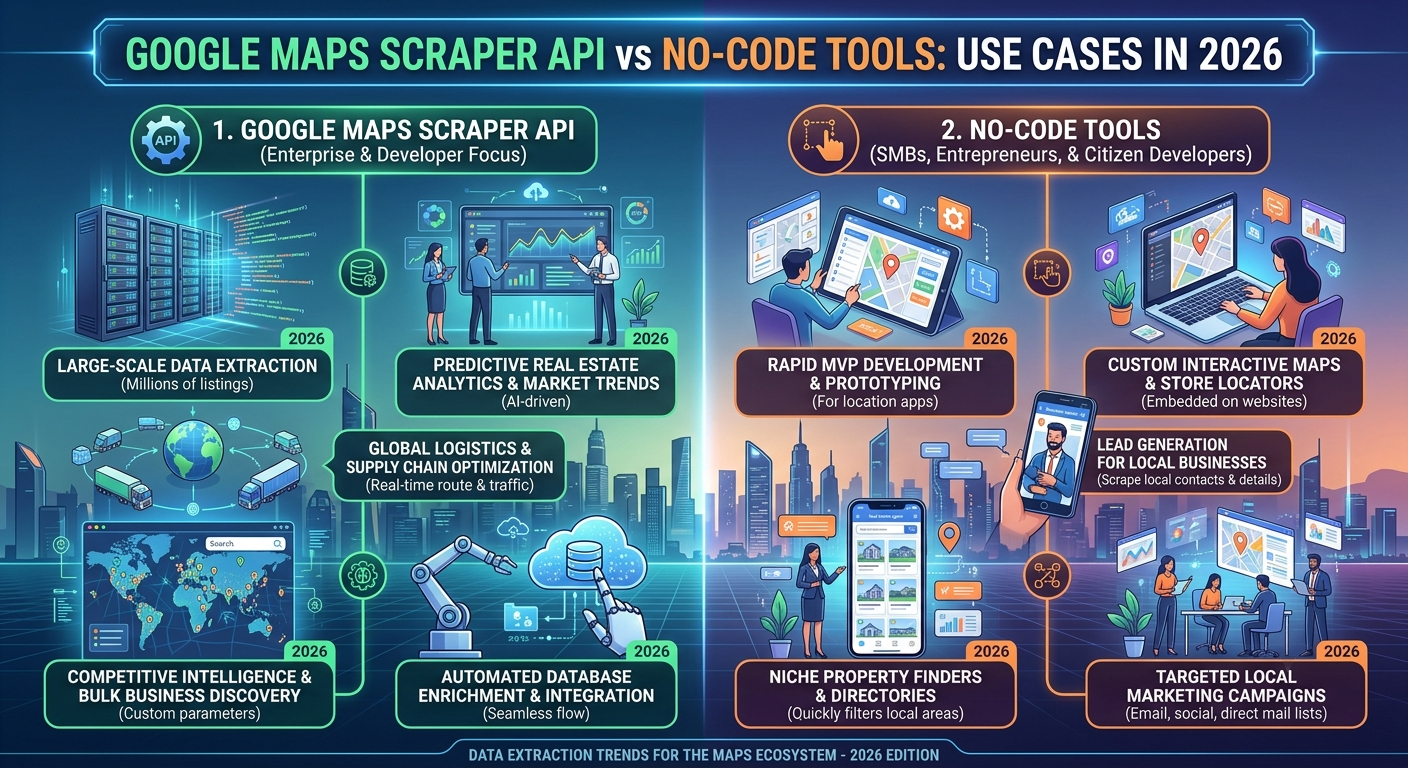
Local Lead Generation
A landscaping company or HVAC equipment supplier needs a targeted list of local contractors in 10 cities. A no-code tool like a template-based Google Maps scraper can pull those 500–1,000 listings in under an hour, export them to a spreadsheet, and hand them off to a sales rep no developer needed.
But if that same company wants to scrape 200 cities on a weekly refresh schedule, deduplicate against their CRM, and automatically trigger email sequences for new businesses that's an API-driven workflow.
Agency Workflows
Agencies running local lead generation for clients face a recurring challenge: volume, speed, and white-label flexibility. Many agencies start with no-code tools to deliver fast results for smaller clients, then migrate to API-based systems as client volume scales.
The best agencies in 2026 are building hybrid workflows using no-code tools for rapid campaign setup and APIs for production-scale delivery. Local lead intelligence is increasingly a premium service offering, and the agencies charging the most are the ones with clean, enriched, validated data delivered automatically.
SaaS Data Enrichment
SaaS companies targeting small businesses restaurant tech, HVAC software, salon booking platforms need a continuous feed of new local business listings as part of their go-to-market motion. A Google Maps Scraper API embedded in their data pipeline delivers a steady stream of net-new potential customers matched against their ICP.
This is a core growth strategy in 2026: map Google Maps scraping to your ideal customer profile, feed new listings into an enrichment pipeline, validate contact info, and trigger personalized outreach automatically.
Sales Prospecting Automation
Modern sales teams don't scrape and then manually outreach. They scrape, enrich, qualify, and sequence all inside a connected workflow. A typical 2026 prospecting stack for a sales team looks like:
- Google Maps scraper API pulls business listings by category and city
- Data flows into an enrichment tool to find decision-maker emails and LinkedIn profiles
- AI scoring layer ranks leads by fit signals (review count, rating, website quality)
- Qualified leads push automatically to a sequencing tool
- Personalized emails send based on business-specific signals
This kind of automation is only possible at scale with API-based scraping at the foundation. No-code tools can approximate parts of this, but the full pipeline requires custom logic.
Multi-Location Outreach
Companies targeting franchises, multi-location businesses, or specific chains across geographies need scraping tools that can handle structured, repeatable searches across dozens or hundreds of cities. APIs make this systematic. No-code tools can do it, but often require manual repeat runs for each location which kills efficiency at scale.
AI Impact on Lead Generation
The most significant shift in Google Maps scraping tools 2026 isn't about how data is collected it's about what happens next.
AI has fundamentally changed the value of scraped data. Raw business listings used to be the end product. Now they're the starting point.
Intent-Based Extraction
AI systems can now analyze scraped business data to identify intent signals: businesses with poor reviews that might be open to switching platforms, businesses that recently opened (high growth intent), or listings with incomplete profiles (indicating operational strain). This kind of signal extraction requires more than scraping it requires an AI layer on top.
AI-Assisted Enrichment
Platforms are increasingly using large language models to do things that traditional scraping couldn't: summarize recent customer reviews for personalization, infer decision-maker names from email patterns, classify businesses into micro-verticals, and generate personalized outreach one-liners at scale.
AI lead generation tools in 2026 combine scraping with natural language processing, giving teams data that's not just accurate but deeply contextual.
Automated Validation
AI-driven validation catches what rule-based logic misses. A phone number might pass format validation but belong to the wrong person. An email might be syntactically correct but belong to a defunct address. AI-powered enrichment tools cross-reference multiple signals to surface the highest-quality contacts from a scraped dataset.
The Shift From Scraping to Intelligence
The industry is moving away from the idea that scraping is a standalone operation. In 2026, the most competitive teams treat scraping as step one of a multi-layer intelligence workflow. Data is collected, enriched, validated, AI-analyzed, and acted upon all inside connected systems that run without manual intervention.
This shift is why the "API vs no-code" debate is slowly giving way to a newer question: which platforms combine all of these capabilities in one place?
Where Leads-Sniper Fits in This Ecosystem
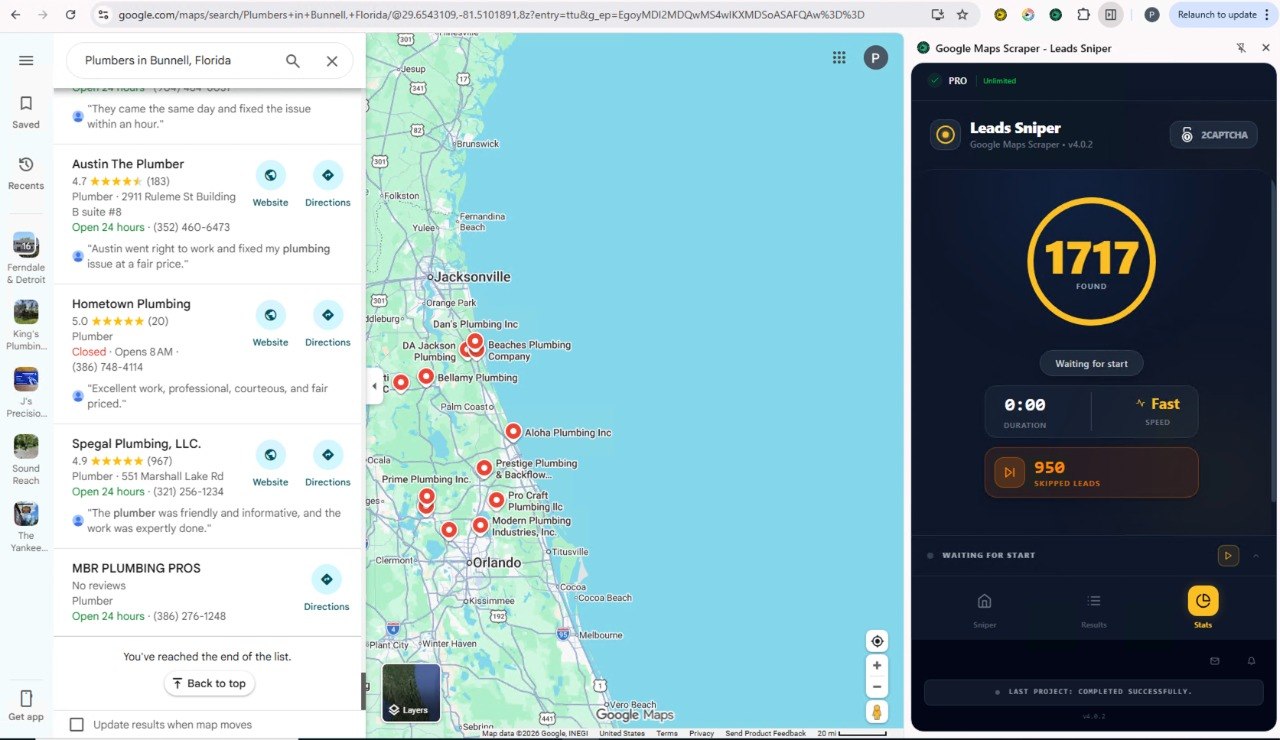
Not every team needs to stitch together a scraping API, an enrichment tool, a validation service, and a sequencing platform. That complexity has a real cost in time, money, and maintenance overhead.
Leads-Sniper is one of the platforms that has emerged in response to this gap. Built specifically for Google Maps lead generation and AI-powered scraping workflows, it's designed for teams who need the output of a sophisticated pipeline without the burden of building one from scratch.
Rather than forcing users to choose between raw API control and the limitations of basic no-code tools, Leads-Sniper sits in the growing middle ground: a platform that automates the full journey from search to enriched, ready-to-contact leads. It's particularly well-suited for agencies, sales teams, and growth operators who run high-frequency local outreach campaigns and need clean, actionable local lead intelligence delivered consistently.
In the broader market context, Leads-Sniper represents where the category is heading: away from tool-stitching and toward integrated workflows where data collection, enrichment, and outreach readiness happen in one place.
If you're evaluating Google Maps scraping tools in 2026 and your primary goal is qualified, enriched leads delivered efficiently rather than raw data infrastructure it's worth exploring what purpose-built platforms like this offer versus assembling your own stack.
Frequently Asked Questions
What is the difference between a Google Maps scraper API and a no-code scraping tool?
A Google Maps scraper API is a developer-facing service that programmatically extracts data from Google Maps through code, offering maximum flexibility and scalability. A no-code scraping tool lets non-technical users extract the same data through a visual interface or pre-built templates, trading customization for speed and simplicity.
Which is better for beginners a scraper API or a no-code tool?
No-code tools are significantly better for beginners. They require no coding knowledge, offer template-driven workflows, and can produce usable lead lists within an hour of setup. APIs are best suited to teams with developer resources or technical co-founders who need custom data pipelines.
How much do Google Maps scraping tools cost in 2026?
Pricing varies widely. API-based tools typically charge per request, per proxy unit, or based on bandwidth usage costs scale with volume and can range from a few dollars per thousand requests to hundreds of dollars per month for heavy usage. No-code tools usually charge by credits consumed, seats, number of rows exported, or monthly workflow executions. Most offer free tiers for low-volume testing.
Is it legal to scrape Google Maps in 2026?
Scraping publicly available data from Google Maps is generally legal in most jurisdictions following court rulings affirming that public data is accessible. However, Google's Terms of Service prohibit unauthorized automated access, and regulations like GDPR and CCPA govern how you store and use any personal data extracted. Always consult legal counsel before running large-scale scraping operations, especially in regulated industries.
Can no-code scraping tools handle large-scale lead generation campaigns?
They can handle mid-scale campaigns effectively, but hit limitations at enterprise scale. Most no-code tools cap usage by credits, rows, or workflow executions per billing period. If you need to scrape millions of listings per month or run continuous, automated pipelines, an API-based solution or a purpose-built platform with higher execution limits will serve you better.
What data can I extract from Google Maps with a scraping tool?
Common extractable fields include business name, address, phone number, website URL, star rating, total review count, operating hours, business category, price range indicators, and geographic coordinates. Some advanced tools and AI-enhanced platforms can also extract review summaries, owner response patterns, and secondary contact points.
How do AI lead generation tools change the Google Maps scraping workflow?
AI lead generation tools add intelligence on top of raw scraped data. They can enrich business listings with decision-maker contact information, score leads based on fit signals, generate personalized outreach copy from review data and business context, validate contact details, and classify businesses into micro-segments. The result is a workflow that moves from raw listing data to contact-ready, personalized leads with minimal manual effort.
What is local lead intelligence and why does it matter?
Local lead intelligence refers to enriched, contextual data about local businesses that goes beyond basic contact information. It includes signals like review sentiment, business health indicators, recent activity, technology usage, and decision-maker profiles. In 2026, sales teams that operate on local lead intelligence rather than raw listing data see significantly higher response rates because their outreach is specific, timely, and relevant.
Which type of tool is better for agencies running Google Maps lead generation for multiple clients?
Agencies typically benefit most from either a purpose-built multi-client platform or a hybrid approach using no-code tools for quick campaign delivery and API-based solutions for high-volume, recurring work. The key consideration is whether the tool supports white-labeling, multi-campaign management, and bulk export. Platforms that combine scraping with enrichment and delivery in one interface reduce the operational overhead of managing separate tools for each client.
Do Google Maps scraping tools include email finder or contact enrichment features?
Some do, and this is increasingly a standard feature in 2026 platforms. Basic scrapers return only the contact info listed on Google Maps (phone, website). Advanced platforms and enrichment-focused tools go further using waterfall enrichment across multiple data providers to find owner emails, LinkedIn profiles, and verified contact details. If this is important to your workflow, prioritize tools that include enrichment natively or integrate cleanly with enrichment services.
Conclusion
The Google Maps Scraper API vs no-code tools debate doesn't have a universal winner it has a right answer for each type of team.
If you have developer resources, need custom data pipelines, and operate at high volume, an API-first approach gives you the control and scalability to build exactly what you need. If you're a marketer, SDR, agency owner, or founder who needs qualified local leads fast without writing a line of code, no-code tools deliver real results with minimal friction.
The more interesting trend in 2026, though, is that the market is converging. The best platforms are no longer purely one or the other. They combine the extraction power of API infrastructure with the accessibility of no-code interfaces and they layer in AI enrichment, data validation, and workflow automation that makes the output genuinely useful, not just technically impressive.
For teams focused on local lead generation and sales prospecting, the question isn't just "API or no-code?" It's "which platform gets me from search query to enriched, ready-to-contact lead with the least friction?" That framing shifts the decision from a technical one to a business one and in most cases, it points toward integrated platforms built specifically for this workflow.
Whatever your current scale, start by mapping your actual requirements: volume, technical resources, enrichment needs, and how the data flows into your outreach motion. From there, the right tool or combination of tools becomes clear.