Quick Answer: B2B outbound lead generation in 2026 requires a precise ICP, intent-driven account selection, personalized multi-channel outreach, and a disciplined follow-up cadence. Generic spray-and-pray tactics are a fast track to burned domains and empty pipelines. This guide covers the full framework from list building to booked meetings, including proprietary frameworks, real case studies, contrarian opinions, and actionable steps for building outbound that actually scales.
The outbound playbook that worked in 2018 is dead. Not slowing down. Dead. Cold email reply rates have cratered. LinkedIn connection requests go ignored. Decision-makers have become expert at filtering out anything that smells like a template. And yet, some of the fastest-growing B2B companies in 2026 are still running outbound as their primary pipeline channel.
So what separates the teams generating 30+ qualified meetings per month from the ones getting ghosted on every sequence? It's not volume. It's not the latest AI sequencing tool. It's the underlying system.
After auditing dozens of outbound programs across SaaS, IT services, agencies, and enterprise tech companies, one pattern stands out: the teams winning with outbound have done the unsexy foundational work that most teams skip. Sharp ICP. Clean data. Relevant messaging. Consistent follow-up. That's it. There's no secret channel or magic subject line.
This guide breaks down exactly how modern B2B outbound lead generation works, why most campaigns fail before they even start, and how to build an outbound engine that generates predictable, qualified pipeline, not just activity. Whether you're a founder running outbound yourself, an SDR manager rebuilding your team's playbook, or an agency owner scaling outreach for multiple clients, you'll find frameworks, case studies, and tactics here that actually move the needle.
What Is B2B Outbound Lead Generation?
B2B outbound lead generation is the process of proactively identifying and reaching out to potential business customers rather than waiting for them to find you. It's the opposite of inbound. You define the ideal customer, source the contact data, craft a message, and initiate the conversation.
The end goal isn't a reply. It's a qualified sales conversation: a meeting, a demo request, or a direct response that moves a prospect into your pipeline. Everything before that is infrastructure.
Outbound prospecting includes tactics like cold email, cold calling, LinkedIn outreach, direct mail, and targeted event engagement. In 2026, the most effective teams blend all of these into coordinated, account-based outbound sequences rather than relying on any single channel.
One thing worth clarifying: outbound isn't just for companies with large SDR teams. Some of the most efficient outbound programs we've seen are run by one founder with a well-built list, two messaging angles, and 45 minutes a day. Scale matters less than precision.
Expert Note: Many teams assume outbound is a volume game. It isn't. According to Gartner's 2025 B2B buyer survey, 73% of B2B buyers actively avoid suppliers who send irrelevant outreach. That stat alone should reframe how you think about targeting and messaging. Relevance isn't just a best practice; it's the baseline for getting any response at all. (Source: Gartner, June 2025)
How Modern Outbound Lead Generation Differs from Traditional Cold Prospecting

Traditional outbound was a numbers game. Blast a list of 10,000 contacts, hope 0.5% respond, close a few. It worked when inboxes were less crowded and buyers had fewer defenses.
Modern outbound is a precision game.
The shift happened for several reasons. Email deliverability became harder to maintain at scale. LinkedIn cracked down on automation. Buyers became conditioned to ignore generic outreach. And with AI-generated content flooding every channel, authenticity, actual human specificity, became a competitive differentiator.
Here's the practical difference: a traditional cold outreach team might target "VP of Marketing at SaaS companies with 50-500 employees." A modern outbound team targets "VP of Marketing at Series B SaaS companies who recently posted about pipeline challenges, hired two demand gen managers in the last 90 days, and are running paid search but haven't yet built an outbound function."
That level of specificity is what generates replies in 2026. It requires better data, sharper messaging, and more deliberate sequencing, but the conversion rates justify the investment many times over.
One pattern we've noticed when reviewing underperforming outbound programs: teams almost always blame the channel when the real problem is the list. The message isn't landing because it's being sent to the wrong people. Tighten the audience before you rewrite the copy.
According to Salesforce's State of Sales report, sales reps spend 70% of their time on non-selling tasks. (Source: Salesforce State of Sales, 2024) A big part of that is wasted effort on poorly qualified accounts. Better targeting doesn't just improve reply rates; it gives your reps their time back.
Why Most B2B Outbound Campaigns Fail
Most outbound campaigns don't fail because of bad execution. They fail because of bad foundations. Here are the five most common root causes and what they look like in practice:
Poor ICP Definition
"Our ICP is B2B SaaS companies with 10-1,000 employees" is not an ICP. That's half the internet. Without a tight, layered ideal customer profile that includes technographic, firmographic, behavioral, and situational signals, you're targeting too broadly to craft relevant messaging. You end up sounding generic because you are targeting generically.
Many teams assume ICP definition is a one-time exercise. It isn't. Your ICP should be revisited every quarter based on what's actually converting, not what you assumed would convert when you built the business.
Weak Messaging
Most cold outreach leads with the product. "We help companies like yours do X." Buyers don't care about your product; they care about their problem. Strong outbound messaging opens with a specific, relevant observation about the prospect's situation and connects it to a credible outcome.
The pitch comes later, if at all in the first touch.
A common mistake: treating the first email like a sales pitch rather than an opener. The goal of the first message is to earn the reply, not close the deal.
Bad Data
Stale contact data kills deliverability and wastes rep time. If 30% of your list bounces, your domain reputation suffers. If job titles are wrong, your personalization falls flat. Data quality isn't glamorous, but it's foundational.
One team we worked with had invested heavily in a sequencing tool and spent weeks crafting messaging, then launched on a list that hadn't been verified in 18 months. Bounce rates hit 28%. Their sending domain was flagged within two weeks. Three months of rebuilding infrastructure followed. The lesson: verify data before you send, not after.
Lack of Personalization
AI-generated personalization ("I saw you went to Stanford, impressive!") is now so recognizable that it creates the opposite effect. Prospects spot it immediately, and it signals that you didn't do any real research. Real personalization is specific to the account and the individual: a recent funding round, a specific podcast appearance, a challenge visible in their recent job posts.
The goal isn't to show you did research. The goal is to show you did relevant research that connects to why you're reaching out.
Channel Dependency
Running outbound exclusively through cold email is like having one revenue stream. When Gmail and Outlook tighten spam filters, and they do this regularly, your entire pipeline dries up overnight. Multi-channel outreach, coordinated across email, LinkedIn, phone, and other touchpoints, creates resilience and compounds effectiveness across the sequence.
Actionable Takeaway: Before launching or relaunching your outbound motion, audit these five areas in order. Fix foundations before optimizing tactics. A perfect sequence sent to the wrong list, with weak messaging, won't generate pipeline; it'll generate spam complaints.
The Modern B2B Outbound Lead Generation Framework
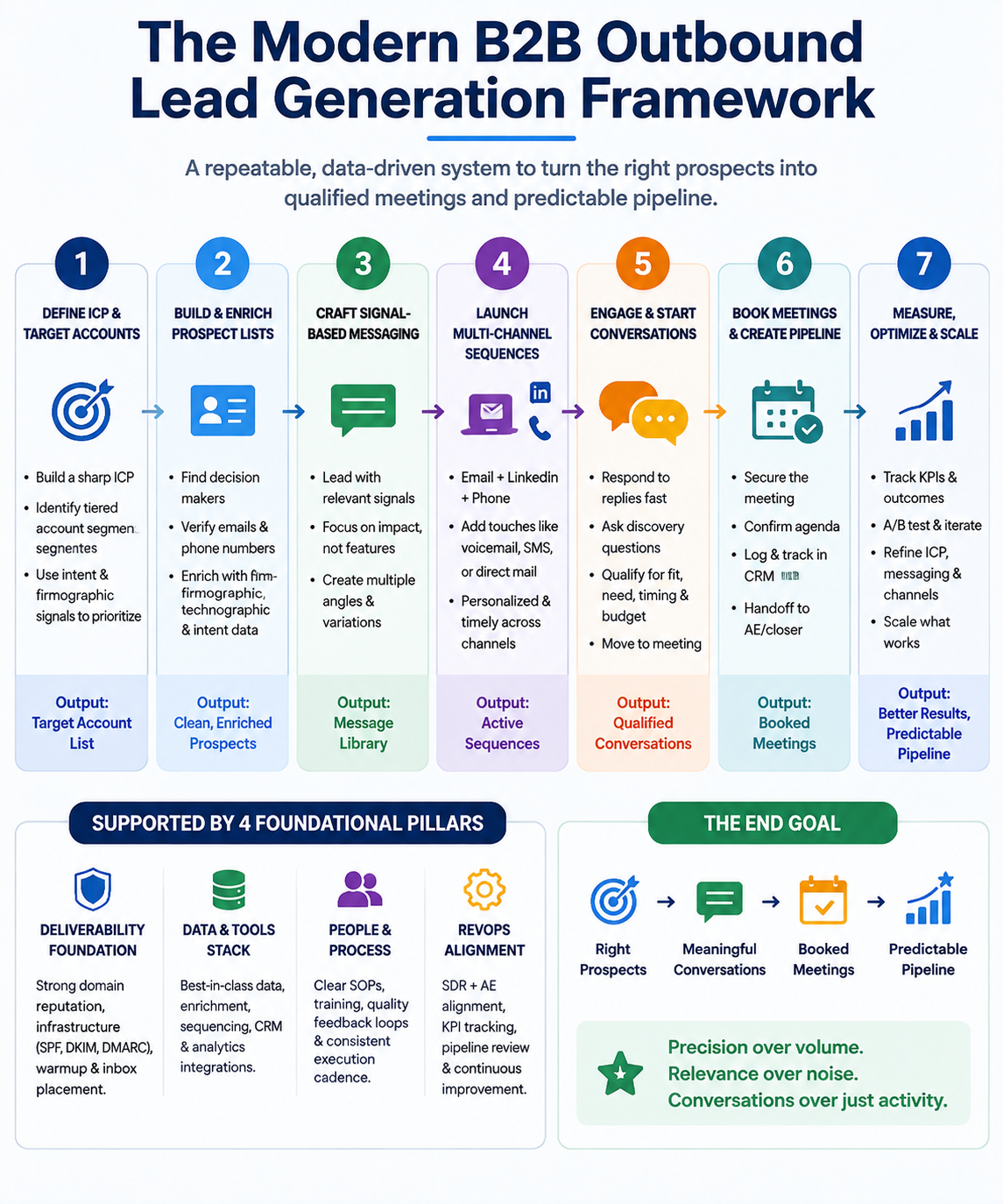
Here's the framework senior outbound strategists use to build repeatable pipeline generation systems. Think of it as a seven-layer stack. Each layer depends on the one beneath it.
1. ICP Development
Start by analyzing your best existing customers. Not your largest, your best. Who has the highest retention, fastest time-to-value, and strongest expansion revenue? Map their firmographics (industry, size, funding stage, geography), technographics (tools they use), and situational triggers (what was happening in their business when they first engaged you?).
Build your ICP from evidence, not assumptions.
A useful exercise: interview your top five customers and ask them what prompted them to explore your solution. Their answers will reveal situational triggers your marketing team probably hasn't documented.
2. Account Selection
Use your ICP criteria to build a tiered target account list. Tier 1 accounts get full account-based outbound treatment: multiple stakeholders, personalized outreach, multi-channel sequences. Tier 2 gets a lighter touch. Tier 3 might just get a well-crafted single email.
Don't treat a 500-account list as one homogenous group. The accounts that most closely match your ICP deserve your best effort and personalization. The rest can be worked with a more templated approach.
A warning: many teams build Tier 1 lists that are too large. If you can't genuinely personalize your outreach to an account, it shouldn't be in Tier 1. Twenty accounts with real personalization will outperform 200 accounts with fake personalization every time.
3. Contact Sourcing
For each target account, identify 2-4 relevant contacts, typically spanning economic buyers, users, and internal champions. Use tools like Apollo, Clay, or LinkedIn Sales Navigator to source verified contact data. Always validate emails before sending.
Reaching multiple contacts in the same account isn't spam; it's how enterprise deals actually get done. The key is coordinating the outreach so it doesn't feel like a blast. Different messages, different angles, different timing.
4. Intent Signals
Layer intent data onto your account list to prioritize who to contact first. Intent signals include G2 category page visits (via Bombora or G2 Buyer Intent), job postings indicating a relevant initiative, hiring patterns, recent funding announcements, executive hires, and relevant social content.
A prospect who just posted about a problem you solve is exponentially more likely to reply than one who fits your ICP but shows no active buying signals.
Intent data is what separates good outbound from great outbound in 2026. It shifts you from reaching people who should care to reaching people who currently care.
Revenue operations teams that have integrated intent signals into their pipeline attribution models consistently report better meeting quality and shorter sales cycles. It's not just a sourcing tool; it's a qualification tool.
5. Personalization
Personalization should be meaningful, not cosmetic. For Tier 1 accounts, research each contact individually. Thirty minutes per account is not unreasonable at that tier. For Tier 2, use semi-customized messaging built around account-level signals (industry pain, recent news, shared connection).
Avoid the trap of personalizing the first line while leaving the rest of the message generic. Buyers read the whole email. A personal opener attached to a generic pitch is still a generic pitch.
6. Multi-Channel Outreach
Build sequences that span email, LinkedIn, and phone in a coordinated pattern. A strong sequence might look like: LinkedIn connection request, Day 2 cold email, Day 4 LinkedIn message, Day 7 phone call, Day 10 follow-up email, Day 14 breakup message.
The touchpoints reinforce each other rather than operating in isolation.
Think of it as a signal strategy, not a spray strategy. Each touch should feel like a natural continuation, not a separate cold approach.
7. Follow-Up Strategy
Most outbound meetings are won in the follow-up, not the first touch. According to RAIN Group research, most sales meetings require 5-8 touchpoints before they're booked. (Source: RAIN Group, Top Performance in Sales Prospecting) A single email almost never converts.
A tasteful, value-adding follow-up cadence, one that doesn't just say "bumping this up," can significantly increase your reply rate. Add a new angle, a relevant insight, or a short piece of content with each follow-up. Give the prospect a reason to respond, not just a reminder that you exist.
Actionable Takeaway: Map your outbound framework layer by layer before touching a single sequence. Infrastructure first, execution second. The teams that skip straight to writing emails almost always have to rebuild from scratch within 90 days.
The 4-Layer Outbound Qualification Model
Most outbound teams qualify accounts based on two dimensions: company size and industry. That's not enough. Here's a more rigorous qualification model we use to prioritize outbound efforts:
Layer 1: Firmographic Fit
Does the account match your baseline criteria? Industry, company size, funding stage, geography. This is the entry filter, necessary but not sufficient.
Layer 2: Technographic Fit
What tools is the account using? Are they running a competitor you displace? Are they using complementary tools that signal maturity or need? Technographic data reveals whether a prospect has the infrastructure to buy and use what you sell.
Layer 3: Situational Fit
What's happening at the account right now? Recent funding, new executive hires, a job post for a role that signals a specific initiative, a product launch, a market expansion. Situational signals tell you whether the timing is right, not just whether the account looks good on paper.
Layer 4: Behavioral Fit
Has anyone at the account shown intent? Visited your pricing page, engaged with competitor content, attended a relevant webinar, or posted about a problem you solve? Behavioral signals are the strongest leading indicator of purchase intent.
How to apply this model: Score your target accounts across all four layers before beginning outreach. Accounts that score high on all four get Tier 1 treatment. Those that score on firmographic and technographic fit but lack situational or behavioral signals go to Tier 2. This structure alone typically reduces wasted outreach by 30-40% while improving meeting quality significantly.
Implementation Tip: You don't need a sophisticated scoring platform to start. A simple spreadsheet with columns for each layer, scored 1-3, will give you more qualification clarity than most teams have. Build the logic manually first, then automate once the model is proven.
The Signal-to-Message Framework
Generic messages get generic results. The Signal-to-Message Framework is designed to ensure every outbound message is anchored to a specific, observable signal about the prospect's situation, not a general claim about your product.
How it works:
Every outreach message is built around three components:
- The Signal: A specific, observable fact about the prospect or their company. Not "you're a VP of Sales." Something real: "I noticed you've posted twice this month about the difficulty of building predictable pipeline." Or: "Your company just raised a Series B and posted three new SDR roles in the last 30 days."
- The Bridge: A sentence that connects the signal to a relevant challenge or outcome. "That usually means you're under pressure to build outbound fast without burning your sending infrastructure or hiring ten reps before the playbook is proven."
- The Ask: A low-friction, specific request. Not "can we get on a call?" but "would it be worth 20 minutes to show you how two companies in your space solved this in their first 60 days post-raise?"
Why this works: It demonstrates research, creates immediate relevance, and makes the ask feel proportionate. It also forces you to do actual account research before writing a word of copy, which is exactly the discipline most outbound programs are missing.
Applying it at scale: For Tier 1 accounts, each signal should be unique to that contact. For Tier 2, you can build signal categories (hiring patterns, recent funding, category intent) and write templated bridges for each. This gives you semi-personalized messaging at volume without requiring individual research for every contact.
Practical Warning: The most common failure mode in applying this framework is using signals that are too generic. "I saw you're hiring SDRs" is weak if everyone on your list is hiring SDRs. The signal needs to be specific enough that the prospect thinks, how did they notice that? That's when you have their attention.
Why Most B2B Outbound Campaigns Fail: Real Case Studies
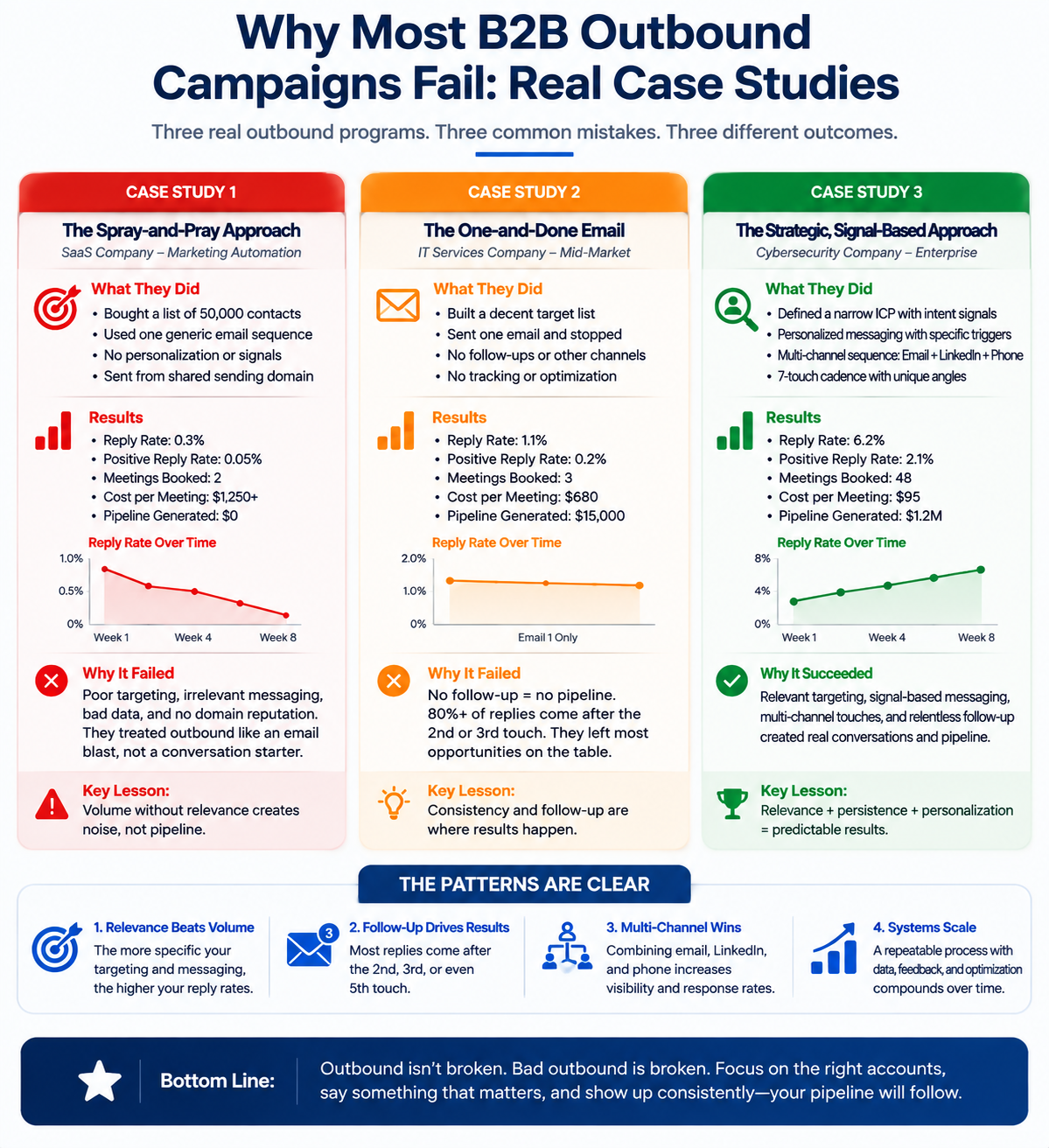
Theory is useful. What's more useful is seeing how these failures and fixes play out in real programs.
Case Study 1: SaaS Company - Fixing Low Reply Rates by Narrowing ICP and Sharpening Messaging
Company Type: B2B SaaS, project management software for professional services firms
The Challenge: The team was sending around 400 cold emails per week with reply rates consistently below 1%. They'd invested in a solid sequencing tool, had reasonable list hygiene, and were following up 3-4 times per sequence. But the pipeline wasn't moving. Leadership was starting to question whether outbound was worth continuing.
What We Found: Their ICP was defined as "professional services companies with 20-200 employees." That covered consulting firms, law offices, marketing agencies, accounting practices, IT services companies, and half a dozen other verticals, each with completely different pain points, workflows, and decision-making dynamics. The messaging tried to speak to all of them and ended up resonating with none of them.
Actions Taken:
- Narrowed the ICP to one specific segment: independent management consulting firms with 25-75 employees that had recently hired a project or operations manager (a trigger indicating growing complexity)
- Rebuilt messaging around the specific pain of that segment: client project visibility, consultant utilization tracking, and billing accuracy
- Rewrote the email sequence with one clear angle per touch rather than restating the same value proposition three different ways
- Added LinkedIn profile engagement before the first email to create name familiarity
Results: Reply rates climbed from under 1% to 6.2% within eight weeks. Positive reply rate reached 2.4%. Meetings booked per month went from 2-3 to 14. More importantly, the quality of those meetings improved; prospects arrived already understanding the use case and wanting to explore fit, not needing to be educated from scratch.
Lessons Learned: A tight ICP doesn't limit your market; it improves your ability to speak to the market you can actually win. The instinct to cast a wide net is understandable, especially in early-stage companies, but it consistently produces diluted messaging. One specific message to the right 100 people will always outperform a generic message to the wrong 1,000.
Case Study 2: Marketing Agency - Improving Lead Quality Through Intent-Based Targeting
Company Type: B2B demand generation agency serving mid-market technology companies
The Challenge: The agency was generating meetings. Their SDR team was hitting activity targets and booking 10-12 meetings per month. But their opportunity rate was terrible. Fewer than 20% of meetings converted to qualified opportunities, and the sales team was spending significant time disqualifying prospects that never should have been booked.
What We Found: The agency's outbound list was built on firmographic criteria alone: "B2B tech companies, 50-500 employees, VP of Marketing or above." The contacts fit the profile on paper, but there was no behavioral or situational qualifier. Many of the booked meetings were with companies that had no immediate need, limited budget, or a marketing team that had just rebuilt its strategy three months prior.
Actions Taken:
- Layered Bombora intent data on top of the existing ICP to identify accounts actively researching demand generation and pipeline topics
- Added job posting triggers: companies posting for demand gen managers or content marketers (a sign of a growing function that likely needs outside support)
- Introduced a simple pre-qualification question in the outreach sequence: "Are you currently planning to invest in outbound pipeline generation in the next quarter?" It sounds simple, but it filtered for urgency
- Segmented the account list into "active buyers" (intent + trigger signals) and "future buyers" (ICP fit, no current signal) and built separate sequences with different CTAs and timelines
Results: Total meetings booked per month dropped slightly to 8-9, but opportunity rate climbed from 20% to 52%. Pipeline quality improved substantially. The sales team stopped complaining about wasted demo time. Revenue from outbound-sourced deals increased even though meeting volume decreased.
Lessons Learned: Meeting volume is a vanity metric if the meetings aren't qualified. Intent-based targeting doesn't just improve reply rates; it self-selects for buyers who are actively in a purchasing mindset. The short-term optics of fewer meetings booked can be a political challenge internally, but the downstream impact on revenue is always positive when qualification improves.
Case Study 3: B2B Technology Company - Recovering from Deliverability Collapse
Company Type: Enterprise data integration software provider
The Challenge: An outbound team that had been performing well for 18 months suddenly saw reply rates collapse from 4.5% to under 0.5% over a six-week period. Nothing about the messaging or targeting had changed. Investigation revealed that their primary sending domain had been flagged by Microsoft's spam filters, and a significant portion of their emails were being routed to junk folders or rejected entirely before reaching inboxes.
What We Found: The team had been sending 300-400 emails per day from a single domain. They hadn't implemented DMARC properly. Their bounce rate had crept up to 18% over several months without anyone monitoring it. And they had been using one of their product demo links in outreach emails, a link that had been flagged as promotional by spam classifiers.
Actions Taken:
- Immediately reduced sending volume to under 50 emails per day on the affected domain and began a 12-week warm-up period on two new sending domains
- Audited and corrected SPF, DKIM, and DMARC records on all sending domains
- Removed all links from cold outreach emails (links dramatically increase spam filter sensitivity, including booking links and case study links)
- Built a two-domain sending architecture: Domain A for cold outbound, Domain B for follow-ups and warm conversations, with the primary company domain kept entirely out of cold outreach
- Added a weekly deliverability monitoring process using tools like GlockApps and MailReach to catch issues before they compound
Results: After the 12-week infrastructure rebuild, inbox placement rate recovered to 91%. Reply rates climbed back to 3.8% within four months. The two-domain architecture has maintained deliverability through multiple rounds of updated filtering from both Google and Microsoft.
Lessons Learned: Deliverability is not a set-it-and-forget-it concern. It requires active monitoring. Most teams don't notice deliverability degradation until it's severe, because reply rates drop gradually and teams assume it's a messaging problem before they check inbox placement. Build monitoring into your outbound operations from day one, not after a crisis.
Best Outbound Channels in 2026
Every channel has tradeoffs. Here's an honest assessment of each and when to use them.
Outreach Channel Comparison Table
A note on cold email in 2026: Google and Microsoft have continued tightening deliverability requirements. Sending from aged domains with properly configured SPF, DKIM, and DMARC is non-negotiable. Limiting daily send volume per domain (typically under 100 emails per day for newer domains) is equally important. Treat your sending infrastructure with the same care as your messaging, because a perfect email that lands in spam generates zero responses.
LinkedIn's growing role: LinkedIn has become the most reliable outbound channel for VP and C-suite prospects at sub-500-person companies. The approach that works is slower than most teams want: engage with the prospect's content for a week before connecting, send a connection request with a brief note, follow with a DM after connection. It takes longer but converts at a higher rate than leading cold.
According to HubSpot's 2025 State of Sales Report, 42% of sales professionals say social media delivers the highest cold outreach response rate, compared to 26% via email and 23% via phone. (Source: HubSpot State of Sales, 2025) That number probably overstates LinkedIn's role across all segments, as it varies significantly by industry and persona, but it reflects a real shift in where senior buyers engage.
Step-by-Step Process to Build an Outbound Engine
Building an outbound lead generation system from scratch takes 8-12 weeks to do properly. Teams that rush this timeline almost always have to rebuild within six months. Here's the sequenced approach:
Week 1-2: Foundation
- Finalize your ICP with firmographic, technographic, situational, and behavioral criteria (use the 4-Layer Qualification Model)
- Audit your sending infrastructure: domain age, SPF/DKIM/DMARC configuration, current bounce rates, spam placement rates
- Choose your outbound tech stack and keep it lean until your process is proven
- Set up deliverability monitoring from day one
Week 3-4: List and Data
- Build Tier 1 and Tier 2 target account lists based on ICP scoring
- Source and verify contact data (bounce rate should be below 5% before any sequence goes live)
- Layer intent signals to prioritize accounts for outreach timing
- Map 2-4 contacts per Tier 1 account
Week 5-6: Messaging
- Develop 2-3 distinct messaging angles based on different pain points or persona priorities
- Apply the Signal-to-Message Framework to every email template
- Write sequence copy for each channel (email, LinkedIn, phone scripts)
- Get messaging reviewed by someone outside your organization, ideally a target customer or peer in the industry
Week 7-8: Sequence Build and Testing
- Build sequences in your sequencing tool with proper sending limits
- A/B test subject lines and opening lines before full rollout (test on small cohorts of 50-100, not 500)
- Set up tracking for reply rates, positive reply rates, and meetings booked
- Confirm CRM integration so outbound activity feeds cleanly into pipeline attribution
Week 9-12: Launch and Iterate
- Launch with a small cohort first: 50-100 accounts per segment
- Review results weekly, not monthly. Outbound moves fast enough that monthly reviews leave you flying blind.
- Iterate on messaging based on actual replies, not assumptions. If people are replying "not the right time," that's a timing problem. If they're not replying at all, it's a relevance problem.
- Capture feedback from sales on meeting quality and feed it back into ICP refinement
Team Management Insight: One of the most common operational mistakes is holding a monthly pipeline review while running a weekly outbound program. Outbound data needs weekly review. Patterns that indicate a deliverability issue, a messaging problem, or a list quality concern become visible quickly, but only if you're looking at the numbers consistently. Build a Monday morning metrics review into your team rhythm from the start.
Outbound Readiness Scorecard
Before launching any outbound program, use this scorecard to assess readiness. Score each area 1 (not ready) to 3 (fully ready):
Scoring guide:
- 20-24: You're ready to launch. Focus on execution and weekly optimization.
- 14-19: You have gaps that will limit results. Fix low-scoring areas before scaling.
- Below 14: Launching now will generate noise, not pipeline. Rebuild foundations first.
Metrics That Actually Matter in Outbound Prospecting
Outbound KPI Benchmark Table
Vanity metrics, such as open rates, email send volume, and total touches, tell you almost nothing about whether your outbound program is working. Open rates are unreliable since Apple's Mail Privacy Protection changes and inbox-level tracking limitations.
Send volume tells you how busy your reps are, not how effective they are.
The metric that correlates most reliably with pipeline health is positive reply rate. If that number is healthy, the rest of the funnel tends to follow. If it's low, the problem is almost always ICP, messaging, or both.
Actionable Takeaway: Build a weekly reporting dashboard with the core metrics from the table above. Review them as a team every Monday. Declining reply rates with stable delivery usually indicate a messaging problem.
Declining inbox placement indicates an infrastructure problem. Low opportunity rates with healthy meeting volume indicate an ICP or qualification problem. Each pattern points to a different intervention.
Common Mistakes Companies Make in Outbound Lead Generation
Beyond the five foundational failures, here are the operational pitfalls that experienced teams still fall into:
Hiring SDRs before the playbook is proven. If your messaging isn't converting, adding headcount scales your failure. Prove the motion works at a small scale before hiring reps to run it. One person running a tight outbound program for 60 days will tell you more about what's working than a five-person team running a broken process.
Treating outbound as a campaign rather than a system. A campaign has a start and end date. A system runs continuously and improves over time. Outbound demand generation requires ongoing iteration: new messaging angles as market conditions shift, ICP refinement as you learn what converts, list refreshes as old contacts go stale.
Ignoring deliverability until it's a crisis. By the time your emails are landing in spam, you've already burned your domain reputation. The damage takes months to undo. Monitor deliverability metrics proactively using tools like GlockApps, MailReach, or Smartlead's built-in monitoring. Weekly checks take 15 minutes and can prevent catastrophic pipeline disruption.
Optimizing for activity, not outcomes. 200 emails per day is not a sign of a healthy outbound program; it's often a sign of a broken one. High volume with low relevance generates spam complaints, hurts deliverability, and burns your brand with the exact buyers you're trying to win. Focus on quality of contact, not quantity.
Not closing the feedback loop with sales. If SDRs are booking meetings with the wrong prospects, the problem is upstream in ICP or list quality, not in the sales team's ability to close. Build structured feedback loops: AEs should be reporting weekly on the quality of outbound-sourced meetings, and that feedback should directly inform ICP refinement and targeting decisions. This is a core RevOps function that most teams underinvest in.
Letting sequences go stale. A sequence that was written six months ago reflects market conditions from six months ago. Buyers notice when messaging feels dated. Refresh your copy every 60-90 days based on what's resonating and what's changed in your target market.
Skipping the breakup email. The final touch in a sequence, a "closing the loop" message that gives the prospect an easy out, consistently generates replies from prospects who ignored every previous touch. Don't end a sequence without one.
How Lead Sniper Supports Modern B2B Outbound Lead Generation
Successful outbound campaigns depend on three things: accurate data, targeted prospecting, and consistent execution. That's where Lead Sniper comes in.
Lead Sniper helps B2B companies identify decision-makers, build highly targeted prospect lists, and streamline outbound lead generation efforts. Instead of relying on broad contact databases or generic outreach, teams can focus on the right accounts with verified data and a more structured prospecting process.
Whether you're a SaaS company, agency, IT service provider, or sales team, Lead Sniper helps create the foundation needed for more relevant outreach, better conversations, and a more predictable sales pipeline.
Learn more about how Lead Sniper can support your outbound growth strategy.